Aum Shinrikyo: A Cult of Redemptive Violence?
Aum Shinrikyo (Japanese, “religion of supreme truth”) was established in 1986 by Matsumoto Chizuo (b. 1955), known to his followers as Shoko Asahara. Aum has been described as a “doomsday cult,” yet it initially appeared to be one of many cultivation disciplines (like yoga and meditation) to emerge from East Asia, blending Buddhism and Hinduism.
After traveling to the Himalayas, Asahara became convinced that the Hindu god of destruction, Shiva, had spoken to him and that he was destined to rescue humankind from impending catastrophe. Asahara’s readings of the Christian book of Revelation and the sixteenth-century French prophet Nostradamus further reinforced his obsession with the end time. He fixated upon 1999 as the final time of reckoning for the human race, believing that only his teachings stood between planetary annihilation and world salvation.During the 1990s, Asahara’s messianic ideas became darker and more paranoid. After failing to attract enough votes for Aum to enter the Japanese Parliament, Asahara concluded that Japan was no longer receptive to Aum’s redemptive message. Instead of averting disaster, Asahara reasoned, the time had come to bring on the Apocalypse, believing that destruction on a massive scale would cleanse the world of its accumulated evils and lead to the establishment of a utopian order. He persuaded his followers to build bomb shelters and procure military weapons in preparation for the impending world doom. Like many of the more maniacal religious leaders Bruce Lincoln discusses in his book Holy Terrors, Asahara had long since convinced himself that his voice was the voice of God.-
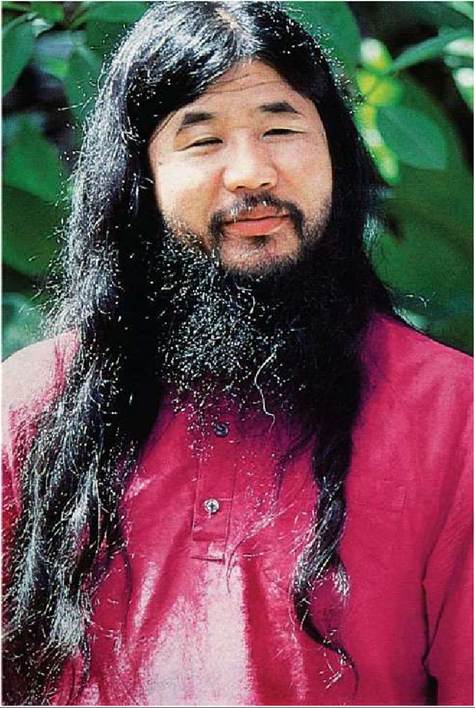
Aum Shinrikyo founder Shoko Asahara.
On March 20,1995, Asahara ordered Aum members to release sarin gas on a Tokyo subway station, killing twelve and injuring thousands.
Further investigation revealed that Asahara and his disciples had not only committed earlier crimes against their opponents—and against defectors from their movement—but that they had been stockpiling even more lethal weapons in anticipation of a final struggle for world supremacy. Asahara and several dose associates were tried and finally put to death in 2018. Asahara’s followers, however, have since formed two new groups in Japan (“Aleph” and “Circle of Rainbow Light”). Although both groups claim to have renounced Asahara’s advocacy of violence, they remain under close surveillance by the Japanese government.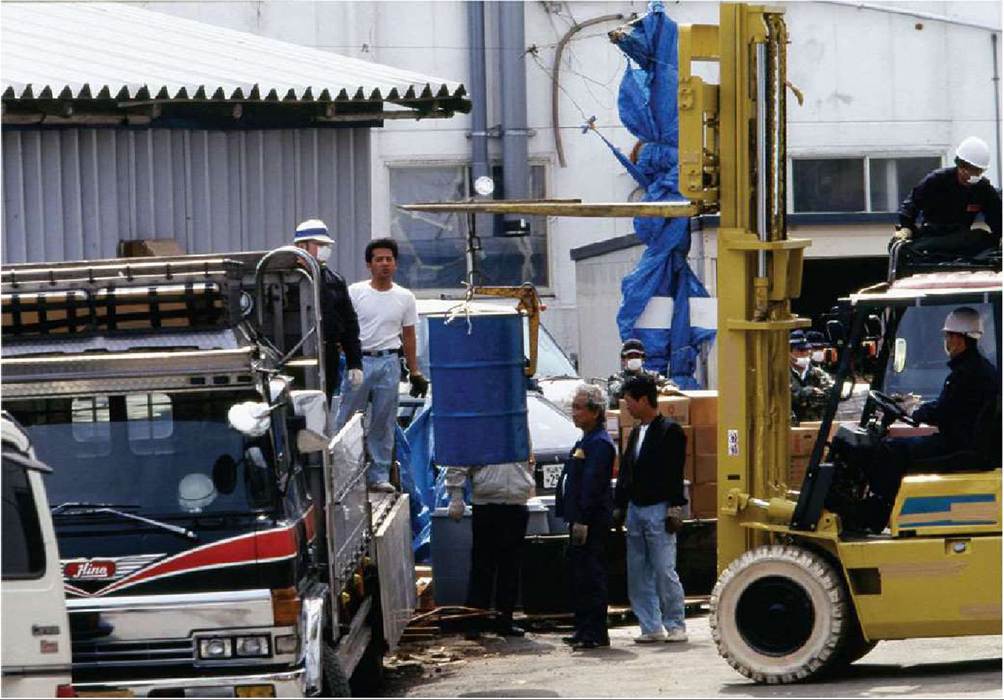
In the weeks after the 1995 deadly sarin gas attack on a Tokyo commuter train, Japanese police raided an Aum Shinrikyo compound near Mount Fuji and confiscated chemical and biological weapons as well as explosives.
It is difficult to explain how a man of limited education and extreme views could attract thousands of followers and inspire them to engage in criminal activities bordering on genocide. While Aum’s worldview resembles other “world-renouncing” religious philosophies in its desire to separate from a perceived corrupt social order, in its advocacy of mass murder as the path to salvation, Aum stands alone.
Self-Assessment 14.3
[Please note: You must be using an online, browser-based eReader in order to view this content.]