Falun Gong
The influence of Eastern religious thought on contemporary “seekers” is not confined to philosophical influences emanating from India. One recent movement that traces its descent from traditional Chinese sources—and one that has aroused both interest and controversy—is the movement known as Falun Gong or Falun Dafa.
Falun Gong is often described as a “cultivation system,” one that employs a variation of qigong (martial art) exercises (Chapter 8). But important as meditational and physical routines are to Falun Gong practice, most followers of this movement and of the teachings of its founder, Li Hongzhi, would insist that it offers a discipline of spiritual restoration and a path to philosophical enlightenment.At the heart of the Falun Gong belief system is a triad of ethical principles designed to guide human beings toward a fuller life, one that is in harmony with nature and the underlying forces of the universe: truthfulness, benevolence, and forbearance. Cultivation of these moral attributes on a collective, and not just personal, level leads to what Master Li calls a “divine culture,” whereby an entire society pursues the highest goals humanity is capable of. Seen in this light, Falun Gong resembles a form of redemptive theology, leading its practitioners toward something like salvation. Leaders of the movement take a very dim view of Chinese communism, seeing Marxism as an alien Western ideology, and regarding any form of materialism as a rejection of Daoist first principles. When thousands of Li Hongzhi’s followers assembled outside a Chinese government compound in Beijing on April 25,1999, in silent protest against the government crackdown against the movement, the action provoked an even more severe suppression of Falun Gong teachings and practices. The Chinese government declared Falun Gong to be subversive and “heretical,” leading to long prison sentences and reports of torture for those who persisted in public adherence to Falun Gong ideas and rituals.
Since then, Falun Gong practitioners appear to have gone underground in China, while interest in the movement has grown elsewhere, particularly in the West.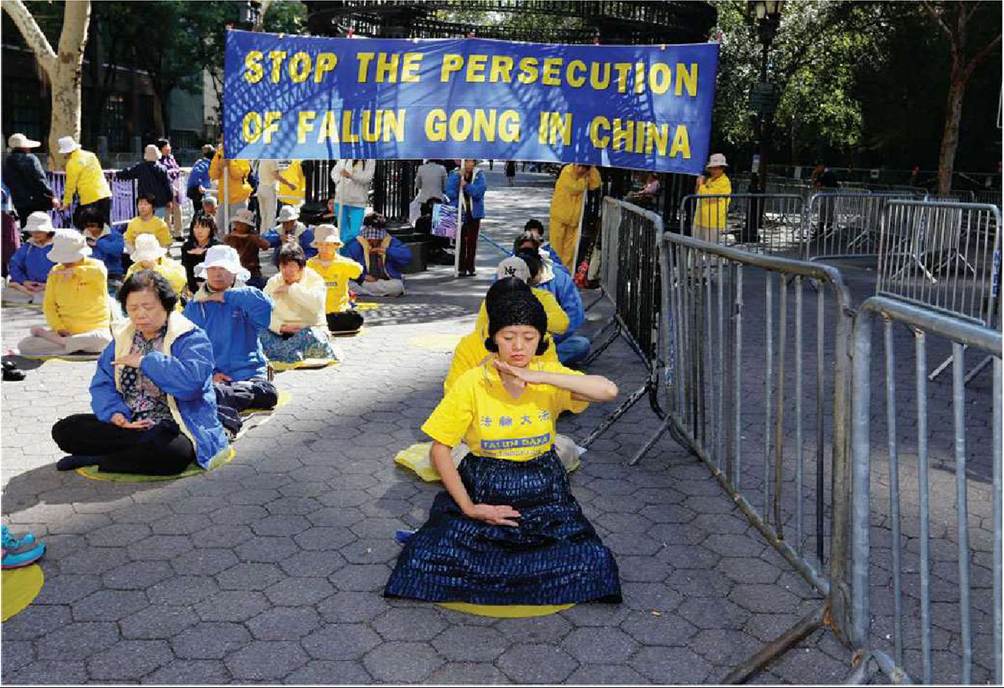
Falun Gong devotees in New York City protest the Chinese government's repression of their movement.
Although its roots are in Chinese philosophy and religious practice, Falun Gong also borrows ideas from Buddhism, and the very name of the movement reflects that influence: Falun Gong means “the Dharma Wheel of Practice.” Stressing the importance of counteracting the effects of karma (personal and ancestral) upon one’s health and moral well-being, Falun Gong practitioners note that the accumulation of such karma affects not only the health of individuals but also society at large. At some point, Master Li insists, entire civilizations perish from an accumulation of moral sickness; in fact, he believes that humanity has undergone eighty-one such destructions of advanced societies, and that our own world civilization may be on the brink of yet another catastrophic collapse unless we can arrest this cycle of growth and decline through personal and collective purification.
In 1994, Li published a summation of his teachings, the Zhuan Falun, that is carefully studied by followers of the movement and serves as a guide to right thinking and restorative living for practitioners. In 1997, Li emigrated from China to the United States, where he has since received asylum and from which he continues to guide the movement he helped to create.7
VOICES:
An Interview with Dr. Xinyu David Zhang
Dr. Zhang is a senior database administrator for the California Commission on Teacher Credentialing and has a PhD in organizational psychology. He is a practitioner of Falun Gong.
Is it appropriate to think of Falun Gong as a “religion,” or should we think of it as something similar to hatha yoga or tai chi?
For people in the West, it may very well resemble a religion, but most Chinese think of it as a cultivation system, that is, as a body of teachings designed to improve both mind and body.
In China the word religion is unfamiliar and Western sounding—and even has a pejorative meaning—but aside from the unfamiliarity of the concept, Falun Gong has none of the trappings of Western religions: no sanctuaries, no clerical hierarchy, no sacred rituals, and practitioners are free to enter or leave the movement, as they please.Nevertheless, Falun Gong does seem to possess a sacred text in the
Zhuan Falun.
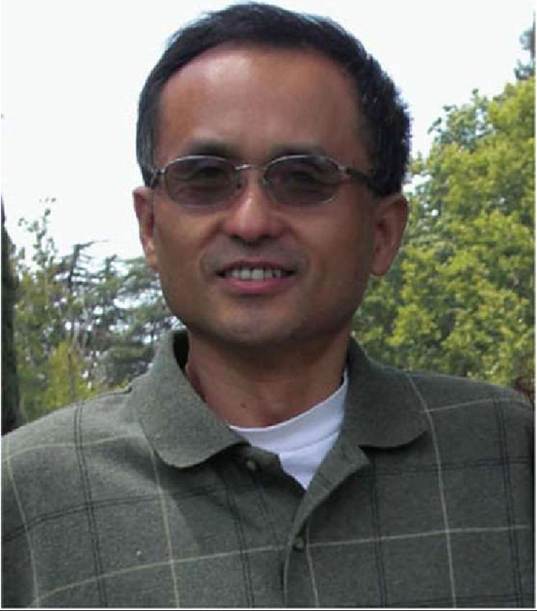
Dr. Xinyu David Zhang.
Once again, your Western analogy is a bit misleading. The Zhuan Falun (meaning “The Turning of the Wheel of the Law”) contains Master Li's thoughts on the importance of mindfulness in the search for the moral life. His recent teachings place particular stress on the need for social justice, the restoration of human rights denied by the communist regime, and the necessity of bringing back a “divine culture” to China. We in Falun Gong have come to regard Chinese communism as a wholly foreign materialist philosophy that can only increase the amount of bad karma in the world. Our ultimate aim, therefore, is the restoration of moral health to both the individual and the world.