Buddhism Beyond India
Buddhism’s future beyond India was ensured by missionary monks and lay Buddhists who spread the Dharma along three lines of transmission: a Southern Transmission into Sri Lanka and Southeast Asia, a Northern Transmission into Central and East Asia, and a more recent Western Transmission that has brought Buddhism to lands far beyond Asia.
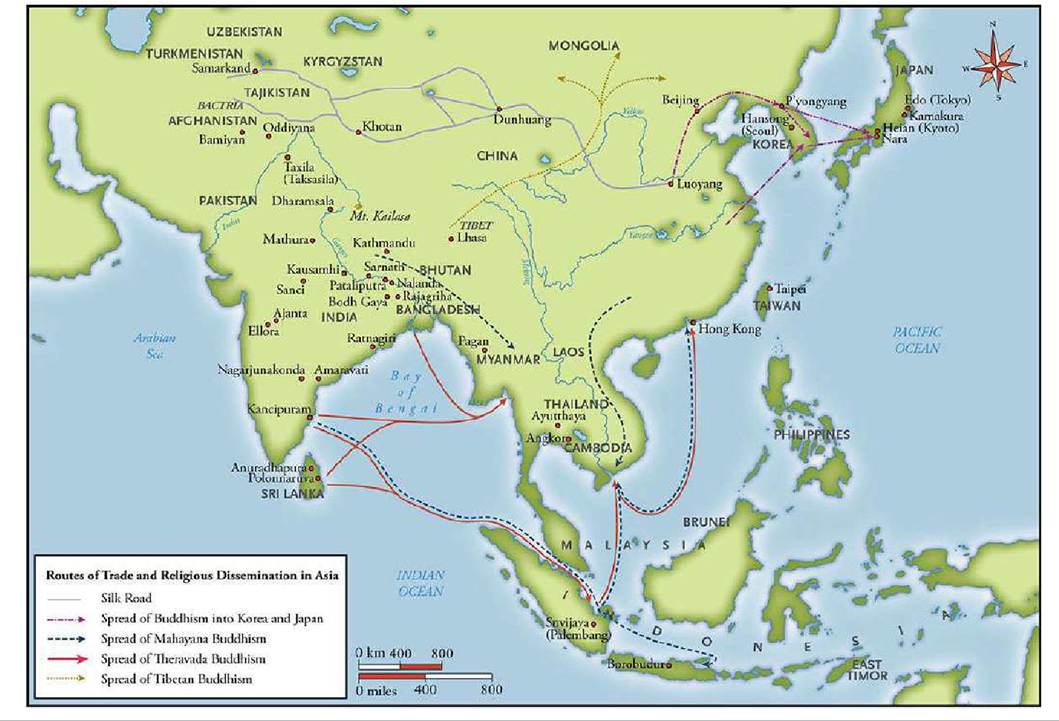
Diffusion of Buddhism across Asia.
The Southern Transmission
One of the first lands to adopt Buddhism was Sri Lanka, an island off the southern tip of India. Ancient accounts say that Ashoka’s son, Mahinda, brought the Dharma there in the third centuiy все and that King Devanampiyatissa, his first convert, built a huge monastery complex in his capital at Anuradhapura. It is said that Ashoka’s daughter, Sanghamitta, also came to the island, planted a sapling from the Buddha’s Bodhi tree, and established an order of Sri Lankan nuns. From the beginning, monastic institutions were strong in Sri Lanka, nourishing a society devoted to the Dharma and making the island a bastion of Theravada Buddhism.
Buddhism may have arrived in Southeast Asia as early as the third centuiy все. For centuries, the Theravada and Mahayana traditions existed alongside each other there. A pivotal moment came in the eleventh century with the creation of a Burmese Empire (1057-1287) and its adoption of Theravada Buddhism as its state religion. In time, Theravada became the predominant form of Buddhism in Cambodia, Thailand, and Laos as well. Mahayana Buddhism prevailed in Vietnam, largely because of its close cultural relationship with China, its northern neighbor, where Mahayana had great influence.
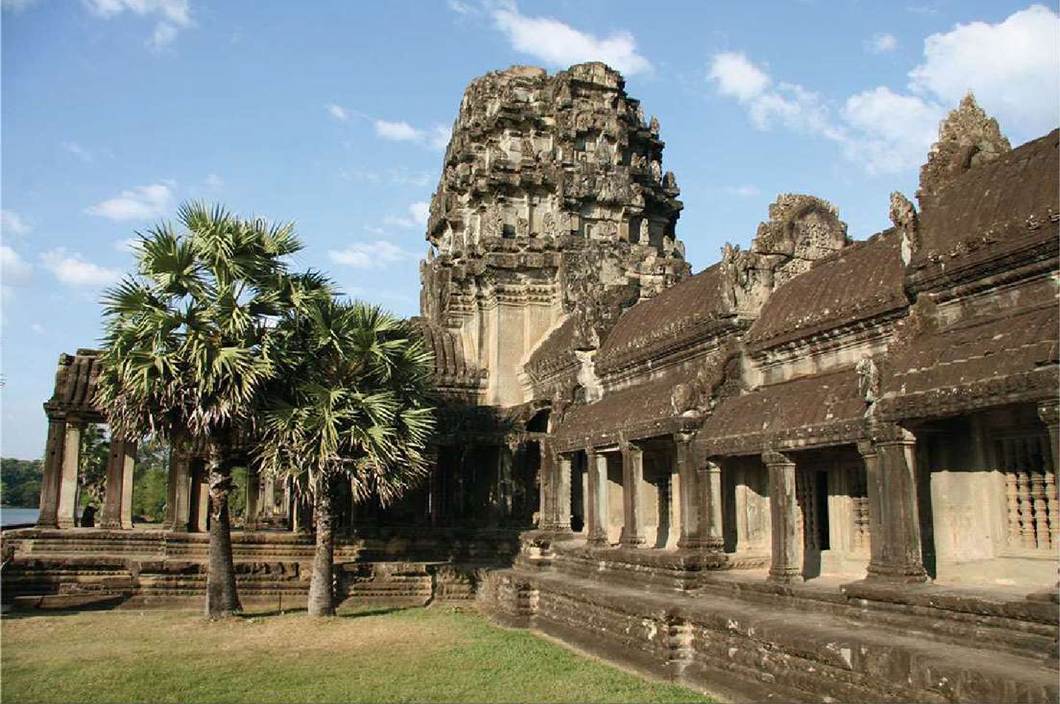
The Angkor Wat temple complex, Cambodia.
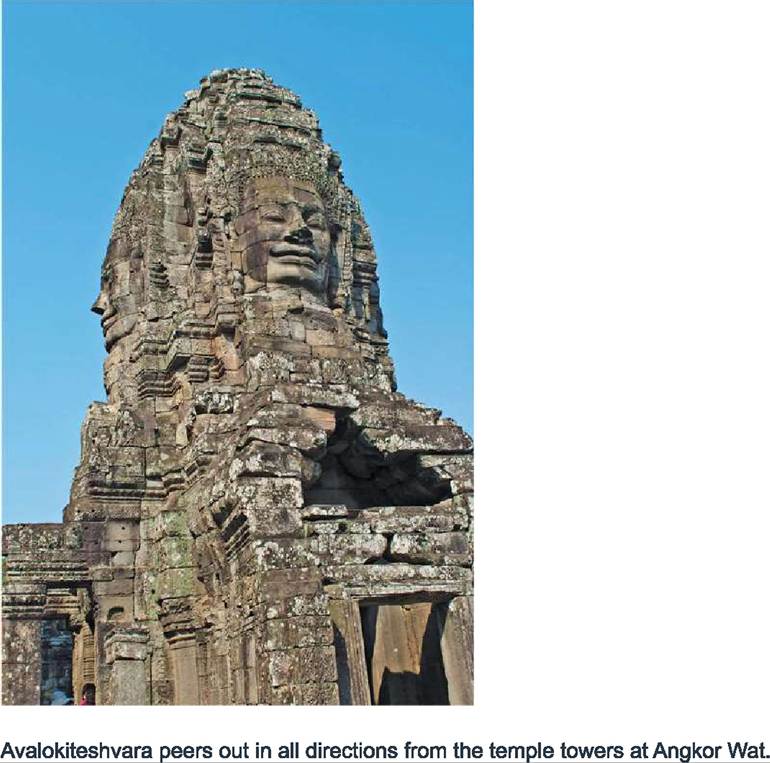
Buddhist beliefs and ideals have been preserved in some of Southeast Asia’s greatest sacred sites. Covering more than 400 acres, Cambodia’s Angkor Wat (“City of Temples”) is the largest religious monument in the world. This vast temple complex was originally dedicated to the Hindu god Vishnu but was later transformed into a Buddhist temple whose architecture expresses aspects of both Theravada and Mahayana Buddhism. These include relief sculptures of the bodhisattva Avalokiteshvara and the high central tower, which represents Mount Meru, the center of the universe in Buddhist cosmology. Another great monument is the Borobudur Temple on the island of Java in Indonesia. Built in the ninth century, this gigantic Mahayana temple contains 504 statues of the Buddha, some of them hidden within perforated screens of stone. For centuries, pilgrims have ascended to its summit through three levels that correspond to the three bodies of the Buddha described in the trikaya doctrine. Along the way, they pass through endless corridors and stairways lined with 1,460 relief sculpture panels that depict the life of the Buddha and describe his teachings.
The Northern Transmission
According to tradition, Ashoka sent missionaries northward into Central Asia as well as southward to Sri Lanka and Southeast Asia. In time, Buddhism established a presence in regions known today as Iran, Afghanistan, Pakistan, Kazakhstan, Kyrgyzstan, Tajikistan, Turkmenistan, and Uzbekistan. In some places it flourished as a state religion; for example, in the Kushan Empire (c. 30-350) and the Kingdom of Khotan (56-1001). But the Muslim conquest of Central Asia that began in the eighth century brought a virtual end to Buddhism in Central Asia.
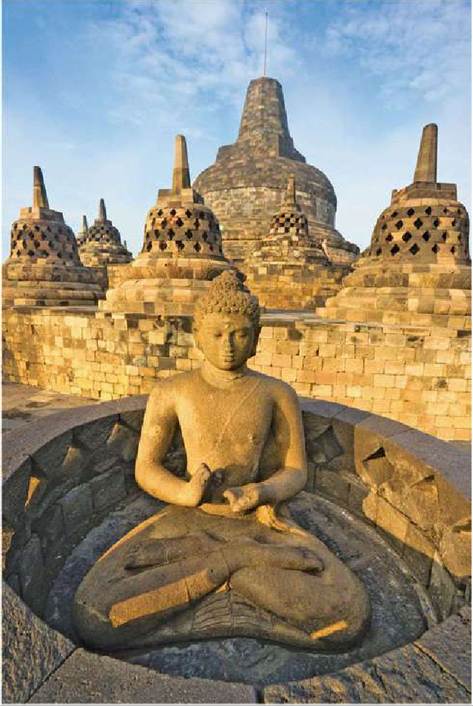
Borobudur Temple, Java, Indonesia, c. 800 ce. Here, one of the hidden statues of the Buddha is revealed.
In order to see others, pilgrims would have to peer through holes in bell-shaped stupas, such as those visible in the background.According to legend, Buddhism came to China after the emperor Ming of the Han Dynasty (r. 57-75 ce) dreamed of the Buddha, who appeared to him as a golden-robed figure flying before his palace. Intrigued, he sent envoys to India who returned with Buddhist monks and two white horses laden with Buddhist scriptures and images of the Buddha. Scholars regard this story as more fiction than fact but most agree that Buddhism did come to China in the first century.
China was not eager to embrace the Theravada form of Buddhism that was first to arrive there. Its emphasis on monasticism seemed incompatible with the Chinese ideals of achieving material success in the world and the importance of family life. Mahayana Buddhism, which came to China in the second century, received a more favorable response. Its transcendent buddhas and bodhisattvas were reminiscent of the Chinese pantheon of gods and goddesses, and its teaching that laypeople as well as monks and nuns can achieve enlightenment made it more appealing than Theravada. In addition, Mahayana Buddhism easily accommodated Chinese ethical values, such as filial piety and submission to rulers. It also addressed the issues of death and the afterlife, largely ignored by native Confucianism and Daoism, in teachings about rebirth in accordance with one’s karma.
By the sixth centuiy, Mahayana had established itself as the predominant form of Buddhism in China, hundreds of sutras had been translated into Chinese, monasteries had appeared everywhere, and Buddhism had taken its place alongside Confucianism and Daoism as one of China’s three great religions. For the most part, these have coexisted peacefully throughout China’s history, sometimes coalescing as their common features were identified and explored. Each has passed through periods of favor and disfavor tied to the preferences and policies of China’s rulers.
In the case of Buddhism, such a change in fortune happened early in its history in China. Its golden age under the Tang Dynasty (618- 907), when it was promoted by notable rulers such as the empress Wu Zetian, came to a sudden end in 845 when the emperor Wu launched a major persecution in which monks and nuns were forced to leave their monasteries and thousands of temples were destroyed. Despite occasional setbacks, Buddhism flourished in China. Schools with origins in India thrived, and new Chinese schools appeared. The most influential schools have been Chan (Zen), Jingtu (Pure Land), Tiantai, and Huayan, a philosophical school noted for its teachings about the fundamental unity of all things.Buddhism came to Korea from China in the fourth century ce. It soon won support from the rulers of the peninsula’s three kingdoms and formed a symbiotic relationship with its indigenous nature religion. Buddhist monks performed shamanistic rituals and Buddhist temples served as centers for the veneration of Korean mountain spirits as well as the Buddha. Several Mahayana schools made their way to Korea, including Tiantai, Pure Land, and Chan. Known as Seon in Korea, Chan has long been the predominant form of Buddhism there.
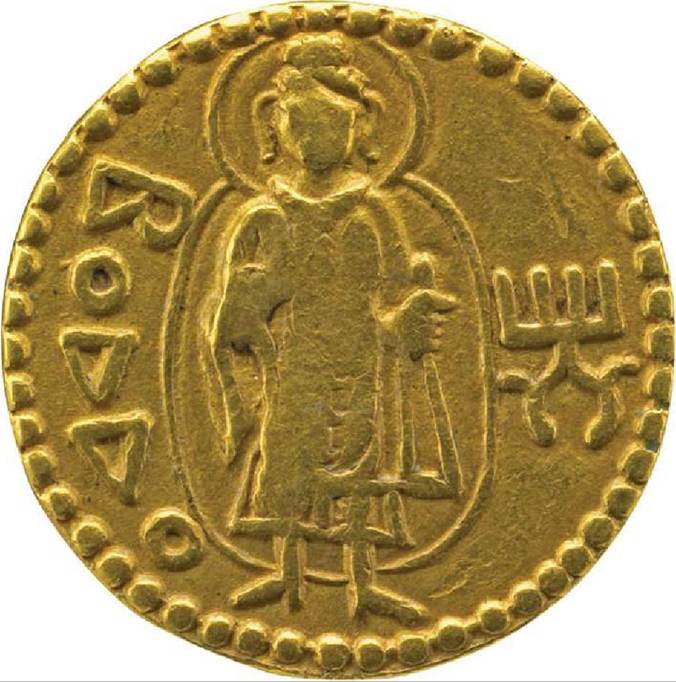
The earliest known image of the Buddha appears on the reverse of a coin minted by the second-century Kushan king, Kanishka I. Previously, the Buddha was depicted more as an absence than a presence, symbolized with images such as footprints or an empty chair.
Buddhism arrived in Japan in 552 ce in the form of sutras and images of the Buddha—gifts from a Korean king to the ruler of Japan. Not long thereafter, Prince Shotoku (574-622), a prominent member of Japan’s ruling family, incorporated both Buddhist and Confucian ideals in a constitution he created for the newly institutionalized Japanese state. Buddhism became Japan’s predominant religion in the Nara period (710-784) and has remained an essential feature of Japanese culture ever since, always existing peacefully alongside Japan’s indigenous Shinto religion.
Mahayana has always been the dominant form of Buddhism in Japan. Most of its schools were imported from China. A few, such as Nichiren, are native to Japan. Historically, the most influential forms of Buddhism in Japan have been Pure Land, Zen, Nichiren, and Shingon, a Japanese form of Vajrayana.The Western Transmission
Buddhism was almost unknown in the West until the late eighteenth century. Unlike the earlier Southern and Northern Transmissions in which missionary monks were the prime agents in transmitting the Dharma, the Western Transmission has been carried out primarily by laypeople, including travelers, scholars, and immigrants, as well as by monks.
Many of the West’s earliest contacts with Buddhism resulted from its colonization of Asia. European colonials who traveled there returned with Buddhist texts and accounts of Asian cultures that generated interest in the West. Before long, Western scholars began translating Buddhist literature into Western languages, making Buddhist teachings available to wider audiences. One of the most influential scholars was T. W. Rhys-Davids (1843-1922), a British colonial administrator who became fascinated by Buddhism while stationed in Sri Lanka. His translations of Buddhist texts attracted the attention of thousands of Westerners, many of whom came to see Buddhism as a practical philosophy whose teachings could be tested through personal experience and did not require faith in truths that could not be verified by reason and observation.
Waves of Asian immigrants also played an important role in the Western Transmission. Chinese immigrants who came to the United States, Canada, Australia, and New Zealand in the nineteenth century brought Buddhism with them, as have more recent immigrants, many of them refugees from Southeast Asia and Tibet. An important event in the history of Western Buddhism was the 1893 World Parliament of Religions in Chicago where leading Buddhists from Japan, Sri Lanka, and other Asian countries gave stirring speeches that made a lasting impression on Western religious thought.
This was followed by the arrival of twentieth-century Buddhist teachers such as D. T. Suzuki (1870-1966), a Japanese proponent of Zen Buddhism; Ajahn Chah (1918-1992), a Thai monk who popularized Theravada Buddhism in Europe and North America; and Thich Nhat Hanh (b. 1926), a Vietnamese monk who has founded monasteries in France, Germany, and the United States and published more than seventy books in English teaching a blend of Theravada and Mahayana Buddhism. Perhaps the most influential of all recent teachers is Tibet’s fourteenth Dalai Lama, Tenzin Gyatso (b. 1935). The recipient of the Nobel Peace Prize in 1989, he has traveled widely in the West and published more than fifty books on Buddhism in English.Although Western Buddhism is still in its infancy, it is already exhibiting its own distinctive features. In the West, Buddhist communities representing numerous traditions and schools can be found even in small cities. This is a departure from the situation in Asia, where entire countries can be identified as Theravada, Mahayana, or Vajrayana. Western Buddhist communities are more democratic in their organization and give greater authority to laypeople and women than their counterparts in Asia. Finally, Buddhist communities whose members are converts to Buddhism generally focus on the practice of meditation. Groups whose members share an ethnic identity tend to emphasize other traditional practices and to foster cultural aspects of Buddhism inherited from their immigrant ancestors.
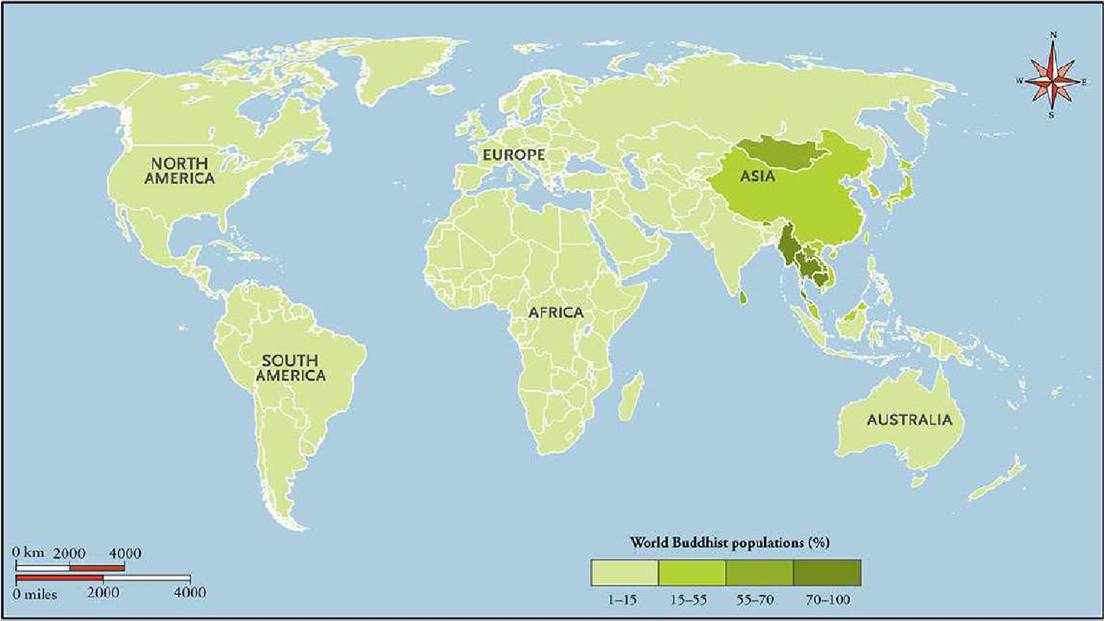
World Buddhist populations.
Video: American Buddhism
[Please note: You must be using an online, browser-based eReader in order to view this content.]
1. In the United States, different kinds of local Buddhist gro
compete for converts.
often coexist without communicating with each other.
usually join together in the celebration of holidays.
O are usually led by monks and nuns from Asia.
2. American Buddhists without cultural roots in traditionally
give more emphasis to meditation and Buddhist philosophy than t
O emphasize study of sutras.
C") ioin Pure Land sanuhas.
O join Tendai sanghas.
3. American Buddhists
are just as numerous in the Midwest as on the East and West Coas tend to value Buddhist philosophy without practicing traditional ri tend to be divided along ethnic and racial lines.
generally find it difficult accept traditional teachings about reincai
Self-Assessment 5.2
[Please note: You must be using an online, browser-based eReader in order to view this content.]
1. Which of the following teaches that enlightenment depem
O Pure Land

Shingon

Nichiren
O Zen
2. Mahayana is the largest tradition in Buddhism.
O True
O False
3. Buddhism has always thrived in India.
O True
O False