Buddhism as a Way of Life
Buddhists practice the teachings of the Buddha in many ways. Seeking to observe the ethical principles he taught, they aspire to proper conduct in daily life. Those who seek to observe the workings of the mind and to see reality more clearly practice meditation.
Some become members of monastic orders. Most Buddhists participate in rituals that celebrate important events in the history of Buddhism and mark important transitions in human lives. In this part of our investigation, we will look at Buddhist practices to gain an understanding of the meaning they have for followers of the Buddha.Who Is a Buddhist?
You will recall that the Budda preached his first sermon, the Sermon in the Deer Park, to the five ascetics who had once practiced severe austerities with him. Convinced that he had found what they had been seeking, they became the first members of the sangha. To solemnize their commitment to practicing the Dharma, the Buddha asked them to make three assertions known as the Three Refuges and the Three Jewels:
I take refuge in the Buddha.
I take refuge in the Dharma.
I take refuge in the Sangha.
Since then, followers of the Buddha have affirmed their Buddhist identity by reciting this formula, Buddhism’s most fundamental ritual. To take refuge in the Buddha is to acknowledge him as the supreme example of the potential of human life. To take refuge in the Dharma is to recognize it as the path to enlightenment and an end to suffering. To take refuge in the sangha is to acknowledge one’s reliance on the order of Buddhist monks, which has been the custodian of the Dharma and responsible for teaching and preserving it.
Monks, Nuns, and Monastic Life
From the beginning, monasticism has been Buddhism’s most important institution. Monks and nuns have been responsible for teaching and preserving the Dharma and for living lives that model Buddhist values.
The foundation of Buddhist monastic life is the Vinaya, a collection of texts in the Pali Canon that contains rules governing the lives of monks and nuns. These require the cultivation of good moral character, nonattachment to material things, and abstention from sexual activity and other forms of inappropriate contact with others.
In Theravada countries, a monk’s day begins at daybreak. He rises, washes himself, and spends time in meditation. He then joins his fellow monks in going from house to house asking for food. This provides monks with the nourishment they need and offers laypeople an opportunity to gain merit. Returning to the monastery, the monk eats a vegetarian breakfast with his companions and then sits with them in an assembly hall for a time of chanting and instruction. Because monks are not permitted to eat after noon, there is an opportunity for a second meal just before noon. Spending the afternoon in his room, a monk typically devotes his time to study and meditation. At sundown, he sweeps his room and lights a lamp. Later, he returns to the assembly hall for instruction and meditation and then retires to his room for the night.
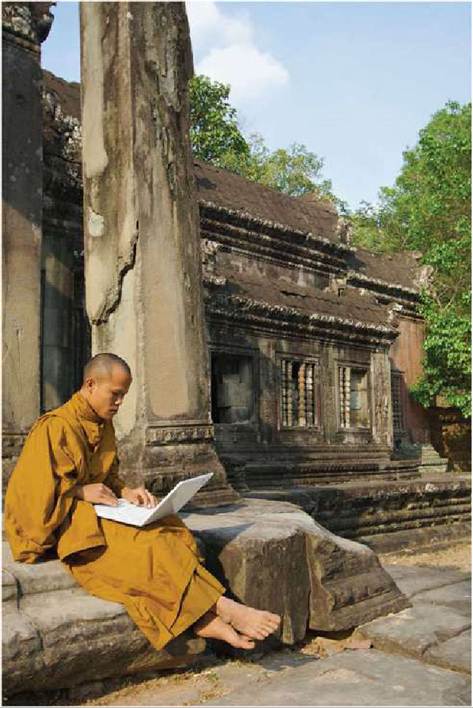
A Cambodian monk at work on his computer.
The lives of monks in the Mahayana and Vajrayana traditions resemble those of Theravada monks in their emphasis on simplicity and meditation but can vary in significant ways. In Tibet, where extreme cold makes the usual vegetarian diet impractical, monks eat meat. Some East Asian monks and nuns are allowed to marry. In China, Japan, and Korea, where begging is not socially acceptable, monks and nuns prepare food donated by their local communities or grown in their own gardens.
Early Buddhist texts say that the order of nuns was established by the Buddha at the request of his aunt, Mahapajapati, who became the first Buddhist nun. The Buddha’s initial hesitation in agreeing to Mahapajapati’s request may reflect contemporary attitudes toward women, and these must also have influenced the Vinaya, which contains twice as many rules for nuns as as it does for monks. The order of nuns has always been subordinate to the order of monks, but fully ordained nuns may teach, perform rituals, and officiate at ceremonies, just as fully ordained monks do.