The Buddha’s Teachings on Ethics
Like most religions, Buddhism includes a body of teachings on ethics, the principles that define moral behavior. The Buddha taught that ethical behavior alleviates suffering, the great problem that afflicts all beings, and brings compassion to others.
Unethical behavior causes suffering and seeks to benefit oneself in ways that are inconsistent with the Buddha’s teaching that there really is no essential self.Buddhists recognize the Ten Precepts as basic guidelines for ethical behavior. These require abstention from (1) killing or harming other beings; (2) taking anything not freely given; (3) sexual misconduct; (4) false speech; (5) using intoxicants; (6) eating after noon; (7) dancing, singing, and foolish entertainments; (8) adorning the body with scents and jewelry; (9) sleeping in luxurious beds; and (10) handling money. The first five of these, the Five Precepts, are enjoined on all Buddhists. They urge abstention from actions that are harmful to oneself or others. The remaining precepts apply only to monastics, although some laypeople observe the Eight Precepts on holy days when they want to make a special effort. These are the first nine precepts, with the seventh and eighth combined and considered just one. Monks and nuns observe all of the Ten Precepts and the rules of the Vinaya as well. Some Buddhists believe these precepts are rules that must always be followed to the letter. Others see them as general principles that are subject to interpretation.
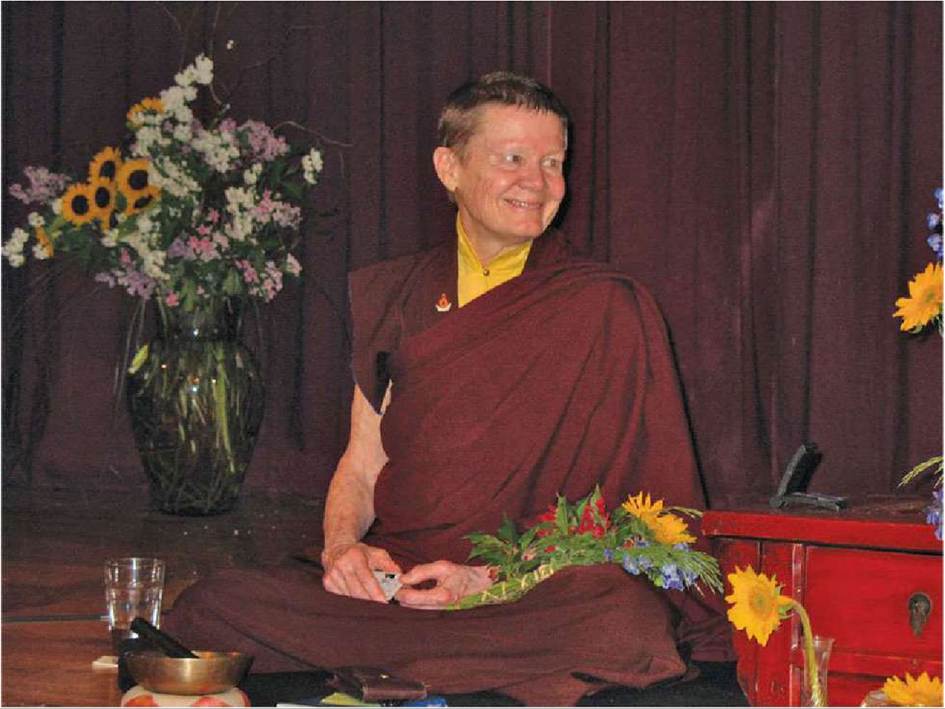
Pema Chodron is an American-born Buddhist nun whose books describe skillful ways of dealing with everyday suffering.
Buddhism sees wisdom and compassion as more helpful than absolute standards of right and wrong in matters of ethics. Absolute standards dictate that certain actions are always right or wrong regardless of circumstances.
As we saw earlier in our discussion of skillful means, wisdom and compassion allow us to adapt our actions to circumstances in order to achieve the highest good—even if this means setting aside normal standards. The untruth told by the father in the Buddha’s parable of the burning house is a good example.GLOBAL SNAPSHOT
The Emergence of Western Buddhism
For centuries, Buddhism was known exclusively in Asia, where one or another of its schools and sects predominated in every region. Today, Buddhism is becoming increasingly popular in the West, and especially in North America and Europe, where Buddhist groups of many kinds often coexist in the same neighborhoods. Members often call these groups sanghas, expanding the application of this term, which has traditionally referred only to monastic communities.
Developments in California are typical of those occurring elsewhere in the West. In Sacramento, for example, there are sanghas representing many Buddhist traditions. Some, founded by immigrants, continue to cherish rituals, languages, and cultural practices with roots in Asia. Buddhism’s cultural roots are less important for sanghas whose members have non-Asian and non-Buddhist backgrounds. Because Buddhism is beginning to thrive in the West, the question arises: What form will its emerging Western tradition take?
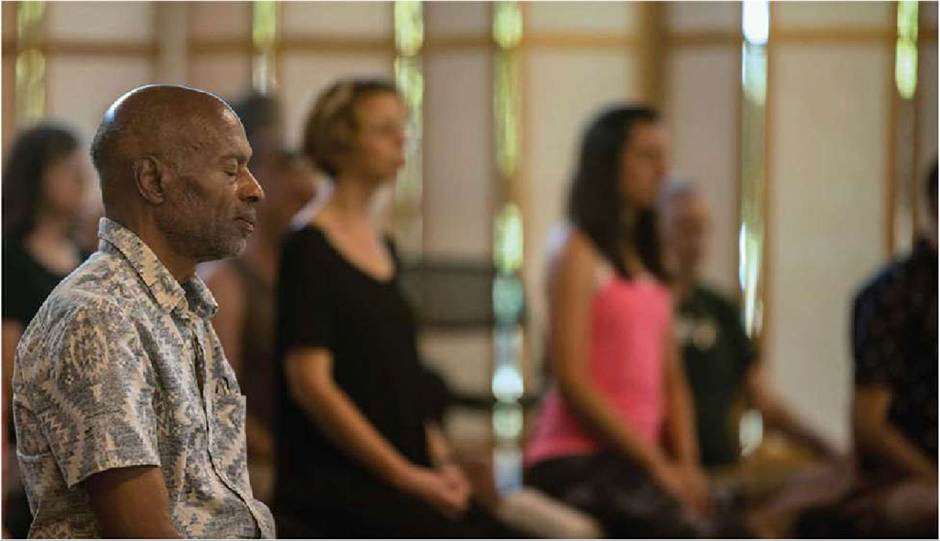
Members of the Sacramento Dharma Center participate in a group mediation session.
The Reverend Bob Osh ita served for many years as priest at the Sacramento Buddhist Church, a sangha in the tradition of Japanese Jodo Shinshu, a form of Pure Land Buddhism. Although his sangha has an unmistakably Japanese flavor, Reverend Bob is pleased to see that Western Buddhism is taking the form of something larger—a “Dharma buffet,” as he puts it, that will offer Western Buddhists the benefits of all of Buddhism’s many traditions.
Across town, members of the Sacramento Dharma Center have created a space in which only a single image of the Buddha and a few Tibetan thangkas, or painted mandalas, suggest a connection with traditional forms of Buddhism. Many members say their commitment to meditation as a practice that reduces suffering is more important than the religious and cultural aspects of Buddhism. As for the future of Buddhism in the West, they agree with Reverend Bob that wisdom and compassion are certain to lie at the heart of the emerging Western tradition. Buddhists have always prized these two virtues: wisdom grounded in an understanding of the true nature of reality and a compassion for all beings that arises from awareness of the interconnectedness of all things.
More on the topic The Buddha’s Teachings on Ethics:
- The Teachings of Sikhism
- The Teachings of Shinto
- What Did the Buddha Teach?
- The Teachings of Hinduism
- Guru Nanak’s Teachings
- The Teachings of Christianity
- Religious Questions and Challenges
- The History of Confucianism and Daoism
- The advent of the Early Historic period in northern India in the sixth and fifth centuries bce saw the emergence of monarchical and oligarchic states and the beginnings of a sustained discussion of the relationship of kingship with violence and non-violence.
- REFERENCES