Meditation
The Buddha encouraged his followers to practice meditation, which enables practitioners to identify and eliminate patterns of thought that perpetuate desire and suffering. Of course, most of the Buddha’s followers were monks and nuns who devoted themselves entirely to meditation and other monastic practices.
With families to care for, most lay followers contented themselves with supporting monastic communities and doing their best to practice the other virtues which, together with meditation, are aspects of the Noble Eightfold Path. This has remained the case for most of Buddhism’s history. It is only in recent years that large numbers of lay Buddhists have begun to make meditation a part of their daily lives.Samatha and Vipassana Meditation
From the beginning, Buddhists have practiced two basic and complementary forms of meditation: samatha, which calms the mind, and vipassana, in which one gains insight into the workings of the mind.
Samatha meditation calms the mind by allowing awareness to rest lightly on just one thing. For most meditators, this is the breath. By simply following their breath, letting each inhalation and exhalation fill their awareness, they allow the mind to settle into a state of greater calm and stability.
The object of vipassana meditation is to gain insight into the nature of the mind and of reality as a whole. Also known as insight meditation and mindfulness meditation, vipassana begins with calming and stabilizing the mind. The meditator then observes how thoughts, feelings, and sensations arise and learns how to let them pass without becoming caught up in them.
Gradually, it becomes clear how attachment and aversion to these and all other phenomena cause suffering and that letting go of attachment and aversion brings greater calmness of mind. With each new insight, the meditator takes a step, however small, on the path that led the Buddha to enlightenment and an end to suffering.
Other Forms of Meditation
As Buddhism grew, new forms of meditation developed, each suited to the tradition in which it developed.
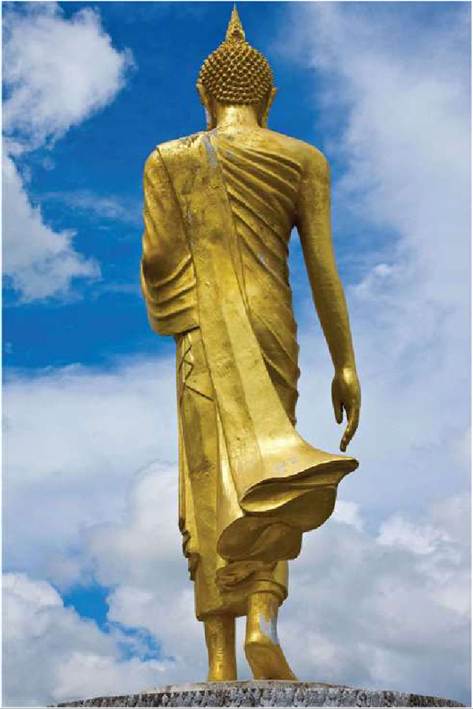
A large contemporary image of the Walking Buddha in Thailand. Thai images often stylistically craft his right arm to represent the graceful swaying trunk of an elephant.
Some Buddhists practice meditation while walking, one of the techniques taught by the Buddha. Chinese Tiantai Buddhism builds its meditation practice on samatha and vipassana and takes a special interest in correct and incorrect forms of breathing. In Tendai, the Japanese form of Tiantai, meditation often includes the chanting of mantras and the use of mudras, symbolic gestures made with the hands and fingers. In Pure Land Buddhism, meditation is focused on repetition of the name of Amitabha Buddha who has promised to bring all who call upon him to rebirth in his Western Pure Land. Some practitioners repeat the name constantly, devoting themselves to Amitabha throughout each day. Others visualize Amitabha, the bodhisattvas who surround him, and his pure land while meditating. Chan meditation emphasizes correct posture. It is important to sit straight with the head held high and hands resting one upon the other in the lap. To calm the mind, awareness is allowed to settle on the breath. As in vipassana, the meditator observes as thoughts and sensations arise and then pass away without becoming entangled in them. Some schools of Chan/Zen favor awareness of the totality of all phenomena rather than the breath or some other object. Others make use of koans, paradoxical riddles that confound the mind and move it to a deeper awareness of the true nature of reality. As we have seen, Tibetan Buddhism makes use of Tantric meditation practices. These include deity yoga, in which meditators focus on a mental image of a buddha or bodhisattva, and death yoga, in which the death process offers opportunities for enlightenment and the avoidance of rebirth. Another form of Tibetan meditation involves seeing through thoughts and sensations that arise in the mind in order to experience the ultimate nature of mind itself, which is identical with Buddha nature. Finally, Buddhists of many kinds practice loving-kindness meditation. This is the cultivation of boundless compassion for oneself and for all other beings.
Video: Tibetan Buddhist Mandala
[Please note: You must be using an online, browser-based eReader in order to view this content.]
More on the topic Meditation:
- Aum Shinrikyo: A Cult of Redemptive Violence?
- Plato
- The Yogi's Way of War
- 41 Buddhism in China
- Monks and Friars
- §107. Sitting in Oblivion
- Later Jainism
- O’Connor and the ‘Second Contradiction'
- Index of Ancient Texts
- Taking Control