The Teachings of Shinto
The term Shinto is a relatively late but elegant reference to the longest existing religion in Japan. “Shin” is the Japanized pronunciation of the Chinese word shen, which refers to gods and deities (see Chapter 8).
“To,” alternatively “do,” is the Japanese pronunciation of the Chinese word Dao, which suggests the “way.” Hence, Shinto literally means “the way of the gods.” The term Shinto did not come into existence until the Japanese used it to distinguish their preexisting religion from Buddhism, which, when first introduced into the country, was known as Butsudo, “the way of the Buddha.” In more colloquial form, Shinto is known as kami-no-michi, “the way of the kami,” as the core of Shinto is the belief in the existence and power of kami, a broad term that suggests a whole range of meanings that will be discussed later in this chapter.To start off, Shinto has no identifiable founder, nor does it have a sacred book similar to the Bible. Rather, it is based on a set of highly revered texts, dating back to the eighth and ninth centuries ce. The Kojiki (Record of Ancient Matters, completed in 712 ce) and the Nihon shoki (alternatively known as Nihongi, Chronicles of [the Land Where] the Sun Originates, compiled in 720 ce) are the two authoritative texts for the study of ancient Shinto mythologies and beliefs. The following narrative is based primarily on the Kojiki.
Creation Myth in the Kojiki
The Kojiki begins with several generations of invisible divinities at the beginning of time, all of whom have titles that end with the word kami, until the primordial pair, Izanagi and his wife Izanami, appears. The couple is credited with bringing the world out of its original chaos. Standing on the Heavenly Floating Bridge, they lower a jeweled spear to stir the ocean below. When they lift up the spear, the brine dripping down from its tip forms an island.
In like manner, “the grand eight islands” of the Japanese archipelago are created. This simulated and figurative sex act of the divine couple has brought forth the sacred Japanese islands as well as the various nature deities that inhabit there.Izanami is burned to death while giving birth to her last child, the fire god. Izanagi follows his wife to Yomi, the underworld of the dead, where, upon seeing her putrefied and decomposing body, he is horrified and makes a hasty retreat. After his return to the world of the living, Izanagi washes himself in a stream. From his eyes are born the solar goddess Amaterasu-no- Omikami (The Great August Kami Who Shines in the Sky) and the lunar god Tsukiyomi, her brother and lover. From Izanagi’s nose comes the violent and ill-tempered storm god Susa-no- o.
When the Kojiki continues, the focus shifts to the relationship between Amaterasu and her brother Susa-no-o, rather than that between her and her brother-husband. Petulant and mischievous, Susa-no-o gives much grief to his sister. He ravages her heavenly domain, destroys her rice fields, and desecrates her house. Annoyed and frightened, Amaterasu retreats into a cave, thereby plunging the world into darkness. The other deities try to lure her back out with all sorts of tricks, but to no avail, until a goddess by the name of Uzume performs a lewd dance that causes so much raucous laughter among the gods that the curious Amaterasu is finally enticed to emerge from her hiding. (This is an ingenious Shinto attempt to explain solar eclipse.) Susa-no-o is forced to apologize to his sister and is banished to Izumo, a region facing the Japan Sea (alternatively referred to as the East Sea) on the other side of the main island from Ise, the future home of Amaterasu’s grand shrine. Having battled and subdued a huge serpent in Izumo, Susa-no-o settles down and locates a sword, which he presents to Amaterasu as a token of his apology and goodwill. The sword will later become one of the “three imperial regalia” Amaterasu bestows on her descendants who occupy the Japanese throne.
The final cycle of the narrative in the Kojiki deals with the successors of Susa-no-o and the descendants of Amaterasu. Ninigi, grandson of Amaterasu, is instructed by her to rule all of Japan. But his mission is thwarted by Susa-no-o’s successors in Izumo, who refuse to yield to the Amaterasu line until she promises to honor her young brother by building him a grand shrine. After Izumo’s accommodation with the Sun Goddess group, the descendants of all the other deities fall in line, and Ninigi’s own grandson, the Emperor Jimmu, is the first human ruler to claim imperial authority over all of Japan. He is provided with the three imperial regalia of a sword, a mirror, and a crescent-moon-shaped jewel as symbols of his power, which he is believed to have exercised in the Yamato region near present-day Nara. According to tradition, this momentous event took place in 660 bce, and the imperial line has supposedly continued uninterrupted to the present time.
From the Kojiki story just outlined, major themes of Shinto belief can be identified: the divine creation of Japan, a concern with fertility and purification, the importance of the feminine, an absence of ethical teachings, a corresponding lack of absolute good or radical evil, and a profound intertwining of divinity with imperial power.
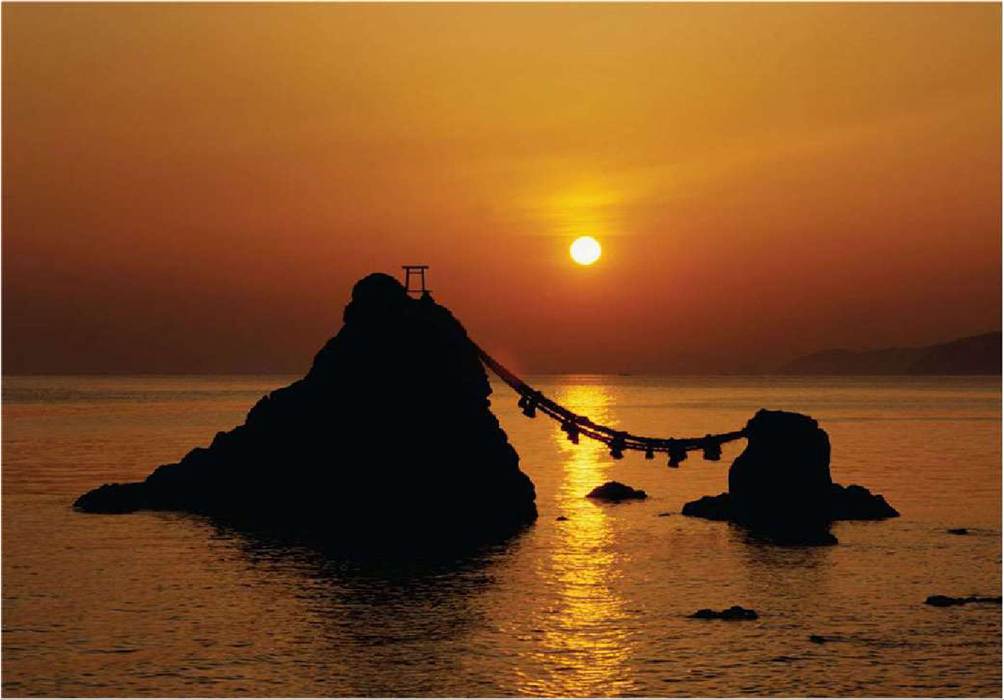
The Meoto-iwa (Husband and Wife rocks) in Mie Prefecture is an iconic landmark in Japan that symbolizes the union between Izanagi and Izanami.
Japan as a Divine Creation
The core belief of Shinto centers on the kami and Japan’s unique relationship with them. Representative of the Shinto notion of the sacred or the holy, kami are mysterious and tremendous powers in nature and in the human world. They are most evident in nature. Illustrious objects in the sky such as the sun and the moon, majestic mountains such as Fuji, serene waterfalls such as the Nachi, and strange-shaped rocks are all regarded as kami.
There are multitudes of spirits and supernatural beings who inhabit the invisible world who are designated as kami. Certain animals, such as the fox, are also worshiped as kami. In the human world, clan ancestors, rulers, and people with extraordinary accomplishments are revered as kami as well. By one count, the ancient texts list 8 million kami. Most kami are believed to be the source of blessing and protection; hence, worship of them is understood either as thanksgiving or as pleading for more divine gifts. But some kami are ill-tempered and even ill-intentioned, so worship of them is a necessary and prudent act for preventing disaster. According to this Shinto creation myth, then, Japan is the land of kami, created and populated by them as a paradise on earth. Nature, with its awesome power and captivating beauty, is the very expression of divine presence. Human beings, who can trace their origins back to the same divine forces, therefore have the duty to respond in celebration and adoration to the gifts and blessings of the kami.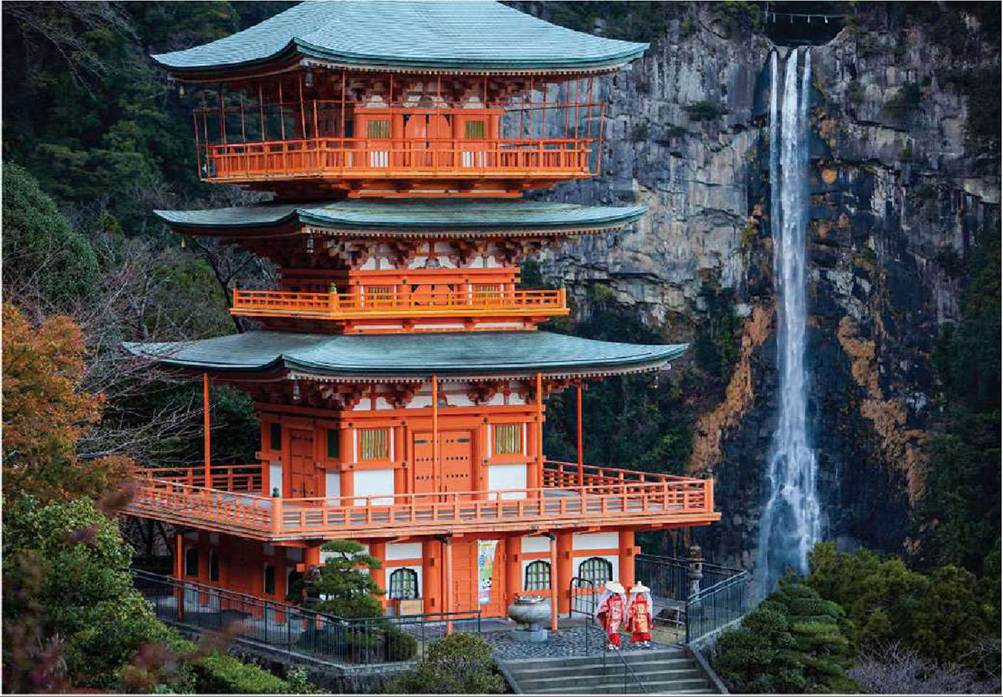
The Nachi Waterfall in Kumano, Japan. Like Mount Fuji, the Nachi Fall is an iconic Shinto symbol long revered in Japan. Also considered a kami, it is a popular site for Shinto pilgrims who appreciate not only its magic power but also its scenic beauty.
Fertility and Purification
Early Shinto is centrally concerned with fertility. In the Kojiki cosmogonic (explanation of how the cosmos came about) myth, the main function of the primeval pair of kami is to “fertilize” the land and to procreate the other gods. This procreative power of the original divine couple continues even after the death of Izanami, when Izanagi, on his own, manages to bring forth more deities through ritual washing. At the same time, this mythic story highlights the Shinto fear of contamination and defilement, as well as its emphasis on purification. Despite the love that he has for his wife, Izanagi is so horrified and repulsed by Izanami’s decomposing form after her death that he abandons her in the netherworld and hurries back to the world of the living.
Death, disease, and blood are thus seen as polluting; persons connected to those things are considered spiritually impure and must be ritually purified before they can approach the kami. The arrangement of the typical Shinto shrine and the main ritual responsibility of theShinto priests illustrate well this vital aspect of Shinto belief, as you shall see later in this chapter.
A “dark” side of Shinto, again owing to its aversion to defilement and impurity, is the plight of the burakumin, the Japanese version of “untouchables” who traditionally perform many of the dirty tasks in society, such as butchers, tanners, and undertakers. As their jobs involve exposure to blood and death, they are considered unclean in the eyes of the kami and society at large. Before the (1868-1912 ce), they were forced to live apart in segregated communities with no access to the social services enjoyed by regular citizens. Although the stigma of their religious defilement has been officially lifted in modern times, the discrimination and ostracism against them continue in certain parts of the country to this day. In fact, a large percentage of organized crime (yakuza) membership comes from people with a burakumin background. This is a stain on Shinto that needs to be acknowledged.
The Feminine in Shinto
It is highly noteworthy that in the Shinto myth, the sun, the most illustrious object in the sky, is portrayed as female, despite the later patriarchal (male-dominated) nature of Japanese society. It is equally significant that the Sun Goddess Amaterasu is also the ancestress of the Japanese royal family and that, at least up through the tenth century ce, it was not uncommon for the imperial ruler to be a woman. Also prominent in early Shinto is the role of the shamanic figure, often a female. The ecstatic dance of the goddess Uzume to lure Amaterasu out of hiding, thereby saving the world from perpetual darkness caused by solar eclipse, is indicative of the power of the female shamanic dancer.
In addition, both the Kojiki and the Nihongi mention the mother of Emperor Jimmu, the first human ruler of Japan, whose name is Tama-yori-hime. This name suggests her role as a female shaman, as it literally means “a princess (hime) in whom dwells (yori) the spirit (tama) of the kami.” Equally noteworthy is the account of Emperor Sujin in the Nihongi, whose rule is assisted by two female diviners, one being his own aunt and the other a charismatic commoner named Otataneko, the favorite woman shaman of the deity of the Yamato region. It is Otataneko who is credited with the peace and prosperity of Sujin’s reign, as she is known for her capacity to commune with the kami and to be possessed by them.The high prestige of female shamans in ancient Japan is further attested by the stoiy of Empress Jingo, also recorded in the Nihongi. Jingo is a capable shamanic diviner for her husband Emperor Chuai, after whose death she personally leads an armada to invade Korea because of the oracle of assured victory she receives from the gods. It is the extension of Japanese political control over Korea that paves the way for the powerful reign of her son, Emperor Ojin. (The issue of women in Shinto will be further addressed later in this chapter.)
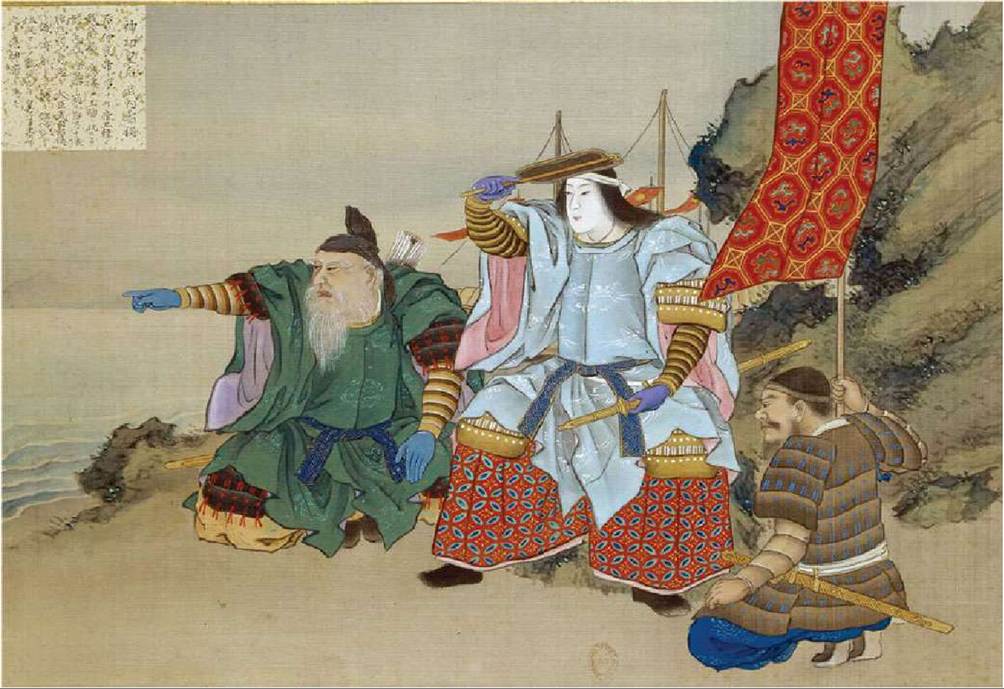
The legendary Empress Jingo, center, leading a military campaign. Japanese silk painting, Edo period.
Ethics, Good, and Evil
Conspicuously absent in early Shinto belief is any reference to ethics. Although much emphasis is placed on fertility and purity, Kojiki’s cosmogonic story does not address the issue of morality at all. The fire god, though causing the death of his mother Izanami, is not depicted as a villain. Izanagi, though abandoning his wife in the eternally dark and terrifying underworld, is not blamed for being a heartless spouse. Susa-no-o, though causing much distress to his sister Amaterasu with his destructive and willful behavior, is not portrayed as an evil culprit. The incestuous relationship between the solar goddess Amaterasu and her brother the lunar god Tsukiyomi is portrayed in a matter of fact way. Likewise, the explicitly lewd behavior of the kami in drawing Amaterasu out of her hiding is not described as immoral. In other words, the early Shinto account of creation and the relationship between the gods places no emphasis on proper ethical conduct. There is no supreme god giving moral instructions and laws. Nor is there any hint of a cosmic struggle between good and evil. Whether in the primeval divine realm of the gods, in the natural world, or within the human community that comes into being afterward, in Shinto beliefs there is no radical evil entity bent on subverting the will and handiwork of a benevolent creator god. Divine and human actions are judged only as fertile or unproductive, pure or impure, desirable or undesirable.
Wayward behavior can be remedied, and impurities can be removed. What are most offensive to the gods are not sin and guilt, but pollution and defilement.
The notable absence of ethical concerns in early Shinto myth by no means signals that the Japanese are not governed by moral principles in their behavior. What it does mean is that Japanese ethics came largely from other sources, primarily Buddhism and Confucianism. The introduction of these two alien traditions in the history of Shinto will be discussed later in this chapter.
Shinto and Imperial Authority
Shinto’s tie to the imperial state and to the worship of the emperor is a crucial aspect of this tradition. Early Shinto texts clearly attempt to establish the divine origin of the imperial family and the august nature of the emperor. As descendant of the Sun Goddess Amaterasu, the Japanese ruler (both male and, not infrequently, female—at least up to the tenth century ce) traditionally wielded both political and religious power. As a matter of fact, government affairs and government in general were originally referred to as matsurigoto, “matters relating to festivals.” There was no concept of the separation between religion and politics, and the relation between Shinto and state, or kami and the Japanese throne, would become a major issue, as we examine State Shinto later in the history section of this chapter.
How has Shinto managed to maintain its independent identity in light of the overwhelming influence of Buddhism and Confucianism in Japan since the beginning of its recorded history?
VOICES:
An Interview with Minoru Watanabe
Mr. Minoru Watanabe is a Shinto priest at a shrine in the Nerima district of Tokyo.
Why did you want to become a Shinto priest?
My family has been in charge of a shrine at my native city of Shizuoka for generations. Both my grandfather and father were chief priests there. So, ever since my childhood, I have been expected to carry on this family profession also.
Did you have to go to a special school in order to become a Shinto priest?
After high school, I attended the Kokugakuin University in Tokyo to learn all about being a Shinto priest. The university is pretty much like all other universities, except that it is one of the two main training centers for Shinto priests, the other being Kogakkan in Mie prefecture, near Ise. In addition to Shinto culture and practices, the university offers numerous other disciplines, including economics and law. I led a typical college student’s life. I was even president of the judo club during my senior year.
What does it mean to be a Shinto priest?
To me, being a Shinto priest is more than knowing all the Shinto teachings and ritual performances. Most important, it is to serve as “cement” for the community by bringing all the neighbors together through year-round shrine activities. The shrine should be a place where people can come and interact with the kami and one another on all sorts of occasions and for all kinds of needs whenever they want to. It is a fundamental aspect of Shinto to have a sense that kami is so close to us that we can communicate with them whenever we need guidance and protection. Respect of the kami and closeness to them either as an individual or as a community form the very basis of our Japanese cultural identity. As a Shinto priest, I consider it my solemn duty to preserve this identity and to invite people to appreciate and respect this identity.
Self-Assessment 9.1
[Please note: You must be using an online, browser-based eReader in order to view this content.]
More on the topic The Teachings of Shinto:
- The Teachings of Shinto
- Teachings
- Teachings
- Shinto as a Way of Life
- The Teachings of Christianity
- Guru Nanak’s Teachings
- 9 Shinto
- The Buddha’s Teachings on Ethics
- Brodd Jeffrey, Little L., Nystrom B., Platzner R., Shek R., Stiles E.. Invitation to World Religions. 4th edition. — Oxford University Press,2022. — 1196 p., 2022
- Nineteenth-Century Japanese New Religions