The History of Shinto
The long history of the Shinto tradition can be divided roughly into three periods: ancient, medieval, and modern. The ancient period lasted from prehistoric times to the unification of the country by the Yamato leaders sometime prior to the sixth century ce.
The medieval period spanned the sixth to the thirteenth centuries when Shinto undertook a process of interaction and accommodation with the two alien traditions of Confucianism and Buddhism. Finally, the modern period witnessed Shinto’s reassertion of its uniqueness and relevance to the Japanese nation, as well as its adjustment to a pluralistic religious landscape after the conclusion of World War II.Ancient Shinto
Shinto probably began with nature worship and clan identities going back to prehistoric times. There was no name or label attached to a growing set of attitudes and practices that focused on the potency of impressive objects in nature and leaders within clan groups. Generically known as “kami,” these objects and personages were revered, and their supposed powers were recognized. In time, a loosely knit set of beliefs developed to define the relationship between humans and nature, as well as among humans. It came to be known as the “way of the kami.” (Earlier in this chapter you were introduced to the major tenets of this ancient Shinto belief as revealed in the classical works of the Kojiki and the NihongL)
Medieval Shinto
By the time the Kojiki and Nihongi had been compiled, Shinto had actually begun its second (medieval) stage of development. This stage was marked by the new religious and political challenge from the continental culture of China by way of Korea. In the year 538 ce, Confucianism and Buddhism were formally introduced into Japan by the Yamato leaders, who had consolidated their power over all other rival clans. This was an accomplishment confirmed by the mythological accounts that describe the submission of the various kami (who were believed to be the founding ancestors of these clans) to Amaterasu, the ancestress of the Yamato rulers.
Confucianism and Buddhism gave a great jolt to this Shinto faith, addressing issues it had ignored or had no interest in. Confucianism (see Chapter 8) provided an ethical framework for state, society, and family, and Buddhism (see Chapter 5) gave special attention to the issues of suffering and death. The clearest evidence of the influence of the two alien traditions can be seen in the “Seventeen Articles Constitution” promulgated in 604 ce by Prince Shotoku, regent to his aunt the Empress Suiko. More a vision statement than a constitution in the modern sense, the document clearly acknowledges the strengths of Confucianism and Buddhism in giving guidance to harmonious living and purpose in life. Article One declares the primacy of Confucian morality and harmony as the operating principles of both state and society, while Article Two professes hearty adherence to the Buddhist Three Treasures: the Buddha, his teachings, and the community of monks he created.
In the face of strong challenge from such potent rivals, Shinto reacted with accommodation and adaptation. With no clear inherent ethical orientation (as noted earlier), Shinto embraced Confucian moral principles with little resistance. With respect to Buddhism, the Shinto reaction was more complicated. Initially, the Buddha was vehemently rejected as a foreign kami with no relevance to Japan. In time, however, when Buddhism began its successful conversion of the Japanese court during the Nara period (710-784 ce), Shinto kami became guardians and protectors of the newly arrived Buddha and his various manifestations. Sometime later, Buddhas and bodhisattvas in turn became saviors of the kami. It was common for Buddhist scriptures to be recited before the altar of kami, and conversely Buddhist monks were in charge of Shinto shrines. At the end, though, the accommodation between Shinto and Buddhism became nearly a total merger, when Shinto kami were worshiped as Buddha or bodhisattva and the alien Buddhist deities were likewise regarded as Japanese kami.
Using the Todaiji temple in Nara as an example, the Vairocana Buddha housed there is known as Dainichi, the “Great Sun,” reflecting a conscious effort to equate and identify with Amaterasu the Sun Goddess. By the Heian period (794-1191 ce), the perfect merger of Shinto and Buddhism was complete.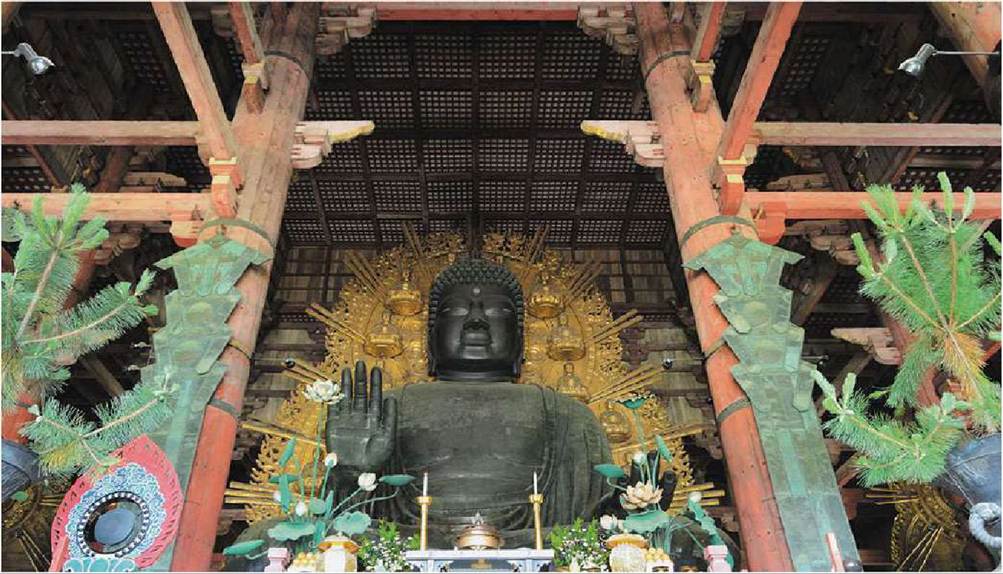
The Dainichi, or “Great Sun,” Buddha at Todaiji temple in Nara, Japan.
One interesting form of this Shinto-Buddhist merger at the folk level was the emergence of a lay Buddhist and occult Shinto group known as Shugendo (“The Way of Cultivating Magical Power”). Practitioners of this faith usually underwent austere training in the mountains to acquire mysterious powers of healing, divination, and exorcism. Commonly referred to as yamabushi (“those who sleep in the mountains”), Shugendo members were ascetics with no formal affiliation with either established Shinto or Buddhism but were revered as shamanic healers and exorcists, as well as guides for pilgrims making their way to remote sacred sites.
The convergence of Shinto, Buddhism, and Confucianism in Japan has been credited with the formulation of the samurai (“sword-wielding warriors”) code of conduct in premodem Japan. Known alternatively as Bushido (“way of the warrior”), this samurai ethic emphasizes purity of the heart and soul, contempt for pain and death, and undying loyalty to the ultimate lord of the land, the august emperor himself. It aims to combine the best elements of Shinto, Buddhism, and Confucianism within Japan’s cultural heritage.
The Modern Period
The modem period of Shinto history began with its attempt to recover its pristine past and its claim of superiority over the non-native traditions. Stirrings of this sentiment can be detected after the unsuccessful Mongol invasions of Japan in 1274 and 1281. The near disasters aroused in the Japanese a strong sense of national consciousness, resulting in a reinvigorated attachment to their native beliefs.
Sentiments showing strong advocacy of Japan’s special position and the emperors’ sacred nature based on Shinto beliefs were expressed by nationalists and royalists from the fourteenth century on. In a work entitled Jinno shotoki (Direct Succession of Gods and Sovereigns), published in 1339 by Kitabatake Chikafusa (1293-1354), the superiority of Japan and the divine status of the emperors were forcefully asserted: “Great Japan is the divine land (shinkoku). The heavenly progenitor founded it, and the Sun Goddess bequeathed it to her descendants to rule eternally. Only in our country is this true; there are no similar examples in other countries.”1With the rise of the Kokugaku (National Learning) movement in the eighteenth century, a call was made for Japan to return to the original beliefs and practices of ancient times before the introduction of “inferior” alien traditions such as Buddhism and Confucianism had contaminated Japanese culture. These concepts were advanced in the writings of Motoori Norinaga (1730-1801) and Hirata Atsutane (1776-1843).
Our country’s Imperial Line, which casts its light over this world, represents the descendants of the Sky-Shining Goddess [Amaterasu]. And in accordance with that Goddess’ mandate of reigning “forever and ever, coeval with Heaven and Earth,” the Imperial Line is destined to rule the nation for eons until the end of time and as long as the universe exists. That is the very basis of our Way. That our history has not deviated from the instructions of the divine mandate bears testimony to the infallibility of our ancient tradition. It can also be seen why foreign countries cannot match ours and what is meant by the special dispensation of our country.
—Motoori Norinaga
[A]s a special mark of favor from the heavenly gods, they gave birth to our country, and thus there is so immense a difference between Japan and all the other countries of the world as to defy comparison. Ours is a splendid and blessed country, the Land of the Gods beyond any doubt, and we, down to the most humble man and woman, are the descendants of the gods....
Japanese differ completely from and are superior to the peoples of China, India... and all other countries of the world, and for us to have called our country the Land of the Gods was not mere vanity.... This is a matter of universal belief and is quite beyond dispute.-—Hirata Atsutane
Meanwhile, with redoubled effort, the priests of the Grand Shrine at Ise actively promoted pilgrimage to the shrine by groups from all over Japan. This helped create a sense of national unity, binding all Japanese together under one common Shinto faith.
Ultranationalism, Imperialism, and Conflict
These efforts became a prime motivating force that eventually brought down the last feudal military government and ushered in an imperial Restoration in 1868. With the help of Shinto nationalism and deep respect for the imperial line, the fifteen-year-old Meiji emperor emerged from the shadow of centuries of domination of the royal family by military commanders to reclaim his divine right to rule. In 1870, the Meiji government proclaimed that “the way of the kami” would be the guiding principle of the nation. Reversing the previous Tokugawa military regime’s practice of requiring all households to register in Buddhist temples, the new government mandated every household to enroll in the shrine of the local kami. The government also actively encouraged Shinto funeral rites in a deliberate effort to deprive Buddhism of its monopoly in conducting funeral services. Indeed, Buddhism was forcefully separated from Shinto, and Buddhist monks who had been affiliated with Shinto shrines were ordered to return to secular life.
But it was the Meiji government’s promotion of the emperor cult that constituted the core of State Shinto. The emperor was venerated as a “living kami”—a god in flesh and blood. During the Meiji reign, a special shrine was built in Tokyo (formerly known as Edo), the seat of power of the just-toppled Tokugawa shogunate, which had become the new capital. The shrine, named Yasukuni Jinja (“Shrine for the Pacification of the Nation”), was dedicated to those who had sacrificed their lives for the royalist cause in toppling the last feudal regime and the restoration of imperial authority in 1868.
All of them had been elevated to kami status, as would others who were subsequently enshrined there after each of Japan’s foreign wars in the twentieth century, including the Russo-Japanese War of 1904-1905 and World War II. Because of its close association with State Shinto and the emperor cult, both of which have been blamed for Japan’s imperialistic expansion in Asia (the colonization of Taiwan and Korea in 1895 and 1910, respectively; the occupation of Manchuria in the 1930s; and the outright invasion of China and Southeast Asia during the Pacific Wars of 1937-1945), the Yasukuni Shrine has become a controversial symbol. That it also houses the remains of some of the most notorious government leaders and commanders at the end of World War II makes matters even more sensitive. Japan’s neighbors (China and Korea, in particular), who were victims of Japan’s ultra-nationalistic aggression in the first half of the twentieth century, invariably file official complaints whenever prominent Japanese political figures (such as the prime minister) pay formal visits to the Yasukuni Shrine.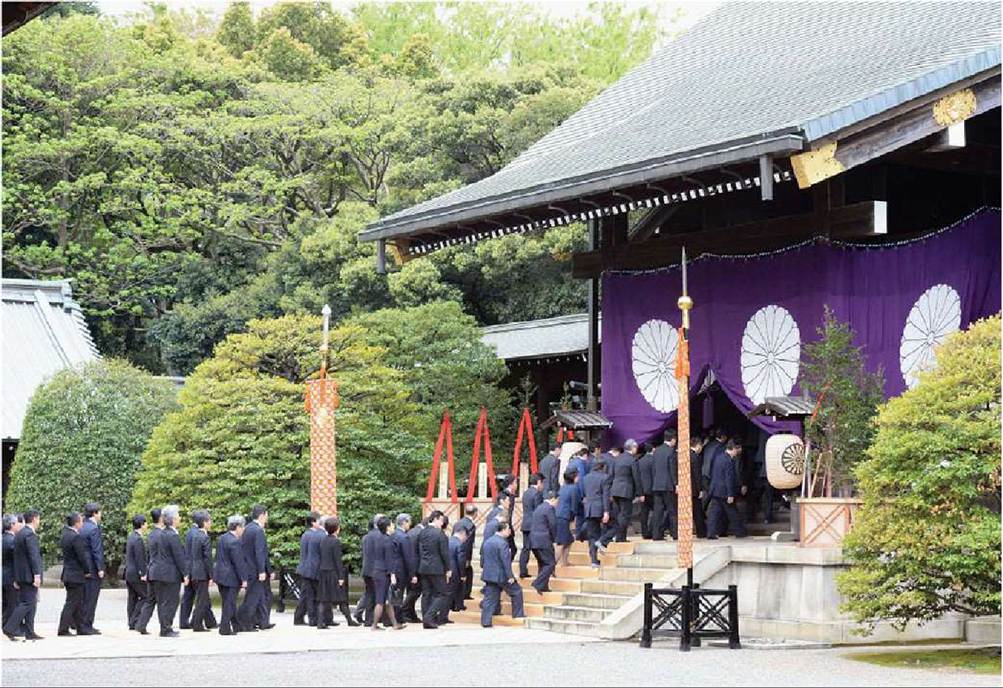
Japanese lawmakers from several political parties visit the war-linked Yasukuni Shrine in April 2017.
But the best illustration of the emperor cult in State Shinto was the building of the Meiji Shrine that began in 1915 and was completed in 1920. Constructed to enshrine the kami spirits of the late Meiji emperor and his wife, the shrine was a tremendous undertaking funded by the government. Located in the heart of Tokyo, the Meiji Shrine covers close to 200 acres of prime real estate, surrounded by elaborate gardens and wooded areas. It remains to this day a popular site for New Year’s celebrations and other festivals.
State Shinto has also been blamed for the fanatical nationalism among many Japanese, particularly among the rank and file of the military, during World War IL Japanese soldiers ravaged much of Asia in the name of their imperial ruler, Emperor Hirohito (r. 1926-1989). They considered their foreign aggression a divine mission, to be carried out without remorse or hesitation. Even when Japanese defeat appeared inevitable by the early 1940s, the military commanders sent suicide pilots to plunge their planes into Allied battleships in a desperate attempt to reverse the fortune of the war. Calling the pilots kamikaze (“divine wind”), they tried to evoke the memory of the Japanese defeat of the invading Mongol troops in 1274 and 1281 when allegedly the kami sent a divine storm (kaze) to protect the nation. State Shinto’s hold on Japan during those war years was gripping and overwhelming.
Sect Shinto
The modern period of Shinto also saw the rise of Sect Shinto and other new religions. A combination of Shinto, Confucianism, Buddhism, Shugendo, and folk beliefs, Sect Shinto arose at the end of the Tokugawa period and became popular throughout the Meiji period. Thirteen such sects have gained official recognition. Grouped with other eclectic religious organizations that arose in the 1920s and 1930s under the general categoiy of “New Religions,” they include such influential sects as Tenrikyo (“Teaching of Heavenly Principles”), Konkokyo (“Teaching of Golden Light”), and Kurozumikyo (“Teaching of the founder, Kurozumi Munetada” [1780-1850]).
Although different in doctrine and practice, these religious groups share a number of common features. Their founders were charismatic individuals steeped in the shamanic tradition of Shinto, the esoteric teachings of Buddhism, and a whole host of other folk beliefs. A noticeable number of them were women. Mostly of farming origin, they appealed to the anxiety and unease experienced by the lower classes during a time of rapid social change and political upheaval, as was the case in much of modern Japanese history. Explaining that calamity and disaster emanate from disturbances in people’s spiritual state, they offered their shamanic powers to bring peace, harmony, health, and prosperity to their followers. The emphasis on worldly benefits was often accompanied by the promise of the impending arrival of a new age and a new world. To impress the faithful and the larger society around them, they have built imposing headquarters and even whole cities of great beauty. Their teachings generally stress clean living, hard work, moral conduct, familial cohesion, and social solidarity. The sectarian nature of these groups has made their believers more fervent than members of the established traditions of Shinto and Buddhism.
After Japan’s surrender to the Allied Forces in 1945, the new Japanese Constitution maintains a strict separation between religion and state. Shinto is no longer the state religion, nor is the emperor any longer a kami. Today, the vast majority of Japan’s Shinto shrines are members of a voluntary organization named The Association of Shinto Shrines (Jinja Honcho) with no government sponsorship. The shrine at Ise, however, remains the ancestral shrine of the imperial family. Some Japanese blame Shinto for its support of the imperial cult that gave rise to Japan’s ultra-nationalistic militarism in the first half of the twentieth century, and resulted in the country’s defeat and devastation in 1945. At the same time, however, the imperial family continues to enjoy great affection from the majority of the Japanese people. Public reference to members of the emperor’s family, even children, has to be couched in honorific language, and great throngs of people visit the grounds of the Imperial Palace on New Year’s Day to greet the imperial family.
As the opening vignette involving the young man Satoshi Tanaka illustrates, most Japanese still live their lives very much shaped by Shinto beliefs and practices. Shinto values continue to give the Japanese people their sense of identity and aesthetics, as well as solace and comfort after disasters. In the aftermath of the 9.0 earthquake and its subsequent nuclear leak and devastating tsunami that wreaked so much havoc in northeastern Japan in March 2011, Shinto beliefs about life renewal and rejuvenation, as well as its emphasis on purification and decontamination, have provided the Japanese people with the purpose and resolve to carry out a massive program of reconstruction and revival of the stricken areas.
In an effort to maintain Shinto’s appeal to the younger generations, some shrines offer services that were unthinkable mere decades ago. The Washinomiya Shrine in Saitama Prefecture outside of Tokyo, for example, has become a mecca for devout fans of the popular anime series Lucky Star. The opening scene of the anime features the torii of this shrine, and two of the central characters are portrayed as sisters working as miko there. As a result, many loyal fans (mostly male) of the anime make pilgrimages there to take pictures of the spots where many of the actions take place and to offer prayer plaques (ema) to their favorite heroines. Likewise, the Tarojinja Shrine in Okayama Prefecture is the setting for the hugely popular science-fiction anime series Tenchi Muyo! The central character is a high school student whose grandfather is a priest at the Tarojinja. The shrine has also become a pilgrimage destination for fans of the anime series. To pique the interest of the pilgrims, the shrine sets up “Tenchi-bako (boxes)” whose doors can only be opened when trivia quizzes about the series are answered correctly. Fans can then leave messages and draw illustrations in the “Tenchi Notebooks” found inside. Two different Kamado Shrines in Kyushu have become favorite sites of worship and sightseeing by fans of the recently wildly popular manga series (and subsequently anime film) Kimetsu no Yaiba (Demon Slayer), whose principal protagonist is named Kamado Tanjiro. According to one survey, at least thirty shrines across Japan have become pilgrimage destinations after being featured in anime. Additionally, a “power spot boom” has swept across Japan in recent years. Power spots are believed to be sacred locations considered to possess a strong invisible energy that elevates the consciousness of their visitors to a higher plane. Various popular guidebooks on these sites have been published, and lavish tours have been organized to allow the faithful to travel to these places for spiritual transfusion and personal fulfillment.
Self-Assessment 9.2
[Please note: You must be using an online, browser-based eReader in order to view this content.]