9 Shinto
Jeffrey Brodd
California State University, Sacramento
Layne Little
University of California, Davis
Bradley Nystrom
California State University, Sacramento
Robert Platzner
California State University, Sacramento
Richard Shek
California State University, Sacramento
Erin Stiles
University of Nevada, Reno
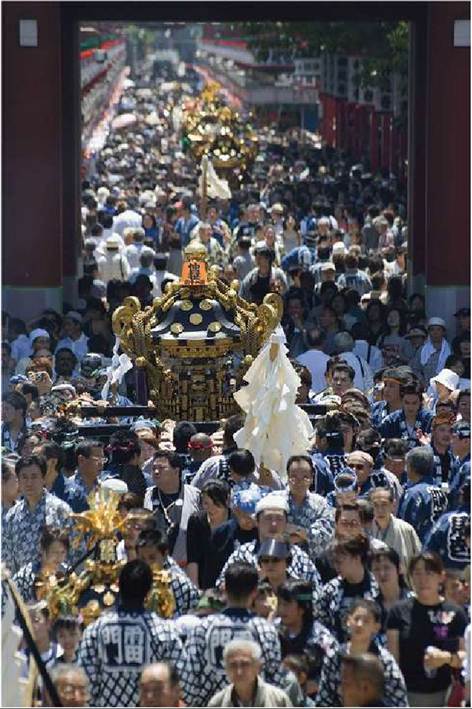
Throngs of portable shrine carriers: Throngs of portable shrine carriers with their respective mikoshi outside the Asakusa Shrine in Tokyo.
IT IS THE LAST DAY of the three-day Sanja Festival in Asakusa, a historic precinct in Tokyo. The climax of the festival is the wild parading of mtfcoshi, portable shrines carrying the "essence” of the patron deities of the various neighborhoods and merchant groups. As one of the most popular annual festivals in Tokyo, the Sanja Festival attracts upward of half a million spectators and participants during the three-day festivities.
At 5 a.m. on the third Sunday in May, Satoshi Tanaka, a young grocery clerk in his twenties, is waiting expectantly outside the Asakusa Shrine. Along with hundreds of other young men (and some equally enthusiastic young women), he has signed up months in advance to be a member of a team of shrine carriers sponsored by a local merchant group. Though ordinarily preferring to sleep late, Satoshi finds himself excited and alert this morning. Dressed in colorful shirt and shorts with matching headbands, he waits with others to receive their purification by the Shinto priests so that he will be considered spiritually clean and ready for the sacred task ahead. Even though he does not see himself as a seriously religious person, Satoshi feels perfectly comfortable in being a shrine carrier at this Shinto festival. It is his way of being Japanese and participating in the activities of his community.
The job of these carriers is to carry the mikoshi through the streets of Asakusa so that all in attendance can share a moment of communal solidarity as well as intimacy with the deities temporarily housed in these portable shrines. These ornately decorated mikoshi rest on poles that are carried on the shoulders of the carriers. Shouting and grunting in unison, to the accompaniment of much drumming, cymbal clanging, and loud cheers from the crowd, the carriers attempt to move the portable shrines along. But because no one among them is in total control of the direction of the mikoshi, all the carriers move back and forth or sideways more or less blindly. The movement of the portable shrines can thus be wild and unpredictable, subject to the unconscious collective will of the entire group of carriers (or, supposedly, that of the deities inside). This cumbersome and potentially dangerous parade lumbers down narrow streets and broad boulevards amid large crowds.
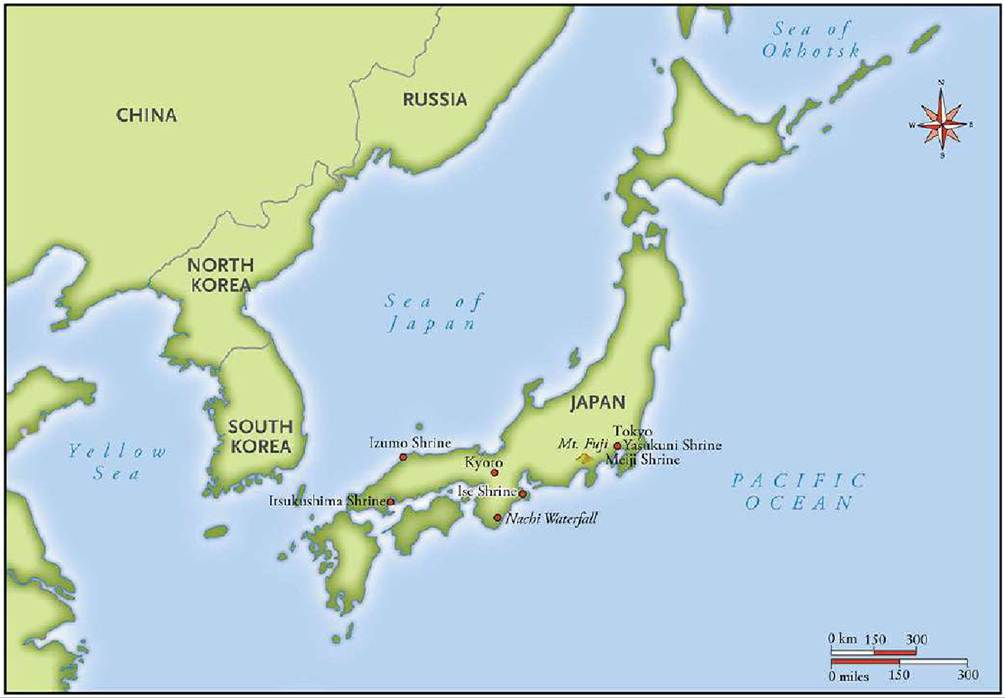
Significant sites in the history of Shinto.
Click here to learn more in an interactive map.
Quite frequently, one shrine will cross paths with another, resulting in great commotion and competition for attention from the throngs of spectators. Sweating profusely and hoarse from too much shouting and chanting, individual shrine carriers drop out and are quickly replaced without disrupting the progress of the shrines. Thirsty and hungry, the temporarily retired carriers sit or lie on the ground in total exhaustion. Meanwhile, the spectators watch, take pictures, applaud, cheer, visit the main shrine, purchase the sundry food, drink, and souvenirs offered by enterprising street vendors, and make a day of it.
TIMELINE
Shinto
| 10,000- 300 BCE* | Jo'mon period. |
| 300 BCE- 300 CE* | Yayoi period. |
| 300-500 CE* | Kofun period. |
| 538* | Introduction of Buddhism and Confucianism, possibly also Daoism, to Japan. |
| 593 | Prince Shotoku becomes regent. |
| 712 | Kojiki (Record of Ancient Matters) completed. |
| 720 | Nihon-shoki or Nihongi (Chronicles of Japan) completed. |
| 794 | Heian (present-day Kyoto) becomes the permanent capital. |
| 1185 | Beginning of samurai rule in Japan. |
| 1339 | Kitabatake Chikafusa publishes the Jinno shotoki. |
| From 1750s* | Rise of Kokugaku (National Learning, Neo-Shinto). |
| From 1780s* | Birth of founders of New Religions. |
| 1868 | Meiji Restoration begins; creation of State Shinto. |
| 1937 | Beginning of Pacific War, fought in the name of Emperor Hirohito. |
| 1945 | Japan surrenders to Allies; State Shinto ended. |
| 1946 | Emperor Hirohito renounces his divinity. Shinto is recognized as one of several religions in Japan, receiving no special government support. |
Note: Asterisks indicate contested or approximate dates.
Click here to learn more in an interactive timeline. The preceding scene is typical of a matsuri, a centuries-old Shinto festival in Japan that helps to create religious awareness and social solidarity within the entire community. The matsuri is both a religious and a social occasion. Though the oldest surviving religion in Japan, Shinto has, by and large, coexisted with and been profoundly influenced by Buddhism and Confucianism since the sixth century ce. The two latter traditions were introduced into the country from China by way of Korea. Although the three religions have been rivals and competitors over the centuries, they have also experienced accommodation and mutual acceptance. There is an observation about Japanese religious behavior that describes perfectly the eclectic attitude of the Japanese. It says that the Japanese are born and wed in Shinto, die Buddhist, and live in accordance with Confucian ethical principles. In other words, most Japanese do not see the three religions as mutually exclusive or incompatible. Rather, they regard them as mutually reinforcing and relevant in separate aspects and stages of their lives. For this reason, it is impossible—and meaningless, to have an accurate count of Shinto believers in Japan or worldwide. We therefore do not provide a map showing global distribution of Shinto adherents in this chapter. Instead, we invite you to get acquainted with the beliefs, history, and ritual practices of this Shinto tradition as it intersects with the Confucian and Buddhist traditions.