The Teachings of Christianity
By the first century, Palestinian Jews had endured centuries of oppression under foreign conquerors, always struggling to preserve their unique religion and culture. Their situation became especially dangerous with the arrival of the Romans (63 bce), whose brutality fueled a bitter resentment that ultimately led to a Jewish rebellion.
Tragically, the revolt ended with the destruction of the Jerusalem Temple, the center of Jewish religious life, in 70 ce.As we have seen in Chapter 11, Jewish groups responded to these pressures in different ways. Pharisees defended Jewish tradition through strict observance of the Torah. Sadducees cooperated with the Romans in the hope of preserving social stability. Zealots advocated antiRoman violence. Essenes withdrew to the desert lands outside Jerusalem to wait for divine deliverance.
Believing that God would soon bring an end to unrighteousness, many Jews looked for the coming of a messiah who would inaugurate a new era of justice and peace. Originally, messiah (“anointed one”) was a title given to Israel’s kings, who were anointed with oil as a sign of God’s favor. Later, it came to mean the deliverer God would “anoint” to save the Jewish people from oppression. Some looked for a supernatural messiah. Others watched for a descendant of David, ancient Israel’s greatest king. Most believed the Messiah would rule as king and judge the wicked and the righteous.
The first Christians were Palestinian Jews who believed that Jesus of Nazareth was the Messiah—in Greek, the Christos, or “Christ.” They proclaimed him as a deliverer not from earthly oppression but from the power of sin. In Jesus, they saw the beginning of a new era of righteousness and peace evident in his teachings, miracles, death, and resurrection.
The Life of Jesus
Our most important sources for the life and teachings of Jesus are the gospels of Matthew, Mark, Luke, and John.
Written between 70 and 100 ce, the gospels are early Christian proclamations of the “good news” (gospel, from Middle English godspel, translates the Greek evangelion, “good news”) about Jesus’s teachings, suffering, death, and resurrection. Because their interests are more theological than biographical, the gospels leave much unsaid about the life of Jesus. Still, their essential agreement on many points allows us to establish the general outlines of his career and teachings.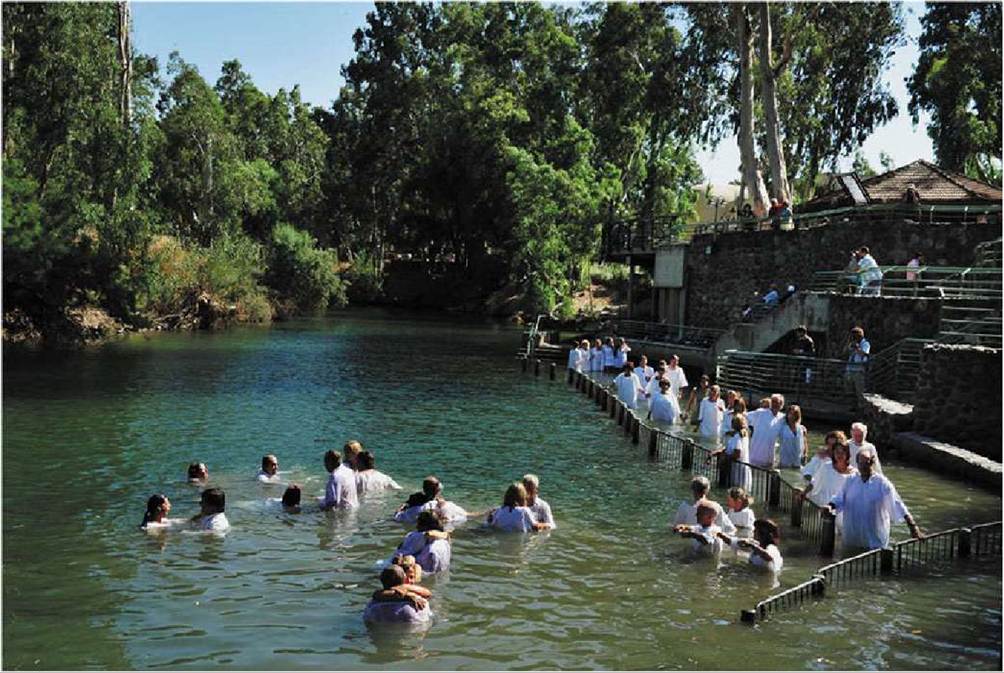
Mass baptism of Christians at Yardenit, the site on the Jordan River in northern Israel where Christian tradition says Jesus was baptized by John the Baptist.
The gospels report that Jesus was horn in the Judean city of Bethlehem. We cannot be certain of the date; Matthew suggests that Jesus’s birth occurred before 4 все, Luke by 1 все. Jesus spent his youth in the Galilean village of Nazareth. At about the age of thirty, he made his way south to the Judean wilderness, where he was baptized by John the Baptist in the River Jordan. A prophetic figure who warned of God’s imminent judgment, John called on sinners to repent and be baptized in water as a sign of spiritual cleansing.
After his baptism, Jesus began a ministry that lasted no more than three years. The gospels say that as he traveled throughout Galilee he performed healings and miracles that testified to God’s presence within him. The gospel accounts also describe Jesus as a charismatic teacher who spoke with authority on the scriptures and urged repentance and baptism in anticipation of the coming kingdom of God, a new era of peace and holiness. Jesus was accompanied by an inner group of disciples, sometimes called “the twelve,” led by three Galilean fishermen (Peter, James, and John), as well as by people from towns, villages, and the countryside. There were also Galilean women among Jesus’s disciples who supported his ministry with their own resources.
Indeed, women figure prominently in the gospel accounts of Jesus’s ministry. Rejecting the social norms of his time, he befriended women and spoke and ate with them both in public and in private. When even the twelve abandoned Jesus in his final days, it was only the faithful women among his followers who remained with him.As enthusiasm for his teachings and miracles grew, Jesus’s popularity aroused resentment and opposition among members of the religious establishment. Jesus himself appears to have understood that dark days lay ahead. As he prepared to leave Galilee for Jerusalem, he warned his disciples that rejection, suffering, and death awaited him there.
Jesus arrived in the holy city just before Passover in or around 30 ce. The gospels describe a triumphal entry in which crowds greeted him as the Messiah. Entering the Temple, he caused a great stir by driving out those who did business there, accusing them of making the sacred place a “den of robbers.” For several days Jesus taught in the Temple, but then events took an ominous turn. After celebrating a “Last Supper” (perhaps a Passover Seder meal) with his disciples, Jesus was brought before a council of Jewish leaders and then handed over to Pontius Pilate, the Roman governor. Fearing that Jesus was a threat to public order, Pilate ordered his execution. Jesus was crucified less than a week after he had entered Jerusalem.
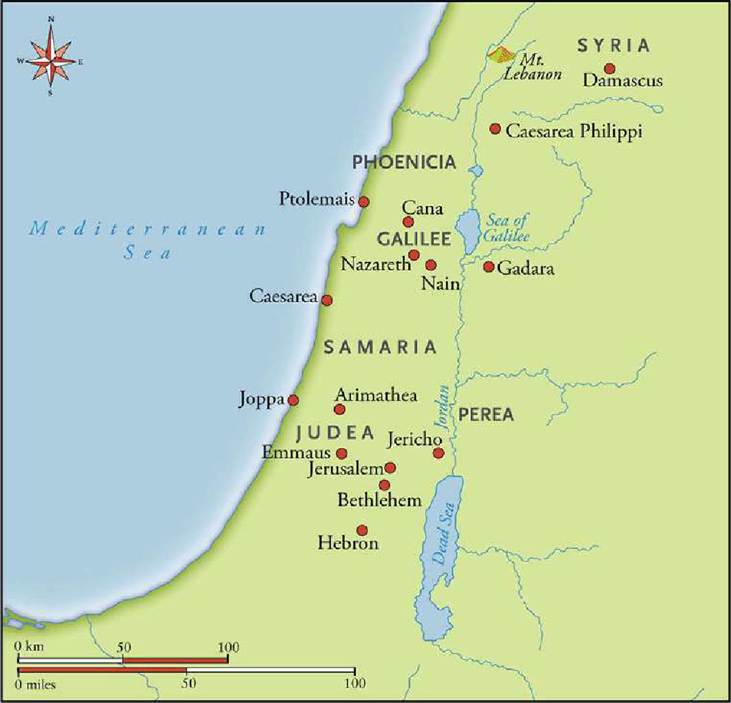
Palestine during the time of Jesus.
Click here to learn more in an interactive map. The gospels add theological reflections to this historical outline. Matthew and Luke assert that Jesus’s mother, Maiy, was a virgin who conceived miraculously in fulfillment of prophecy (Isaiah 7:14). All four of the gospels say that the Spirit of God, or the Holy Spirit, descended upon Jesus at the time of his baptism. According to Matthew, Mark, and Luke, a voice from heaven then declared: “This is my Son, the Beloved, with whom I am well pleased” (Matthew 3:17).
In this way, the gospels link Jesus to King David, who is described in Psalms 2:1-7 as God’s “anointed” and “son.” The gospels also identify Jesus as the “servant” of God who would suffer for the sake of humanity, as foretold by one of Israel’s prophets (Isaiah 42:1-4; 53:10- 12). Finally, the gospels report that women who had followed Jesus found his tomb empty at dawn on the Sunday following his crucifixion. They and the other disciples were overjoyed when Jesus appeared to them and they remembered what he had once told them: “The Son of Man must undergo great suffering, and be rejected by the elders, chief priests, and scribes, and be killed, and on the third day rise again” (Luke 9:22). Convinced that Jesus was indeed God’s Messiah, they began to proclaim the good news that God had acted through him for the salvation of the world.According to the Acts of the Apostles (found in the Christian scriptures), Jesus remained with his disciples for forty days after his resurrection. Then, having sent them out as apostles (Greek apostolos, “one who is sent out”) to preach to Jews and Gentiles alike, he ascended into heaven. Several days later, as they celebrated the Jewish holiday of Pentecost, Jesus’s followers were suddenly “filled with the Holy Spirit,” the same Spirit of God that had descended upon Jesus at his baptism (Acts 2:2-4). Empowered by the Spirit to carry out the mission Jesus had given them, they found themselves able to speak in languages they had not known before, to prophesy, and to perform miraculous healings. According to Acts, the number of believers grew rapidly, for “many wonders and signs were being done by the apostles” (Acts 2:43). Acts also reports that the first Christians spent “much time together in the temple” (Acts 2:46), reminding us that they were Jews who continued to live and worship as Jews. It did not occur to them that their belief that Jesus was the Messiah had given them a new religious identity outside of Judaism.