12 Christianity
Jeffrey Brodd
California State University, Sacramento
Layne Little
University of California, Davis
Bradley Nystrom
California State University, Sacramento
Robert Platzner
California State University, Sacramento
Richard Shek
California State University, Sacramento
Erin Stiles
University of Nevada, Reno
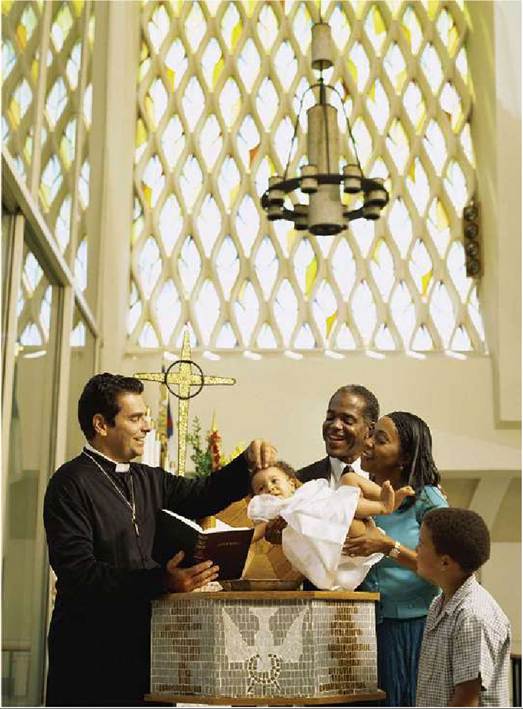
A priest baptizes a baby girl as her family looks on.
STEVE AND RENEE WALKER have had a lot to look forward to during the past two years. First, there was the long-awaited arrival of little Simone, who brings gladness to her parents and her brother, Brent. Today there will be another exciting event as the Walkers present Simone for baptism into a spiritual family that Christians call the Church.
Whereas some Christians prefer to baptize adult believers who understand and accept the essential teachings of Christianity, others such as the Walkers believe that baptism is a special means by which God’s love begins to grow even within small children. Wanting Simone to be touched by God in this way, they have arranged for her baptism to take place at St. James’s Episcopal Church, where they have found friendship and fellowship with others.
Now the church is filled with worshipers whispering quietly in rows of pews while waiting for the service to begin. When it does, the organist fills the building with resplendent strains of music that seem to shake its foundations, the congregation launches into a favorite hymn, and a procession of clergy makes its way to the front of the church. After welcoming everyone, the priest, Father Robert, pronounces a blessing upon them. Then all eyes turn toward the baptismal font, an elevated basin of water. Steve, Renee, and Brent are waiting there, with Renee holding Simone in her arms.
Father Robert now enters into a formal dialogue with Steve and Renee, asking if they will bring up Simone in the Christian faith, if they renounce evil in all its forms, and if they put their trust in Jesus Christ. Answering for themselves and on behalf of Simone, they respond affirmatively. Then, dipping a small silver cup into the water of the baptismal font, Father Robert pours a bit of it three times on Simone’s forehead. As he does so, he says, “Simone, I baptize you in the name of the Father, and of the Son, and of the Holy Spirit. Amen.” Then, placing his hand on Simone’s forehead, he marks the sign of the cross and adds, “Simone, you are sealed by the Holy Spirit in baptism and marked as Christ’s own forever. Amen.”
Now that the baptismal ritual is complete, Simone’s family returns to their seats to await the end of the service. Soon they will be on their way home to join friends and relatives for a festive dinner and celebration of the new life that Simone will live, not just with the Walker family but in communion with more than 2 billion Christians worldwide.
There are three great traditions within Christianity. Historically, the Roman Catholic Church has been the dominant church in the West. In the East (for the purposes of this chapter, the region extending from the Adriatic Sea to the Middle East), most Christians have belonged to the Orthodox Church (also known as the Eastern Orthodox Church). Protestant Christianity, which consists of thousands of “denominations,” grew out of the Roman Catholic tradition in the sixteenth century. Although these churches have been shaped in different ways by complex historical and cultural forces, they are united by shared beliefs that lie at the heart of Christianity. Christians acknowledge a personal and transcendent God, the creator and sustainer of the universe. The Christian doctrine of the Trinity describes God as one in essence but consisting in three “persons”: Father, Son, and Holy Spirit. Christians believe that communion with God, in this life and in eternity, is the ultimate purpose of human existence.
But there is an obstacle to be overcome: sin. The violation of God’s will in thought or action, sin is common to all humanity. Worse, sin separates the individual from God. What is needed is the forgiveness that God gives to all who believe that the sacrificial death of Jesus Christ, the Son of God, atoned for all sin. For Christians, the sacrifice of Christ is the supreme expression of divine love. Similarly, they see in his resurrection and ascension into heaven a sign that not even death can separate from God those who respond to God’s love. Although they remain imperfect, Christians believe that the destructive power of sin is no longer the primary force in their lives, for they have been baptized into a new “life in Christ.”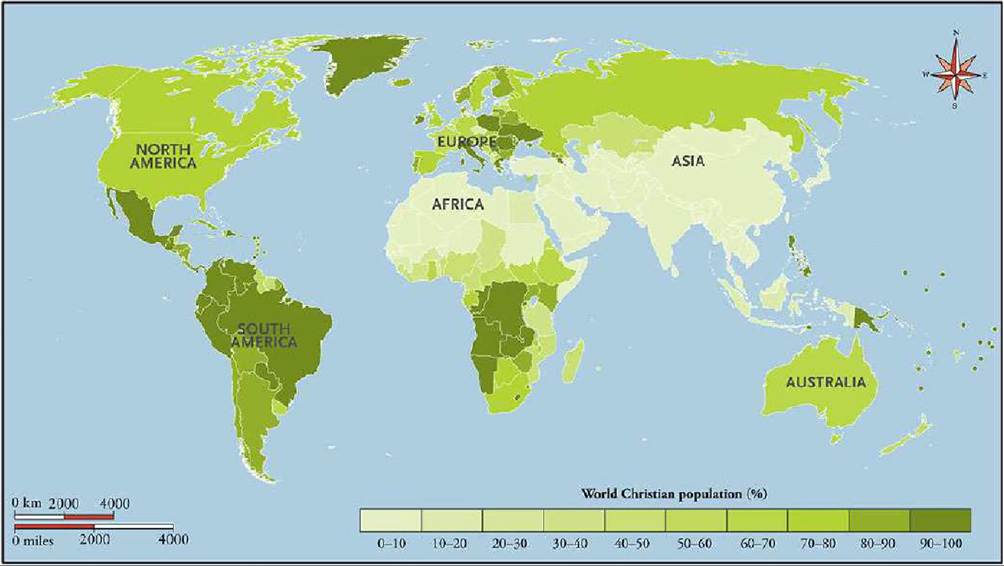
World Christian population.
TIMELINE
Christianity
| C. 30 CE | Crucifixion of Jesus. |
| c. 46-62 | Paul’s missionary journeys. |
| 70-100 | Gospels of Matthew, Mark, Luke, and John written. |
| 313 | Constantine decrees religious freedom for Christians. |
| 325 | Council of Nicea declares God the Son to be “of the same substance as God the Father.” |
| 354—430 | Augustine of Hippo, first great theologian of the West and author of the Confessions and City of God. |
| 367 | Contents of New Testament established. |
| 529 | Benedict of Nursia writes the Benedictine Rule. |
| 949- 1022 | Simeon the New Theologian and the beginning of Hesychasm. |
| c. 1000 | Conversion of Russia to Orthodox Christianity begins. |
| 1054 | The Great Schism divides the churches of East and West. |
| 1095- 1272 | Western Crusaders repeatedly attempt to free the Holy Land from Muslim rule. |
| 1184 | Pope Lucius III inaugurates the Inquisition. |
| 1198- 1216 | Height of papal power under Innocent III. |
| 1265- 1274 | Thomas Aquinas writes the Summa Theologica. |
| 1453 | Constantinople, capital of the Byzantine Empire, falls to the Ottoman Turks. |
| 1517 | The Protestant Reformation begins when Martin Luther posts his Ninety-Five Theses. |
| 1534 | King Henry VIII establishes Church of England. |
| 1545- 1563 | Council of Trent, at which the Roman Catholic Church responds to the Protestant movement. |
| 1647 | George Fox founds the Society of Friends (Quakers). |
| 1703- 1791 | John Wesley, founder of the Methodist movement. |
| 1804— 1814 | Napoleon, Emperor of the French, acts to strip the Roman Catholic Church of its influence. |
| 1834 | The Spanish Inquisition, the last stage of the Inquisition, is formally abolished. |
| 1869- 1870 | First Vatican Council declares doctrine of papal infallibility. |
| 1948 | Founding of the World Council of Churches. |
| 1962- | Second Vatican Council. |
| 1965 |
Click here to learn more in an interactive timeline.
Click here to compare to other Abrahamian religions.
\.
We begin our investigation of Christianity with a survey of its teachings. We then trace the history of Christianity from the earliest days after the death of Jesus to the present time. Finally, we explore the practices by which Christians give outward expression to their beliefs in their daily lives.
More on the topic 12 Christianity:
- Contents
- The culture of early modern Europe was suffused with violence. Christianity's central event prior to the Reformation, and in the case of the Roman Church through the centuries that followed, was the violent death of Christ on Calvary,
- The Conflict Between Judaism and Christianity
- Prospects of World-wide Christianity Today
- Printmaking and Reformation
- Where We Stand Today
- 26 Limitations on the Reception of Jewish Converts to Christianity Seeking Asylum in Churches Arcadius (and Honorius)
- The Spirit as Mother in Early Syriac-Speaking Christianity
- The Teachings of Christianity
- ANCIENT GREECE, CHRISTIANITY, AND HUMAN NATURE