Printmaking and Reformation
The first widespread use of prints, either in the form of single-leaf woodcuts or as woodcuts or engravings used to illustrate pamphlets, occurred in the
Visualising Violence in Reformation Europe service of the early German Reformation movement.
The most important, if not only, aim of these prints was propaganda, to demonstrate the violence of the Roman Church against its members, and the necessity of uncovering the disguises and subterfuge the clergy used to trick and confuse the faithful. So the pope and cardinals were frequently depicted as ravenous wolves who break into the sheepfold and devour the flock of Christ; or as devourers of the dead, shown with body parts hung up to dry, or as carving up cadavers for a feast.1 Melchior Lorch's 1541 engraving, The Pope as a Wild Man, for instance, which displayed a double-headed monster brandishing an uprooted tree as a club while spewing flames with toads, lizards and reptiles out of its mouth, embodied the destructive and ultimately diabolical power that the pope claimed to possess (Figure 32.2). Alternately, violent fury was shown being unleashed on the Roman clergy: monks were turned on by the hunted and driven into the mouth of hell; clerics were paraded as captives; the pope and his cardinals were strung up on gallows, pounded and crushed in large tuns, ground and refined in mills to reveal their true nature, or trampled underfoot by a victorious risen Christ. These images were meant to be instructive, identifying enemies and their deceitful strategies for maintaining power; but they were also meant to demonise, and thereby neutralise, that power, and to incite viewers to act against it.[938] [939]Violent punishment was also graphically depicted in images of Christian martyrs and martyrdom. Martyrdom had certainly been a staple of Christian iconography through the medieval period, such as in the flaying of St Bartholomew or the beheading of St Catherine of Alexandria.
But it achieved new prominence in the second half of the sixteenth century, in a Europe caught up in confessional conflict between resurgent Catholic powers and those who now identified with the various Protestant Churches. For Catholics as well as Protestants, martyrdom was represented as an emulation of Christ's death and therefore a model for Christian life. Images of ancient martyrdom proliferated through printed images, as in Antonio Gallonio's 1594 work describing the various forms of martyrdom illustrated by Antonio Tempesta. The ancient martyrs were also supplemented by the more recent, as in the thirty-four martyr murals created by Circignani for the Jesuit English College in Rome in 1584, which were also replicated in engravings by Giovanni Battista de Cavalleriis.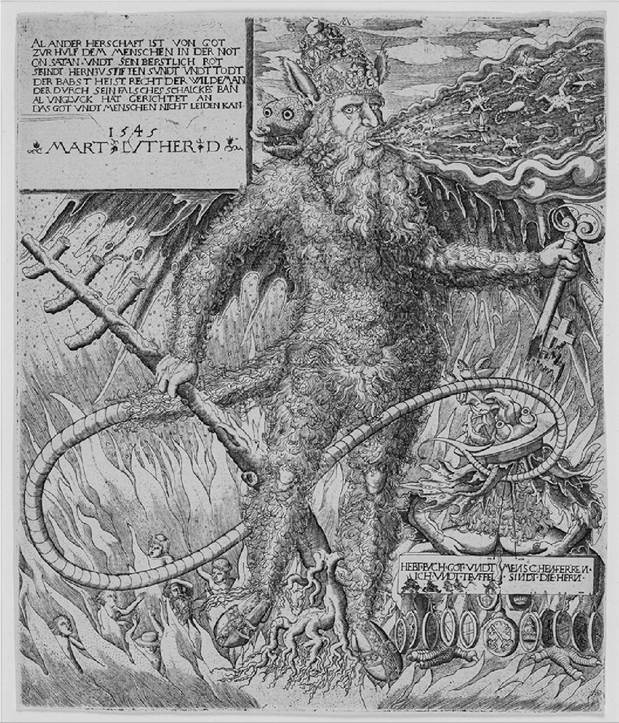
Figure 32.2 Melchior Lorch, The Pope as a Wild Man, engraving, 1541.
For Protestants also, the violence of martyrdom was central to the elaboration of their group identity and was maintained and reproduced through the literary and visual memory of their persecuted history. John Foxe's Actes and Monuments, commonly known as the Book of Martyrs and first published in 1563, is a prominent example. The first edition of the book contained sixty woodcuts that illustrated the violent persecution of the true church ‘of these Latter and Perillous Days' in England and Scotland. By the second edition of 1570 there were 150 woodcut illustrations that accompanied the ‘general
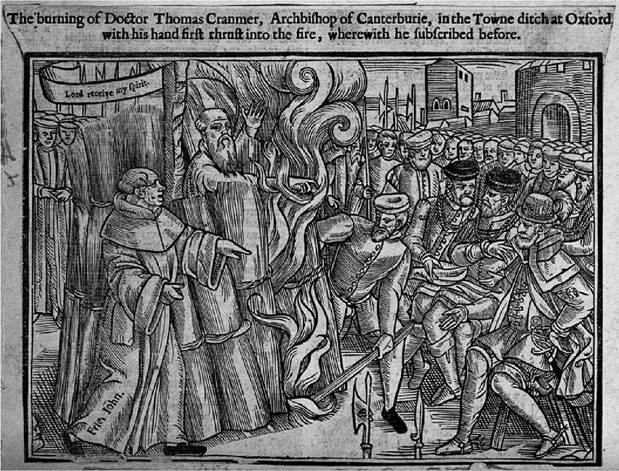
Figure 32.3 Anonymous, The death of Thomas Cranmer at the stake, burned for heresy in 1556, woodcut, originally published in John Foxe's Actes and Monuments.
discourse of these latter persecutions, horrible troubles and tumults styred up by Romish Prelates in the Church'. The illustrations included graphic depictions of the tortures, hangings, garottings and burnings endured by Lollards and Hussites in earlier centuries and recent Protestant martyrs at the hands of Queen Mary (Figure 32.3).
They were clearly meant to elicit strong feelings of horror at the long history of cruel persecution of true Christians, but also wonder and resilience at the martyrs' strong faith. Foxe's work was extremely popular, and was reprinted six times by 1610. According to the English Jesuit, Robert Persons, the visual images were crucial for its popularity, Persons claiming that ‘the bayte of pleasant historyes, fayre pictures and painted pageants' deceived the souls of the simple.[940]The new print media brought about an expansion not only in the number of images but in the range of subjects they covered. This was especially the case with illustrated broadsheets. These were created to spread propaganda, to contribute to political or religious debate, to support territories in times of upheaval and war, to satirise or aggrandise political rulers and their policies or to report on current events. With their large and sometimes crude images and minimal text, broadsheets (or news-sheets, Neue Zeitungen, as Germans called them) circulated through Europe at previously unheard-of speeds, bringing new images of violence into inns and town squares and enabling access to a much broader audience, either through direct purchase or through later oral communication and visual display. For broadsheets could respond and adapt far more quickly to particular events or collective fears. So from the mid sixteenth century an increasing number of broadsheets brought all manner of news reports of wondrous, terrifying and gruesome events. One of the largest contemporary collections of such broadsheets and other similar hand-written reports was the so-called ‘Wonder Book' of the leading pastor of the Reformed Swiss Church in Zurich, Johann Jakob Wick, compiled between 1560 and 1587, the year before Wick's death.[941] The woodcuts and engravings in more than 800 printed pamphlets and single-page broadsheets, and 1,028 pen and ink drawings in thousands of handwritten documents provide some sense of the various forms of violence experienced by the population of sixteenthcentury Europe.
Among the most common subjects found in the Wick images are those depicting violent destruction caused by natural disasters such as floods, earthquakes, storms, lightning strikes, avalanches and freezing weather, which commonly brought crop failure, famine, disease and death in their wake. For the period when this collection was compiled was a time of dramatic cooling associated with the Little Ice Age, which struck most of Europe between 1560 and 1650, reaching its peak in western Europe between 1565 and 1628. Such disasters were most commonly viewed as having God as their primary cause: they were instruments of divine punishment for human sin, the boiling over of God's fury, and warnings of more possible destruction to come. The meteorological disorders were marked by terrifying and violent images in the sky - such as blood rain, dragons spewing fire, bloodied men in armour with fiery swords, armies arraigned for battle. In some images of calamitous lightning strikes, God the father is shown in the sky within a perimeter of thick clouds from which flames radiate out to set the city's buildings ablaze. Together with their accompanying narratives, these images were meant to demonstrate the frightening nature of what Wick calls ‘our miserable times', his belief that these were indeed signs of the Last Days.[942]