Crime and Punishment
The increasing number of violent murders and horrific crimes constituted another sign for Wick that the world was living through the End Time. So the Wick images feature numerous depictions of murder.
There are assassinations of rulers; the stabbing and shooting of neighbours; husbands murdering their pregnant wives, mostly by stabbing, but also by defenestration and drowning them in wells; wives killing husbands with knives, poison, and one with a hammer; fathers stabbing their own children, one decapitating his son with an axe; a son setting his mother alight in her bed, while another kills his mother with a hoe. Clerics are shown murdered at the altar, while others engage in murder themselves. Especially gruesome are the annihilations of whole families, frequently followed by the suicide of the perpetrator, or murders involving the dismemberment of victims, in some cases preceded by rape. While Wick included these murder stories and had them illustrated in order to support his claims about the End Time, we know they were generally very prominent in pamphlets and broadsheets of the time as attempts to imbue feelings of disgust, to justify harsh punishment, as well as to entertain.The harsh punishment for terrible crimes was frequently included in the depiction of those crimes, whereas some images focused on the punishment alone. Hanging or beheading were the most common forms of capital punishment for murder, but a man who killed his nephew and decapitated his son, and another who dismembered the body of his wife, are shown being broken on the wheel, a punishment reserved for especially heinous crimes. These were spectacles of punishment, and the representation on paper aimed to reinforce the message that the severity of the crime would be matched by the punishment. So a man who killed a couple and then burnt them in their bed is shown first broken on the wheel and then burnt; a priest who killed a woman in the process of giving birth is boiled in oil; a woman and her maid who smashed the head of her husband with a hoe are buried alive and impaled.
The notorious 1585 case of an innkeeper from Wangen, Blasi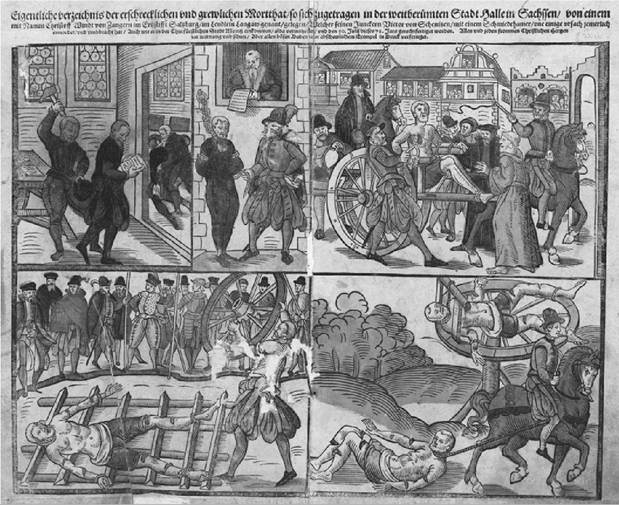
Figure 32.4 Anonymous, The condemnation and execution of Christoff Windt, coloured woodcut, in Eigentliche Verzeichnis der erschrecklichen und grewlichen Mortthat (Magdeburg: Leonard Gerhart, 1572).
Endres, who murdered his wife, his three children, a servant and two maids, had his flesh ripped with red hot pincers seven times and the hand with which he had committed the murders cut off; he was then broken on the wheel, and finally impaled on a spit that was mounted on a wheel for all to witness his terrible and shameful punishment.[943] Such rituals of mutilation and shaming were sometimes depicted in considerable detail, such as in a ‘comic strip' broadsheet depicting Christoff Windt's murder of his noble master Victor von Schenitzen in the city of Halle in 1572 (Figure 32.4). First there is the murder scene, followed by the reading out of his sentence by the judge. Then Windt undergoes shameful mutilation with hot pincers, all in full public view of the citizens peering out at the scene in the city square. Next, the executioner breaks Windt's arms, legs and spine with the wheel; and finally, Windt's mutilated body is dragged by the executioner's horse to the place where the wheel is to be mounted, and his broken limbs are threaded onto the wheel and his head lifted with a rope, so that his body is fully exposed to carrion - the ultimate act of degradation.[944]
As broadsheet images could quickly circulate news of terrible crimes, so they could be tactically employed to create panic about the crimes of social groups or foreign enemies. The nature of witches as violent and cruel, for instance, was partly disseminated through visual imagery. In the Wick drawings and broadsheets the violence is primarily limited to the harsh punishments exacted by authorities.
But in other prints, bones and body parts represent witches' violence, and from the 1590s witches are depicted dissecting corpses and cooking children - a savagery that reaches a high point in the drawings of Jacques de Gheyn II (1565-1629).[945] Similar murderous crimes are ascribed to Jews. A telling example of this bond between Jews and witches is found in a 1585 drawing by the Swiss artist Christoph Murer, which is then copied, etched and reproduced as a stained-glass window for the Nuremberg city council. Witch andJew, as personifications of Envy and Avarice, are shown attacking a goldenhaired Christ child chained to a slab as a personification of Innocence - similar to many images of the child-martyr Simon, beatified as a supposed victim of ritual murder by the Jews of Trent in 1475.[946]Another traditional enemy of Christianity was the Turk. Images of Turkish cruelty became prominent in the second and third decades of the sixteenth century, as Turkish armies advanced on the eastern perimeters of the Habsburg Empire and ultimately laid siege to Vienna in 1529. The cruelty also focused on children, often drawing quite specifically on well-known visual motifs from the Massacre of the Innocents iconography. The title page of a 1529 pamphlet relating the destruction caused by Ottoman military advances on the outskirts of Vienna, for instance, depicts three soldiers each holding an infant, while one uses his sword to slit open the child he holds upside down. The woodcut had been recycled from a work on fifteenth-century prophecies published two years earlier, and was to be recycled once again in 1572, on the title page of a pamphlet describing the massacre of St Bartholomew's Day in Paris. A similar image of Turkish cruelty is found in a 1530 single-leaf woodcut by the Nuremberg printmaker, Erhard Schon. It depicts Ottoman soldiers impaling babies on stakes and slicing them in half, while their murdered mothers lie prostrate on the ground below (Figure 32.5). Cruel acts such as the impalement of babies (also found in examples of The Massacre of the Innocents) became iconic images for the ‘gruesome Turk', demonstrating a callous lack of compassion and the danger to the moral and social order. They were also intended to arouse strong resistance against the Ottomans at times of overt conflict, and continued to be produced throughout Europe until the end of the seventeenth century when the threat of invasion ceased.