Soldiers and Battle
Battle scenes constitute one of the most significant subjects for the visualising of violence. The fascination of artists with soldiers and war was partly driven by developments in arms technology and armour design, and partly by the desire of their patrons to emulate the glory and valour of the ancients.
Much of the imagery of warfare, especially in the first half of the sixteenth century, focused on the fashionable dress and behaviour of soldiers, their armour, marches and camps, baggage trains and sieges. A strong sense of the link between war and death is nevertheless pervasive, and grief over the fallen is not ignored. But in the countless battle scenes from the Swiss, Swabian and Italian wars, the violence is usually distanced, with the central focus on the military formation represented by a forest of lances and pikes, and the destructiveness of war is relegated to burning buildings on the horizon. This is also predominantly the case, for instance, with the illustrated battles in Emperor Maximilian's autobiography, the Weisskunig, compiled between circa 1505 and 1516 by his humanist advisor, Konrad Peutinger, and private secretary, Marx Treitzsaurwein. Maximilian was the first ruler to exploit the new technology of print to display his power, and had himself depicted as a military leader, seated on his horse in full armour, a worthy successor to the ancient Roman emperors. So the battles represented in his autobiography are meant to focus on his military expertise as the commander of large armies, a leader of his knights, a victor welcomed by populations that swear him their fealty. The battles themselves are largely conventional, characterised by massed movements of pikes and lances. The violence of war is not totally forgotten, but appears only infrequently.[947]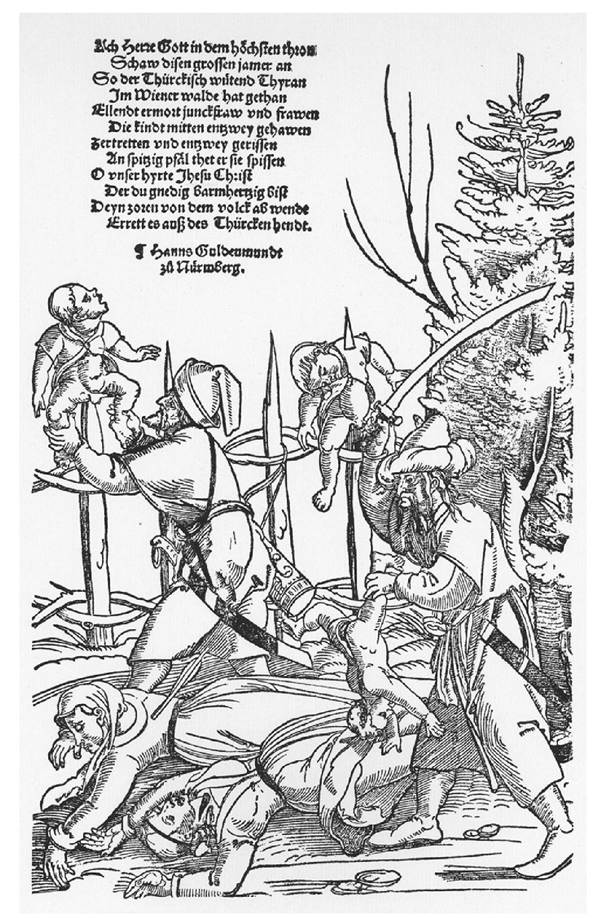
Figure 32.5 Erhard Schon, Turkish atrocities in the Vienna woods, woodcut (Nuremberg: Hans Guldemund, 1530).
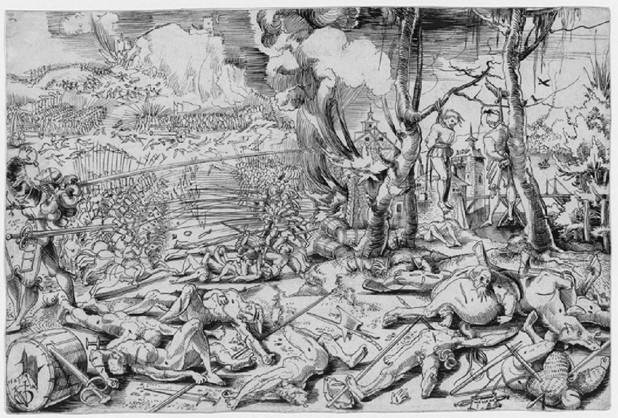
Figure 32.6 Urs Graf, Battlefield, pen and ink drawing, 1521.
Exceptions to formulaic images of battle nevertheless exist. One is a coloured, three-part composite woodcut by an anonymous artist depicting the 1499 battle of Dornach during the Swabian War.11 Whereas the image of battle is conventional, with the Imperial army and their lances facing the massed pikes of the Swiss, on the riverbanks in the foreground and near the town of Dornach on the left, the Swiss pursue the Imperial soldiers and stab them with their pikes. Disembodied heads and bleeding decapitated bodies lie on the ground and float in the river, while the gestures of two women express their utter horror and uncontrollable grief.Another example, possibly inspired by the disastrous defeat of the Swiss at Marignano in 1515, is a drawing by one of the consummate masters of military subjects, the Swiss artist Urs Graf (Figure 32.6). The left background shows a stereotypical battle with the lances of the cavalry arrayed against the pikes of the infantry, and further back a cannon and prostrate stick figures stretched out on the ground. In the foreground, however, the brutal horror of war is made visible. Bodies stripped naked cover the ground, displaying their slashed and gashed flesh, one disembowelled, another still transfixed with lances, a third stretched over an
11 J. R. Hale, Artists and Warfare in the Renaissance (New Haven, CT: Yale University Press, 1990), pp. 48-50. upturned horse's rump, lying as he has fallen, while the horse is releasing its final groans. Behind this devastation, a village building goes up in flames and two peasants hang from trees, while ravens descend in order to pick at their flesh. Meanwhile a young mercenary in the foreground refreshes himself with a drink from his flask, no doubt fortifying himself before returning to further killing. While doubt certainly remains whether Graf s drawing constitutes a critique of war, like critiques by his contemporaries Huldrych Zwingli and Desiderius Erasmus, it indicates a consciousness, at least by some, of the brutal violence and carnage that war could bring.
These two conflicting representations of the violence of war were made publicly visible in a number of paintings commissioned in 1528 by Maximilian's nephew, Wilhelm IV, Duke of Bavaria, and his wife Jacobaa of Baden. The commission was for a cycle of eight vertical panels of male military heroes, and eight horizontal panels of virtuous heroines, which would adorn a space created by Wilhelm's new Court Garden buildings.[948] The panels were completed early on in the twelve-year programme by leading south German artists Albrecht Altdorfer and Hans Burgkmair, who had both been involved in many of Maximilian's key projects, and are two of the most spectacular battle paintings of the sixteenth century. The Battle of Issus (1529) by Altdorfer takes a bird's-eye view of the armies, with their forest of pikes and lances set within an atmospheric landscape and vast sky suffused with the wonderful light of the rising sun, an effect that lends an expanded, cosmic aura to the event. The historic battle - between the Hellenic League led by Macedonian King Alexander the Great and Persian King Darius in 333 bce - gives the impression of an event out of time. Indeed, when one looks closer, the Greek army of Alexander, which is pursuing the defeated Darius in the centre of the painting, is clothed as sixteenth-century Imperial knights, while Darius and the Persians appear as turbaned Ottomans. The depiction of any overt violence is limited, reduced to the falling horses and their turbaned riders on the ground, located at the edge of the battle along the bottom perimeter of the panel. Glorious victory after an epic battle is clearly the message for rulers like Duke Wilhelm, who obviously identified with the Greek forces challenged by their turbaned enemies, just at a time when the Ottomans were laying siege on Vienna; whereas the bloody slaughter and destruction is squeezed to an edge that is hardly visible from the elevated viewpoint.
By contrast, Burgkmair's painting The Battle of Cannae, depicting the defeat of the Romans by Hannibal in 216 bce, has a low vantage point that brings the viewer much closer to the battle.[949] The battle action is extremely violent: cavalry and infantry are thrown together in two of the three tiers of action; figures lunge and stab, wielding sword, axe, and spear; human and equine bodies become entangled as they fall; the arms, hooves and heads of the dead protrude from the tangled mass.
Unlike The Battle of Issus, there is no overt identification with contemporary warfare: the combatants wear all'antica armour and short cloth tunics, modelled on Roman coins and sarcophagi. In fact the battle closely follows a description in a recent German translation of Livy. The combination of historical authenticity and military defeat works against any heroic identification and glorification. It may well be, as Ashley West argues, an exemplum of vulnerability and loss, a result of the failure of the Roman consuls to follow a unified strategy; but it also represents the carnage of battle, for both armies - the violence of war as utterly ruinous.