Wars of Religion
The gruesome violence and destructiveness of war becomes far more pronounced in images created in the second half of the sixteenth century, depicting events during the French Wars of Religion (1562-98) or the first stages of the Dutch Revolt (1568-85).
The confessional nature and religious justifications for these conflicts, their involvement of the broader population and not simply soldiers, their persistence over long periods of time, all influence their different modes of representation. One new element not found in earlier representations of war is the massacre - a large number of deaths suffered by a defenceless population at the hands of a ruthless military. One set of five massacre images is included in a collection of prints entitled Forty tableaus... concerning the wars, massacres and troubles that have occurred in France in these last years. Published in Geneva in 1569-70, the woodcuts and etchings were created by Jean Perrissin and Jacques Tortorel, both refugee artists from Lyon, and covered battles, sieges, raids and massacres between 1559 and 1570 related to the first three French Wars of Religion.[950]The massacre scenes in this work were clearly intended to arouse a sense of horror, fear and anger in viewers. The Massacre of Vassy, for instance,
Visualising Violence in Reformation Europe a woodcut reprinted in seven different French, Latin and German editions, depicted the slaughter by the soldiers of the Catholic Duke of Guise in Vassy on i March 1562 of forty-five to sixty Protestants who were worshipping in a barn.[951] The artist ratchets up the brutality in various ways: the low vantage point brings the action closer to the viewer and the crowded space accentuates the difficulty of escape; the attack on women, who clutch and endeavour to protect their babies from the sword, inevitably suggests comparison with Herod's Massacre of the Innocents and raises the level of both horror and pity.
Similar strategies were used in the Massacre of Cahors, in which forty to fifty Protestants were massacred by Catholics in November 1561, when assembled for worship in the house of a local noble. Here, most who were not yet killed or had succeeded in escaping over the roof before the fires could reach them, are driven out of the courtyard to the external gate, where they are systematically slaughtered. But the additional horrifying detail in this scene is the overt use of terror: the dead bodies of victims are lined up in the street before the house, as a public warning of the consequences of Protestant worship.Two other massacre scenes by Perrissin and Tortorel adopt quite different strategies, probably influenced by paintings of the massacre carried out by the Second Roman Triumvirate in 43 bce by Dutch artist Hans Vredeman de Vries and the French Catholic court painter Antoine Caron.1[952] These works set the Roman massacre in an expansive urban architectural location and focus on numerous different individual acts of violence - stabbing, disembowelling, decapitation, drowning and a carefully arranged display of severed heads. Perrissin and Tortorel's Massacre of Sens (of April 1562), and less so the Massacre of Tours (of July 1562), employ similar techniques of focusing on individual actions in order to communicate the cruelty of the events. In the Sens massacre, individuals are shot and stabbed, stripped naked, dragged to the riverbank and thrown into the river (Figure 32.7). Others are bound together while alive and then thrown into the waters, or tied to planks, three and four abreast, to drown in the surging torrent. Drowning is even more prominent in the Tours massacre, in which the river fills the bottom half of the print. Here victims are murdered by musket fire, drowning, clubbing and also disembowelling. There are also suggestions of rape, with swords strategically directed at the genitals of a naked woman and man.[953] Around the naked corpses on the
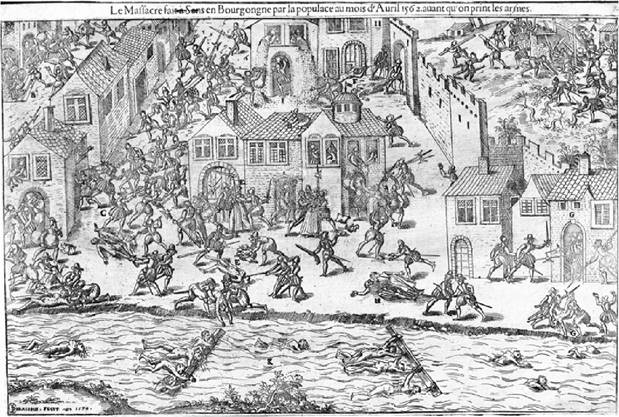
Figure 32.7 JeanPerrissin and Jacques Tortorel, The massacre of the Huguenots by the Catholic population at Sens in 1562, etching, in Histoires diverses qui sont memorables touchant les Guerres, Massacres & Troubles advenus en France en ces dernieres annees (1570), plate 12.
riverbank dogs and ravens gather, while those who survive in the river are clubbed to death by soldiers in boats. In what is probably the most famous depiction of the 1572 St Bartholomew's Day Massacre, by the French painter and Genevan refugee, Francois du Bois, similar techniques are used: the painting is comprised of multiple cameos of brutal violence within the Parisian cityscape where the massacre occurred. Again there is the clubbing and stabbing of victims, the dragging of naked bodies and casting them into the Seine, bloodied corpses of men, women and children, some floating in the river, one seemingly disgorged and lying on a child, others piled up naked in a large mound, and others taken away in the carts - and right of centre, the defenestration, decapitation and disembowelment of the Protestant leader Admiral Coligny.
Visual records of such atrocities were not limited to those by Catholics. A key work in the graphic depiction of barbarous cruelty exacted on Catholics by Protestants was Richard Verstegan's A Theatre of Cruelties by Heretics in our Time. Verstegan, a goldsmith, printer and engraver from England who escaped to the Continent and reached Antwerp in the early 1580s, produced a number of works illustrating the persecution of Catholics in England from 1582. He collated, developed and expanded this material in the Theatre of Cruelties in 1587, with individual sections on France, the Low Countries, England and Ireland, illustrating it with twenty-nine etchings. The work was remarkably popular, totalling eight Latin and French editions by 1607. Verstegan’s images were meant to issue warnings about the consequences of Calvinist rule, to arouse horror and hate towards those terrible heretics and pity for their suffering victims. So the visual strategies he adopted were similar to those used in the Massacre of Sens and in Du Bois’ Saint Bartholomew's Day Massacre: they depict specific individual instances of barbarous cruelty, which are referred to in the six lines of verse below each print and are further amplified in the text on the opposite page.
Each of the etchings on France also included a heading - ‘Certain horrible acts of cruelty against Catholics in France, perpetrated by those whom the people call Huguenots, since they first rebelled against the King in 1562’ - in order to facilitate their sale and circulation as independent prints. Some illustrations clearly drew on the iconography of martyrdom, showing contemporary martyrs having their intestines wound onto a windlass as St Erasmus, or a grill being heated as if for St Lawrence. Yet in other etchings the mutilation and depravity is excessive, and sometimes also sexual. A priest, for instance, is shown completely disembowelled with straw being dropped into his stomach cavity, so as to create a feeding trough for horses. A soldier inserts a large smoking torch into the vagina of a woman stretched out on the ground - and the text confirms what a viewer would presume, that the woman has already been raped (Figure 32.8).[954]Similar cruelties can be found in the large number of violent images created in relation to the Spanish suppression of the Netherlands in the 1570s, following the widespread outbreak of iconoclastic riots by Calvinists in the so-called Wonder Year of 1566. The revolt led to the brutal rule of Fernando Alvarez de Toledo, Duke of Alba, who arrived in Brussels with an army of 10,000 in the summer of 1567 to cleanse the Netherlands of religious heresy and rebellion. Alba’s policy of brutal punishment and elimination of traditional freedoms led to his demonisation in numerous pamphlets and prints, such as in a well-known anonymous print of circa 1570 that depicts him as a diabolical cannibal in the act of devouring a child, his feet resting on the decapitated bodies of the Protestant rebels, Counts Egmont and Hoorn. The prolific Flemish printmaker and publisher, Franz Hogenberg, produced many prints depicting the brutality of the Duke of Alba’s rule
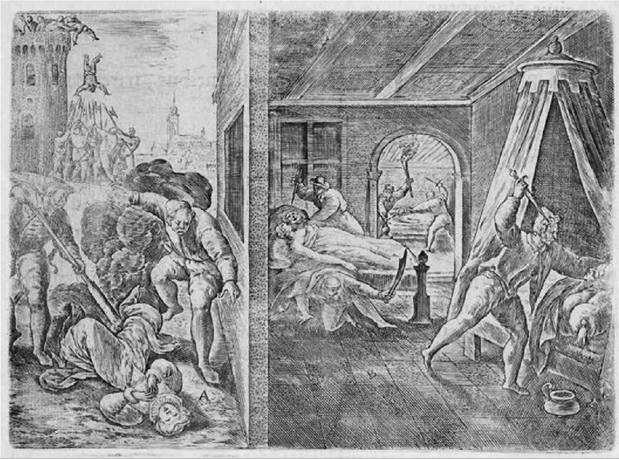
Figure 32.8 ‘Certain horrible acts of cruelty against Catholics in France, perpetrated by those whom the people call Hugenots', an etching from Richard Verstegan's Theatrum crudelitatum haereticorum nostri temporis (Antwerp: Adrian Hubert, 1587), p.
51.over the next decade, which included the sack and plunder of towns like Mechelen and Naarden in 1572, and ultimately Antwerp in 1576, the largest and most wealthy city in the Low Countries.[955] The visual depiction by Hogenberg and others of this bloody pillage, ‘Spanish furies' as they came to be called, was now linked to tales and depictions of Spanish savagery in the Americas, as elaborated by Bartholome de las Casas in A Short Account of the Destruction of the Indies of 1552 (translated from Spanish into French and Dutch in 1578) and increasingly illustrated in works such as Girolamo Benzoni's History of the New World of 1565 (translated from Italian into Latin in 1578, and into French and German in 1579), both of which gave rise to the development of the Black Legend.