Sack, Plunder, Lamentation
The sack and plunder of Netherlandish cities depicted in some of Hogenberg's prints carry graphic suggestions of sexual violence and deep emotional trauma. In the depiction of the plundering of Mechelen, for instance, there is minimal display of the brutal slaughter which is known to have occurred.
Armies mass in the background, several figures are pursued by soldiers, and buildings are entered by force of arms. But two- thirds of the print depicts the plunder of goods. Standing upright in a central location in the foreground, a semi-naked woman is weeping, while another seated and also partly naked woman and two children stretch out their arms to her in a gesture of helpless pleading, serving also to draw in the viewer. This woman clearly represents the city - bereft, despoiled, stripped naked, dishonoured, the menfolk taken away, family and civic community completely shattered. In one of the seven engravings that Hogenberg created of the 1576 sack of Antwerp (reproduced in a composite ‘comic strip' print), a soldier is shown plunging his sword into a woman's genitals, a woman is strung up by her breasts and a man by his penis (Figure 32.9).[956] Such depictions mirror the sexual assaults and violent rapes that become commonplace in numerous contemporary accounts, a violence unleashed not only on material goods and bodies, but on individual and collective honour.[957] Such sexual despoilment is even more graphically displayed in a print of 1577 attributed to Hans Collaert I after Ambrosius Francken, Lament over the Desolation of the Netherlands, in which the Netherlands is figured as a woman surrounded by four soldiers, who assault, strip and rape her, and then rip out her heart.[958]Lament over the stripping and ravaging of the land by soldiers becomes a strong theme in images of war violence following the de facto division of the Netherlands from circa 1585 into the Spanish-controlled south and the Dutch United Provinces in the north.
The Spanish troops mutinied on numerous occasions when not paid, and went on murderous rampages through the countryside. In response, short pamphlets like True Description... of the Barbaric Tyranny of the Spaniards (1621), repeatedly recycled the most gruesome prints of the Spanish fury from the 1570s by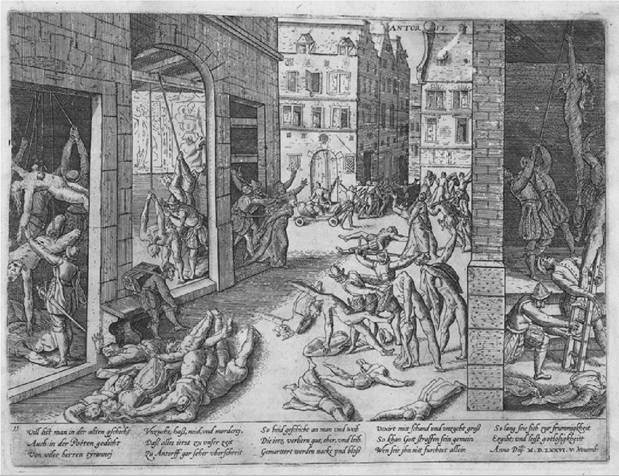
Figure 32.9 Frans Hogenberg, Spanish fury in Antwerp in 1576: the atrocities of soldiers, etching, in Engravings of Scenes from the History of the Netherlands, France and Germany, series 7, Nederlandse Gebeurtenissen, 1576-7, plate 161.
artists like Hogenberg, in anger at the violent attacks of marauding Spanish soldiers against Dutch citizens, their families, women and children. In others, like The Second Part of the Mirror of Spanish Tyranny Perpetrated in the Netherlands (1620, 1628, 1638), the torturing and raping of women, and the impaling of infants, was depicted alongside Spanish violence against Amerindians and the cruelties of the Turk. Such atrocities, moreover, were described as directed against Catholics as well as Calvinists: the raping of nuns and beguines, the hanging of monks by their penises, were not the actions of Catholic soldiers, but of tyrants.[959]
A persistent theme in the work of Peter Paul Rubens between 1623 and 1638 was the tension between war and peace. Rubens used motifs and figures from ancient mythology, such as Mars, Pax and Venus, to give powerful expression to this tension in his paintings, while he also experienced the political difficulties of achieving peace in the many diplomatic missions he conducted on behalf of the Spanish Habsburgs to bring about peace between Spain and the Dutch United Provinces. The response of other Flemish and Dutch artists, such as David Vinckboons, Sebastian Vrancx and Pieter Snayers, was quite different. They were intent on depicting the militarisation of the Netherlandish landscape and the total breakdown of law and order, from the resumption of war in 1621 through to final peace and independence of the Dutch in 1648.
Numerous paintings by these artists depict murderous attacks and the plunder of homes, villages and towns by marauding soldiers, ambushes of convoys and wagons, and in some cases fierce resistance and brutal revenge against these marauders by the peasantry.[960] Like the texts and images found in pamphlets and broadsheets depicting the atrocities committed by soldiers in Germany during the Thirty Years War, confessional issues are not evident. It may well be that the atrocities depicted in these paintings - such as the ‘universal desolation' (famine, disease, murder, pillage, rape and appalling cruelty) described and illustrated in the 1638 pamphlet The Lamentations of Germany - represent the ‘vials of God's wrath' poured out in punishment for human sin. But they are not committed in the name of God or a particular faith; they are described as the barbarous cruelties of both ‘Imperialist' and Swedish soldiers, variously called monsters, devils, men without religion.[961]The much better known series of eighteen etchings by the pre-eminent Lorraine printmaker, Jacques Callot, The Miseries and Misfortunes of War, published in Paris in 1633, represents a similar response to the horrors of war. The first group of prints depict soldiers enlisting, engaging in battle and then demonstrating an appalling breakdown of discipline: they attack a farm like bandits, pillage a house, loot a monastery, burn a village and attack a coach. The second group depicts soldiers arrested and punished for their crimes by torture and execution - on the gallows, by firing squad, at the stake and with the wheel. The third presents the life of surviving soldiers: as maimed and sick, as beggars and paupers dying in the street, avenged by a furious peasantry, and (the good) rewarded by a ruler. The series has been variously interpreted as a political critique of the atrocities of the period, a justification of harsh punishment, and a moral warning of impending divine punishment. Its fascination clearly rests on a capacity to mediate a variety of messages. But any message is mediated through Callot's rich depiction of the devastation that war brings - to perpetrators, victims and survivors. The choreographed discipline of enlistment (plate 2) quickly breaks down into mayhem, reaching a terrifying crescendo in the sacking of a house and the brutal murder and rape of its inhabitants (Figure 32.10), a brutality repeated in the vicious attack of the peasantry (plate 17). Most scenes focus on the terrible violence enacted and suffered in war.