Conclusion
In response to the utter devastation created by decades of war, some seventeenth-century artists, such as Callot and Vrancx, framed war violence as social depredation, and abandoned its earlier confessional resonances.
The appropriation of violence for confessional propaganda certainly did not disappear. It is very evident in the horrific illustrations of Catholic cruelty produced by English Protestants during the Irish rebellion, for instance, in works such as James Cranford's The Teares of Ireland (1642), which aimed to publicise Protestant suffering and thereby mobilise political opinion against Charles I. Yet in the seventeenth century alternative ways of representing violence seemed to gain greater social currency and traction. For while violence was clearly ubiquitous throughout the period of Reformation, its depiction and circulation greatly facilitated by print and printmaking, it was primarily driven by confessional impulses. The visualising of violence was used to arouse fear and incite hatred against enemies and outsiders, to reinforce power and loyalty, to caution against resistance. But it could also be exploited to undermine the powerful, to incite resistance, as well as to create new identity, meaning and hope. But as violent war and its atrocities persisted in the late sixteenth century, through to an uneasy peace in much of Europe in the mid seventeenth, artists also became concerned to confront and lament what were commonly called the ‘miseries' of the times. They had seen the utter desolation that excessive violence could bring if left uncontrolled, and how difficult it was to control once it was unleashed.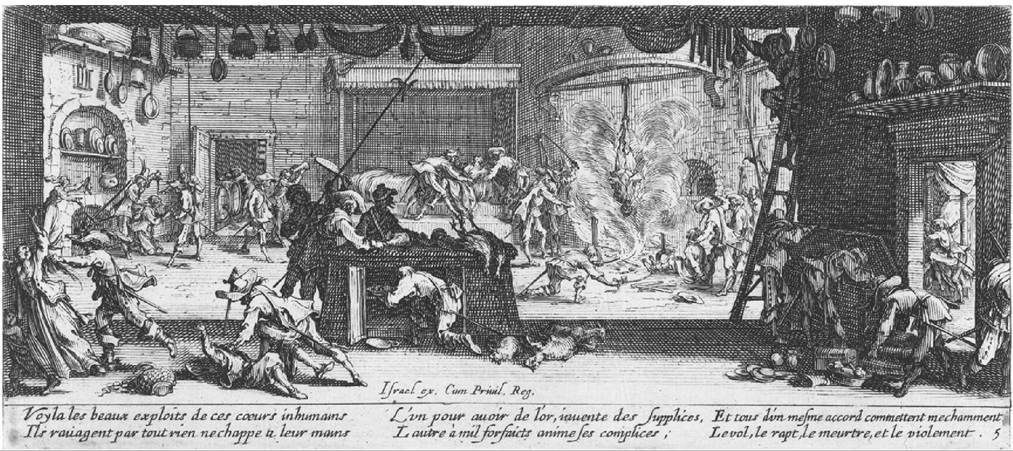
Figure 32.10 Jacques Callot, Soldiers looting a large room inside a farmhouse and slaughtering the inhabitants, etching, in The Miseries and Misfortunes of War, 1633, plate 5.
More on the topic Conclusion:
-
Conflictology -
Ecology -
Economy -
Finance -
History -
Law -
Medicine -
Philosophy -
Religious studies -