Prayer
From its earliest beginnings, Judaism developed a distinctive culture of prayer. The Hebrew Bible includes examples of the principal types of prayer that make up the traditional Judaic liturgy: prayers of praise, confession, petition, and thanksgiving.
In the book of Psalms, for example, the legendary King David (to whom much of that book is attributed) petitions God in the following prayer-like poem:Hear my cry, O God,
Heed my prayer.
From the end of the earth I call to You;
When my heart is faint,
You lead me to a rock that is high above me.
For you have been my refuge,
A tower of strength against the enemy.
O that I might dwell in Your tent forever, Take refuge under Your protecting wings.
—Psalms 61:2-5
In poems like this, biblical writers addressed God in a language that is at once intimate and awestruck, praising his providential care of those who trust in him, while requesting his continued protection against evil and misfortune. But no matter what the character of any particular prayer, all prayers in Judaism are addressed directly to God, and all assume his compassion and just concern.
With the destruction of the Second Temple in 70 ce, the principal site of Jewish prayer shifted to the synagogue, where prayer alone, disconnected from animal sacrifices, became the norm. From that point on, the practice of offering prayer—now no longer primarily the privilege of temple priests—became more democratic. Each community constructed its own house of worship, and before long a recognized liturgy emerged that consisted, in part, of selections from the Hebrew Bible and prayers for various occasions composed by rabbinic authors. By the Middle Ages, these prayers were collected in the Siddur.
The daily routine of prayer appears to have been established during the late biblical period, where we find the exiled Daniel, living in Persia, praying three times a day while turning toward Jerusalem (Daniel 6:11).
The architectural arrangement of early synagogues echoed this practice by orienting the entire building in the direction of Jerusalem, though in later centuries Jews were content with placing the Ark—a large, upright cupboard designed to hold several scrolls of the Torah—on the eastern wall. As the rabbinic protocol of prayer developed during the early Middle Ages, the rules governing thrice-daily prayer became increasingly elaborate and formalized, with an additional early afternoon service added on the Sabbath.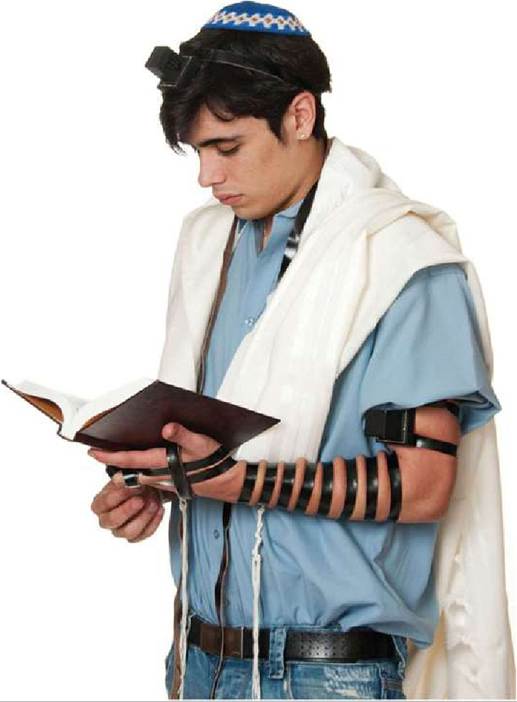
Holding a prayer book and wearing a tai I it, tefillin, and a kipah, a young man prepares to recite morning prayers.
The most common setting for prayer in Judaism is communal, and although individual prayer is always valid, the full complement of prayers in any prayer service can only be said once a quorum of worshipers has assembled, either in the home or, more commonly, in a synagogue. That quorum is referred to in Hebrew as a minyan, and in Orthodox communities it consists of at least ten males thirteen years of age or older; in Conservative and Reform synagogues, a minyan consists simply of ten adults of either gender.
During the morning service, men traditionally wear a prayer shawl (Hebrew, tallit) and phylacteries or prayer amulets (Hebrew, tefillin) throughout, and then remove them at the conclusion of prayers. On the Sabbath it is customary, even in many Reform synagogues, to wear the tallit during prayer services, with tefillin worn only during weekday prayers. In most synagogues today, a head covering (known as a kipah or a yarmulke) is worn during prayer, chiefly by males, and as a sign of respect. Prayer services are conducted in the late afternoon and early evening as well.
One of the most powerful of all the prayers recited during the morning and evening services is the Shema, which consists of biblical verses that first declare the unity of God and then declare Israel’s commitment to his service:
Hear O Israel, the Lord is our God, the Lord is one!
Blessed is God’s glorious kingdom forever and ever!
And you shall love the Lord, your God with all your heart, with all your soul, and with all your might.
Set these words, which I command you this day, upon your heart. Teach them faithfully to your children; speak of them in your home and on the way, when you lie down and when you rise up. Bind them as a sign upon your hand, and let them be symbols before your eyes; inscribe them on the doorposts of your house and upon your gates.—Deuteronomy 6:4-9
This passage is one of the first prayers taught to children and it is, traditionally, the last prayer one utters before death. It is one of several prayers that are recited every day in the week, on major festivals, and on the Sabbath.
In Orthodox and many Conservative congregations, it is customary to read aloud a portion from the Torah every week, on Monday and Thursday mornings, and especially on the Sabbath (morning and late afternoon). In addition, an extra passage from the prophetic books is read on both the Sabbath and the major festivals. On each occasion, the portion selected from the prophetic books either echoes the themes of the Torah portion or reflects the themes of the festival itself. All these readings are normally recited or chanted in Hebrew, with translations in the local language available to the congregation. Today, all Jewish communities employ Hebrew in both the recitation of prayers and in readings from the Torah. Orthodox synagogues conduct services almost entirely in Hebrew, while Conservative, Reform, and Reconstructionist communities use both Hebrew and the congregation’s native language.
Self-Assessment 11.3
[Please note: You must be using an online, browser-based eReader in order to view this content.]
Judaism in the Twenty-First Century
At present, the world Jewish population stands at approximately fourteen and a half million, with the largest concentration of Jews being Israel and the United States. However, Judaism has not merely survived into the twenty-first century; it has also evolved, responding and adapting to changing circumstances. As the oldest of the Abrahamic religions, it carries within itself the longest memory of formative events and personalities, and with it an abiding sense of the divine purposefulness of human history.
Judaism exists, therefore, at a point of intersection between history and theology, as the life experiences of the Jewish people today challenge deeply rooted assumptions about the enduring meaning of faith and religious identity.Decades after the horrors of the Shoah, the Jews of the Diaspora—and particularly that portion of the Diaspora living in the United States—face two fundamental threats to their very existence as Jews and to the survival of modern Judaism in the West: increasing assimilation and the resurgence of anti-Semitism. Like immigrants from other minority ethnic and religious communities, Jewish immigrants to the United States have been obliged to abandon their native languages and social customs, and have generally adapted their religious traditions to harmonize them with the surrounding culture. We have already seen how this process of cultural adaptation has produced variant forms of Judaism in the modern world, and it has allowed Jews to create new religious institutions while retaining some sense of Jewish identity. This type of social/cultural adaptation might be termed creative assimilation.
By contrast, the more destructive type of assimilation, one that entails the rejection of any type of religious identification, or that leads to conversion to an alternative religious culture, has made increasing inroads in Jewish communities throughout the United States and Europe—where the majority of Diaspora Jews reside. As a result, the absolute number of persons identifying as Jews in the United States has declined, according to one estimate, by as much as 5 percent. The primary cause of this decline is presumed by many observers to be intermarriage, but whatever the reason, the specter of what Alan Dershowitz has called the “vanishing American Jew” has grown larger during the first two decades of the twenty-first century. If demography is destiny, then American Jews have every reason to fear for the continued vitality of their over- 300-year-old community.
More troubling still is a global increase in anti-Semitism, not infrequently accompanied by an intense opposition to both Zionism and the state of Israel. Prior to the modern era, most outbreaks of violence against Jews were prompted by religious animosity, but by the nineteenth century a relatively new form of hostility toward Jews began to emerge, a type of hatred many historians have termed “racial” anti-Semitism. In fact, the very term “anti-Semitism” came into vogue in the late 1870s and 1880s, reflecting a growing belief that Jews represented an unassimilable ethnic group whose very presence in society was a threat to its well-being. Conspiracy theories began to emerge that portrayed Jews as uniquely empowered to both manipulate and ultimately destroy the national cultures they were a part of. The rise of Adolf Hitler and the Nazi Party in the 1930s must be seen against the backdrop of this type of racist propaganda.
Unfortunately, the defeat of the Nazi Reich in 1945 has not put an end to Nazism, and the resurgence of familiar anti-Semitic tropes in political discourse and social media, accompanied by an exponential increase in the number of violent attacks on synagogues, has created an atmosphere of mounting dread within Jewish communities in both Europe and in the United States. In short, it is impossible to be certain that the democratic societies where Jews commonly reside will be able to contain what Daniel Goldhagen has called “the devil that never dies.”—
Whether Diaspora Jews can summon up the spiritual tenacity and creativity to overcome both of these challenges remains the most urgent question of our time.
At present, the world Jewish population is estimated to be approximately 14.5 million, with the principal centers of Jewish cultural and religious life being the United States and Israel. And while the horrors of the twentieth century have given way to the turbulence of the twenty- first, the inherent tension between ethnic and religious self-identification that followed Jewish emancipation in the nineteenth century remains one of the constant aspects of Jewish life in the contemporary world.
Moreover, given the denominational divisions in Judaism within the western Diaspora, it is unlikely that any resolution of this conflict will ever occur. Generations from now, people will ask, Who is a Jew?, along with the correlative question, What do Jews believe?Nevertheless, the belief in a covenanted relationship between the Jewish people—however that social entity is defined—and the Creator of the universe (however that concept is understood) is likely to remain at the center of Jewish discourse within any conceivable future. Even those who doubt the very existence of Judaism’s deity, but who persist in identifying themselves as participants in Jewish history, may very well continue to believe in a moral covenant that makes all human communities possible.
SEEKING ANSWERS
What Is Ultimate Reality?
The one God of Jewish faith is understood to be not only the source of all created things but also the highest and most complete form of reality the human mind can imagine. Jewish mystics often refer to this transcendent reality as the Ein Sof, or Infinite One. Traditionalists believe that God revealed himself to the people of Israel at Mount Sinai and that Jewish Scriptures provide a reliable account of that revelation. The biblical view of Creation is, initially, positive: when God views the world he has brought into being, he declares it “very good" (Genesis 1:31). However, later mystics, like Rabbi Luria, traced the evil in the world back to a mysterious cosmic error that subverted the design for the created world that God had originally intended. Nevertheless, the presence of divine “sparks” in each of us inspires us to believe that goodness and not evil will prevail.
How Should We Live in This World?
The divine commandments that make up the core of the Torah are designed to enable human beings to achieve true righteousness, that is, to bring the human moral will into conformity with God’s will, and thereby ensure that justice and peace will prevail in the world. All ideas of right and wrong—such as the Ten Commandments—must, therefore, be referred back to God’s revelation of his will at Sinai and the Torah’s laws that govern human conduct. Both biblical writers and their rabbinic commentators believed that human beings are created in the “image of God” and, at the same time, are torn between good and bad impulses. In the mystical tradition, this conflict can be resolved through study, prayer, and meditation, all of which draw us closer to God.
What Is Our Ultimate Purpose?
Judaism has never believed that human beings are hopelessly evil, nor does it support the view that humanity can never make moral progress. The High Holy Days are dedicated to the belief that both individuals and whole societies are capable of changing their behavior and that, through active repentance, they are even capable of drawing closer to each other and to God.
Jews have long believed that the soul is immortal and survives death. The fate of the soul in the “world to come” and God’s judgment of that soul remain a subject of speculation and wonder, even today; some, however, regard these beliefs as obsolete and no longer a part of contemporary Jewish faith.
REVIEW QUESTIONS
For Review
1. What are mitzvot, and where can they be found?
2. What does the word Torah mean, and how many other meanings can be derived from it?
3. What are Maimonides’s thirteen Principles of Faith?
4. Who was Mordecai Kaplan, and to which movement in modern Judaism is he connected?
5. What does the term Shoah mean, and how is it different from the word Holocaust?
For Further Reflection
1. What are the implications for Judaism of the concepts of election and covenant? Do Jews see themselves as the only people with whom the Creator God has communicated? Is it ever possible for a non-Jew to enter into a covenant relationship with Israel’s God?
2. How did Judaism recover from the loss of the Jerusalem Temple in 70 ce? Why do you think that some Jews living today hope to rebuild the Temple and resume the practice of animal sacrifice? Why are the majority of the world’s Jews content with the synagogue and its prayer routines?
3. How does Maimonides’s approach to both God and Torah differ from that of the mystics? Do the kabbalists really believe that it is possible for human beings to seek union with God or to find the presence of God within oneself?
4. Among the varied responses to the Shoah that modern Jewish philosophers have proposed, which response seems the most compelling to you? If you were a Holocaust survivor, what would your view of life and of faith be now? Would you still find it possible to believe in a just and loving God?
5. What does the word Zionism refer to, and what role did Theodor Herzl play in promoting Zionist ideas?
6. What are the Ten Commandments, and where can they be found?
7.
What is the Talmud, and how many volumes (or tractates) does the Babylonian Talmud contain?
Chapter 11 Self-Quiz
[Please note: You must be using an online, browser-based eReader in order to view this content.]
Chapter 11 Flashcards
[Please note: You must be using an online, browser-based eReader in order to view this content.]
Baal
SUGGESTIONS FOR FURTHER READING
Akenson, Donald Herman. Surpassing Wonder: The Invention of the Bible and the Taimuds. Chicago: University of Chicago Press, 2001. An ambitious, and sometimes argumentative, history of the evolution of biblical and rabbinic literature.
Ariel, David. What Do Jews Believe? New York: Schocken Books, 1995. An accessible and nuanced account of traditional and nontraditional Jewish beliefs.
Bauer, Yehuda. A History of the Holocaust. New York: Franklin Watts, 2001. A well- researched and readable account of the Holocaust, written by the “dean” of contemporary Shoah historians.
Eisenberg, Ronald. The JPS Guide to Jewish Traditions. Philadelphia: Jewish Publication Society, 2004. A well-researched and comprehensive guide to traditional and nontraditional Jewish religious practices.
Fredricksen, Paula. From Jesus to Christ. New Haven, CT: Yale University Press, 1988. A close scholarly reading of the gospels that traces the separation of emergent Christianity from normative Judaism of the first four centuries.
Neusner, Jacob, and Alan J. Avery-Peck, eds. The Blackwell Companion to Judaism. Oxford, UK: Blackwell, 2003. A collection of diverse articles on the history of Judaism, written by some of the leading scholars in Jewish studies.
Plaskow, Judith. Standing Again at Sinai: Judaism from a Feminist Perspective. San Francisco: Harper and Row, 1990. A seminal work of feminist reconceptualization of normative Judaism.
Robinson, George. Essential Judaism: A Complete Guide to the Beliefs, Customs and Rituals. New York: Pocket Books, 2000. A well-written and comprehensive description of Jewish beliefs and practices.
Sarna, Jonathan D. American Judaism: A History. New Haven, CT: Yale University Press, 2004. The best account to date of the historical development of the Jewish community in the United States.
Strassfeld, Michael. The Jewish Holidays. New York: HarperCollins, 1985. A nicely illustrated presentation of major and minor Jewish festivals with detailed accounts of religious observances from around the world.
Click here for more suggested readings, weblinks, and other media for this chapter.
ONLINE RESOURCES
My Jewish Learning
myjewishlearninq.com
A well-researched site for historical subjects and religious practices.
The Jewish Virtual Library
jewishvirtuallibrary.org
A good site for contemporary subjects such as Israel and the Holocaust.
The Jewish Women’s Archive
jwa.org
A comprehensive site for research articles on women in Judaism.
Click here for web links to sacred texts.
LIST OF KEY TERMS
Baal Shem Tov
Bar Mitzvah covenant
Dead Sea Scrolls Diaspora election eschatological ethical monotheism Exodus halacha
Hasidim
Holocaust immanence
Isaac Luria Kabbalah Maimonides messiah mikveh mitzvot
Moses omnipotence omniscience Pesach
Rosh Hashanah Seder
Shavuot
Siddur
Sukkot synagogue tallit
Talmud
Tanakh
tefillin
Torah transcendence
YHWH
Yom Kippur
Zionism
Zohar
More on the topic Prayer:
- Plato
- Argument from Fallacy
- A study of the history of opinion is a necessary preliminary to the emancipation of the mind.
- Dar Fur and Wadai
- From the Shtetl to the Circus
- Monks and Friars
- MUSIK ISLAM AND MUSIK ISLAMI
- The Afterlife
- The Shari'a: Islamic Law
- THE SOPHISTICATED RELIGIONISTS: BUBER AND POLANYI