Religious Questions and Challenges
It might seem disrespectful or even blasphemous to ask, Why do religions exist? Yet this is a perfectly legitimate question. As human enterprises, religions naturally respond to human needs and readily acknowledge reasons for their doctrines and rituals.
A typical reason has to do with some kind of perceived separation from the sacred or estrangement from a state of perfection or fulfillment. The human condition, as ordinarily experienced, is regarded as being disconnected from the fulfillment that lies at the end of a spiritual path. Of the questions and challenges addressed by religions, these three are especially prominent:1. What is ultimate reality?
2. How should we live in this world?
3. What is our ultimate purpose?
The rest of this book’s chapters explore the ways major religions answer these questions. For now, let’s consider these questions more broadly.
What Is Ultimate Reality?
It is difficult to imagine a religion that has nothing to say about ultimate reality—even if this involves asserting that “ultimate” reality consists of no more than the natural world and we human beings who inhabit it. Religions typically assert that ultimate reality is somehow divine, and explanation of the nature and role of the divine takes center stage in a religion’s belief system. But the “divine” is not necessarily thought of as God or gods. When it is, we refer to that religion as a theistic (from Greek theos, or god) belief system. When it is not, the religion is said to be nontheistic. Some forms of Buddhism, such as Zen, are clearly nontheistic. A helpful middle ground term is transtheistic, acknowledging the existence of gods—but of gods that are not vital with regard to the most crucial religious issues, such as the quest for enlightenment or salvation.—
Theistic religions can be further categorized. Polytheism (from Greek polys, or many) is the belief in many gods (“gods” is considered a gender-neutral term and can—and often does— include goddesses).
Monotheism (from Greek monos, or only one) is the belief in only one god (and hence the term is normally capitalized—God—a proper noun referring to a specific being). Here, a kind of middle ground comes in the form of henotheism (from Greek hen, the number one), which acknowledges a plurality of gods but elevates one of them to special status. Some forms of Hindu devotion to a particular god such as Vishnu or Shiva are henotheistic.Pantheism (from Greek ραπ, or all) is the belief that the divine is identical to nature or the material world. Although not one of the world’s living religions, the ancient Greek and Roman religious philosophy known as Stoicism is an example. It is important to bear in mind, too, that the world’s religions often feature entities that are supernatural and yet are not necessarily gods. These quasi-divine figures, such as angels, demons, and the monsters of myths, are difficult to categorize but are important elements of religion nonetheless. To complicate matters further, scholars of non-Western religions have commonly used the term
god to refer to supernatural beings that are more similar to angels, or even to the saints of Catholic tradition. The theos in the “polytheism” of such non-Western religions therefore often refers to a very different type of being than does the theos in “monotheism.” Simplistic application of such terms is misleading.
Nontheistic belief systems include those that uphold atheism, which in a modem context is a perspective that denies the existence of God or gods. In ancient times, a person could be labeled an atheist for denying the significance of deities, even while believing that they exist. Among the ancient Greeks and Romans, for example, Epicureans were considered to be atheists. Even according to the modern meaning of atheism, some atheists nevertheless could be regarded as religious—depending on how one defines “religion.” The HarperCollins Dictionary of Religion definition, with its basis in “supernatural beings,” likely would not leave room for atheism, whereas Bruce Lincoln’s definition could.
Current trends in religiosity among young people suggest that atheism, along with its less insistent relative, agnosticism (which only refuses to assert the existence of God or gods, rather than outright denying it), are becoming more prevalent and deserving of academic inquiry. A May 2015 Pew Forum study indicates that 22.8 percent of people in the United States identify themselves as atheist, agnostic, or “nothing in particular”—a group that is labeled “Unaffiliated” or religious “nones.” This marks a sharp increase. (For more on the Pew Forum study, see the Online Resources list at the end of this chapter; the issue of atheism is addressed further in Chapter 14.)Related to this categorical label of nontheism is monism, the belief that all reality is ultimately one. Some Hindus, for example, while believing in many gods and goddesses, hold that Brahman, impersonal and ultimately indescribable, is the essence of all. Those Hindus therefore embrace monism, which is also described as nondualistic, because there is no distinction between the divine reality, on one hand, and the rest of reality, including human individuals, on the other.
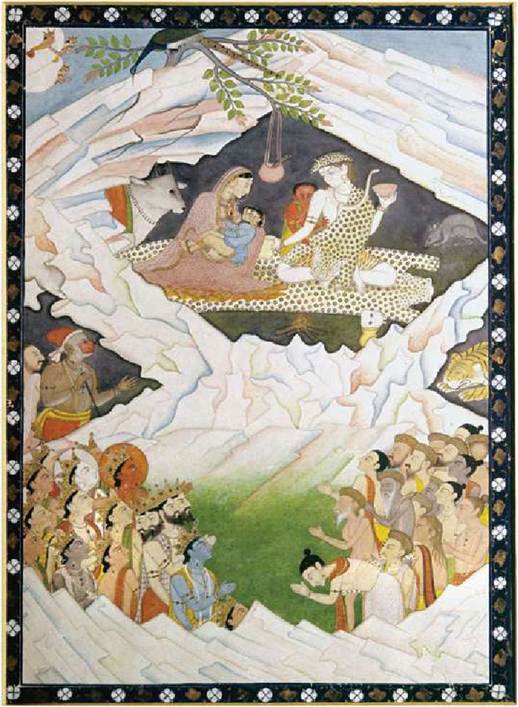
This painting, produced in 1810, depicts the Hindu deities Shiva and Parvati with their children, Ganesha and Kartikeya. Hindus believe in many gods and goddesses; these four—especially Shiva—are among the most popular.
These attempts at categorizing perspectives on ultimate reality involve some complications. Some Hindus are monistic because they understand all reality ultimately to be one thing: Brahman. But some of those same monistic Hindus also pay homage to a variety of supernatural and divine beings, and thus might also be described as polytheists.
Along with asserting the existence of ultimate reality, religions describe how this reality is revealed to human beings. The foundational moments of revelation are frequently recorded in sacred texts, or scriptures.
In the case of theistic religions, scriptures set forth narratives describing the role of God or the gods in history and also include pronouncements directly attributed to the divine. In the Jewish and Christian Bible, for example, God’s will regarding ethical behavior is expressed directly in the Ten Commandments. The giving of the Ten Commandments is described in the narrative about the Exodus of the Israelites from Egypt, in which God is said to have played a central role.Among nontheistic religions in particular—but also among the mystical traditions that form part of every religious tradition—revelation often combines textual transmission with a direct experience of revelation. Revelation is usually experienced by a founding figure of the religion, whose experiences are later written about; subsequent believers can then experience similar types of revelation, which requires their own participation. Buddhists, for example, have scriptural records that describe the Buddha’s experience of nirvana, as well as pronouncements by deities praising the ultimate value of that experience. Followers must then connect to such revelation through practices such as meditation.
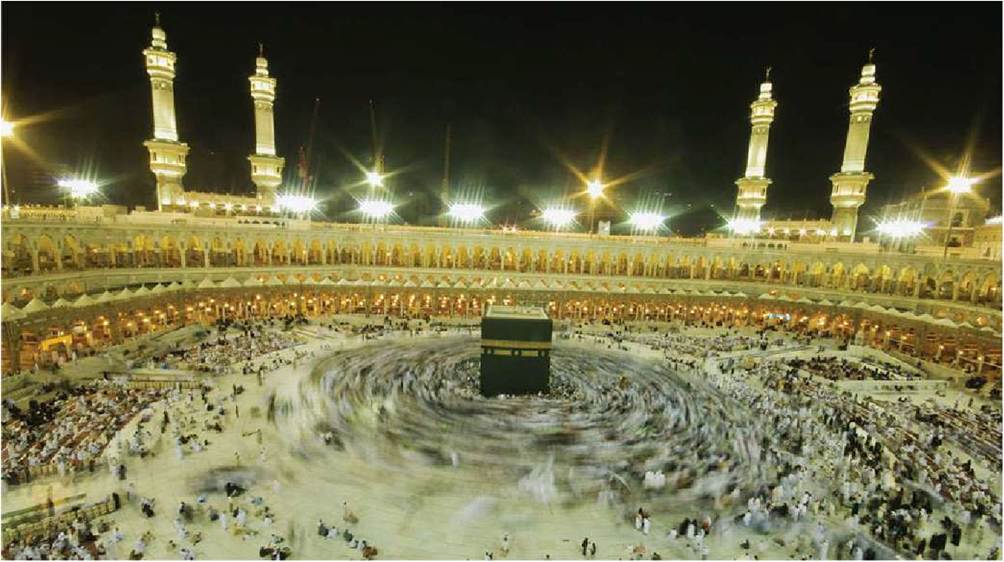
Ka‘ba, Mecca.
Another helpful way of thinking about revelation is offered by historian of religions Mircea Eliade (1907-1986), who describes a phenomenon he calls “hierophany,” or “the act of manifestation of the sacred,” which helps a people to establish its cosmology, or religious understanding, of the order of the world.— Eliade emphasizes how this concept applies to indigenous or small-scale traditions. But the phenomenon of the hierophany is readily apparent within the world’s major religions, often, but not always, as a theophany, a manifestation of God or of gods. The role of hierophanies in establishing places of special significance can be observed in many of the sites related to the founding figures and events of the major religions: Christianity’s Church of the Nativity (and other sacred sites related to the life of Christ); Islam’s sacred city of Mecca; Buddhism’s Bodh Gaya, site of Gautama’s foundational experience of Enlightenment; and so on.
Sacred moments establish sacred spatial monuments, thus establishing a sense of centrality and spatial order.Religions also have much to say about this world. Human beings have always asked searching questions about the origin and status of our planet and of the universe. Typically, these two issues—origin and status—are intertwined. If our world was intentionally fashioned by a creator god, for instance, then it bears the stamp of divine affirmation. Thus, the early chapters of the book of Genesis in the Hebrew Bible (the Christian Old Testament) describe the creative activity of God, including the creation of humankind. In contrast, the creation stories of some religious traditions deemphasize the role of the divine will in bringing about the world, sometimes (as in the religion of the ancient Greeks) describing the advent of the principal deities after the universe itself has been created. The gods, like humans, come into a world that is already established; gods and humans are depicted as sharing the world, which naturally affects the relationship between human and divine. In other religions, notably Hinduism, Buddhism, and other traditions that embrace liberation as the ultimate religious objective, this world is depicted as a kind of illusion. It is thus not so surprising that liberation involves being completely freed from the confines of this world.
These are but a few examples of religious understanding of the nature of the world, a general category known as cosmology (from kosmos, the Greek term for world or universe). Along with clarifying the origin and sacred status of the world, cosmology also explains how the world is ordered. Many traditions attribute the order of the universe to the doings of divine being(s) or forces. Yet in certain respects modern scientific explanations set forth cosmologies that are intriguingly similar to some religious cosmologies taught by religious personages of the distant past, such as Gautama the Buddha or Epicurus, a Greek philosopher who espoused a theory of atomism, arguing that reality is composed entirely of a very large number of very small particles.
(Recall that the Epicureans were labeled “atheists” because they denied the significance of the gods.)Of course, a particular religion’s cosmology strongly influences the degree to which its adherents are involved in caring for the world. On the one hand, religions that are indifferent or hostile toward the natural world are not apt to encourage anything akin to environmentalism. On the other hand, a religion that teaches that the world is inherently sacred naturally encourages a sense of stewardship toward the natural world. Native American traditions, for example, are notably environmentally oriented.
Cosmologies also often include accounts of how the world will end. On this issue, most of the religions considered in this text can roughly be divided into two categories. Some, including Judaism and, more stridently, Christianity and Islam, envision a divinely orchestrated end of the world as we know it. This end is a one-time event, often said to be accompanied by judgment and eternal reward for the good and punishment for the evil. Some forms of Western monotheism, such as Adventism and Jehovah’s Witnesses (both explored in Chapter 14), have placed special emphasis on predictions of precise dates for this cataclysmic end. Religions belonging to the other category, which includes most forms of Hinduism, Buddhism, Jainism, and Sikhism, understand this world to be a temporary phenomenon that is part of an eternal cycle of creation and eventual destruction, to be followed repeatedly by another round.
How Should We Live in This World?
Many religions have much to say about God or other superhuman beings and phenomena, and yet all religions are human enterprises. Their teachings are communicated in human languages, their rituals are practiced by human participants, and their histories are entwined with the development of human societies and cultures. Religions also explain what it is to be a human being.
Explanations regarding what it is to be human also figure into ethical or moral considerations. Are we by nature good, evil, or somewhere in between? Religions tend to recognize that human beings do not always do the right thing, and they commonly offer teachings and disciplines directed toward moral or ethical improvement. On the one hand, to say that we are by nature good, and at the same time to recognize moral failings, is to infer that some cause external to our nature is causing the shortcoming. If we are by nature evil, on the other hand, or at least naturally prone to doing wrong, then the moral challenge lies within and the means of improvement would need to be directed inwardly.
Religions typically prescribe right behavior and condemn wrong behavior, based on a set of ethical tenets, such as the Jewish and Christian Ten Commandments. In fact, the prospects of improving the human condition and of faring well in an afterlife are often understood to depend upon right ethical behavior. The ethical teachings of many religions are notably similar. The so-called Golden Rule (“Do unto others what you would have them do unto you”13) in the Christian New Testament is reflected in the scriptures of virtually all of the world’s major traditions.
The religions differ, however, over the source of ethical truth. Some emphasize revealed ethics, asserting that God, or some other supernatural force such as Hindu dharma (ethical duty), has established what constitutes right behavior and has revealed this to human beings. The divine will might be conceived of as God (or gods), or it might take the form of an impersonal principle, such as dharma. Another common approach, in some forms of Buddhism, for example, emphasizes the role of conscience in the moral deliberations of each individual. These two emphases are not necessarily mutually exclusive. Some religions, Christianity among them, teach that both revealed ethics and individual conscience work together to distinguish right from wrong.
What Is Our Ultimate Purpose?
The challenge of mortality—the fact that we are destined to die—is sometimes cited as the primary motivating force behind religion. And although it is true that all religions have something to say about death, the diversity of perspectives is striking. For example, whereas Christianity, with its focus on the resurrection of Christ and the hope of eternal life, can be said to make mortality a central concern, Zen Buddhism, drawing inspiration from the classic Daoist texts, simply acknowledges the natural place of death in the order of things.
Both the challenge of mortality and the issue of our moral nature relate to questions regarding the human condition. In many faiths, how we conduct ourselves in this world will determine our fates after we die. Most religions acknowledge that human beings are destined to die (although some, such as Daoism, have aspired to discover the means of inducing physical immortality). As we have noted, some religions have little to say about the prospects of life beyond death. But most religions do provide explanations regarding the fate of the individual after death, and their explanations vary widely.
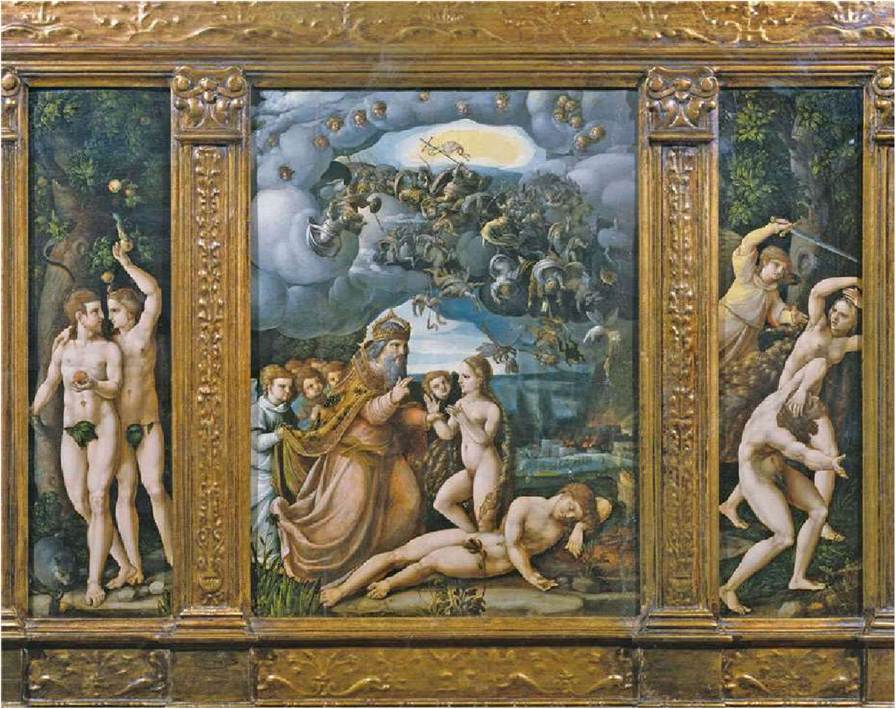
Sixteenth-century triptych (altar painting) depicting the creation of Eve (center), the eating of the forbidden fruit (left), and the expulsion from the Garden of Eden (right). This story of humankind’s first sin sets forth basic biblical perspectives on the human condition.
Hinduism, Buddhism, Jainism, and Sikhism all maintain belief in samsara, the “wheel of life” that implies a series of lives, deaths, and rebirths for every individual. The ultimate aim of each of these religions is liberation from samsara. But most of the adherents of these religions anticipate that death will lead to rebirth into another life form (not necessarily human), one in a long series of rebirths. Furthermore, the reborn are destined for any one of multiple realms, including a variety of hells and heavens.
Other religions, for example, Christianity and Islam, teach that individuals are destined for some sort of afterlife, usually a version of heaven or of hell. Sometimes the teachings are more complicated. The traditional Catholic doctrine of purgatory, for example, anticipates an intermediaiy destiny somewhere between the bliss of heaven and the agony of hell, where an individual can gradually be purified from sin, ultimately achieving salvation and entry to heaven.
Given what a religion says about the human condition, what ultimate purpose is the religious life intended to achieve? Is there a state of existence to which the religious person can hope to aspire that perfectly completes or even transcends the human condition, overcoming entirely its cares and shortcomings?
One such state of existence is the numinous experience, as described by Rudolf Otto in his classic work The Idea of the Holy (1923). Otto (1869-1937), a Protestant theologian and a philosopher of religion, describes the encounter with “the Holy” as “numinous,” a term he developed from the Latin numen, meaning spirit or divinity. A genuine numinous experience, Otto asserts, is characterized by two powerful and contending forces: mysterium tremendum and fascinans. Mysterium tremendum is the feeling of awe that overwhelms a person who experiences the mysterious and majestic presence of the “wholly other.” Fascinans (Latin, “fascinating”) is the contrasting feeling of overwhelming attraction. The encounter with the Holy is thus alluring (fascinans) even as it is frightening on account of the awe-inspiring mystery (mysterium tremendum). The biblical phenomenon of the “fear of God” fits this description, as the God who is being feared is at the same time recognized as the source of life and the hope for salvation. Otto’s analysis of the numinous experience remains an important contribution to religious studies, although it suffers from a significant limitation: based in his Protestant Christian outlook, it may ring true to a Protestant; from a global perspective, however, the analysis is rather narrow. For example, Otto discounts the mystical experience, a category that includes such phenomena as Buddhist nirvana, the complete dissolution of an individual’s sense of selfhood said by Buddhists to be a state of perfect bliss and ultimate fulfillment. According to Otto, nirvana involves too much fascinans without enough mysterium tremendum.
Recall that Bruce Lincoln’s definition of “religion” is based on the notion of the transcendent. Both the numinous experience and nirvana are examples of transcendent states of existence. For Otto, the numinous experience depends on the existence of “the Holy,” or God. For many Buddhists, the experience of nirvana does not depend whatsoever on belief in God or gods. Most world religions, whether or not they embrace belief in a supernatural being, assert the possibility of such a transcendent state of existence, an ultimate objective of the religious life that brings complete fulfillment of all spiritual longings. For a Buddhist who has experienced nirvana, there is, paradoxically, no longer a need for Buddhism. The religious life has been lived to its fullest extent, and the ultimate objective has been reached. Because nirvana involves the complete extinction of individual existence, it is truly transcendent of the human condition. Other religions, in varying ways, also set forth ultimate objectives, whether or not they imply the complete transcendence of the human condition. In some cases, spiritual fulfillment can be said to consist of living in harmony with nature. Others acknowledge the supernatural—usually God (or gods)—and the need for human beings to live in perfect relationship with it. Christianity, for example, offers salvation from the effects of sin, which otherwise estrange the individual from God. Sometimes spiritual fulfillment is thought to be achievable in this lifetime; other times it is projected into the distant future, after many lifetimes.
Of course, improving upon the human condition does not have to involve complete transcendence. Day to day the world over, religious people improve upon the human condition in all sorts of ways. Belief in a loving God gives hope and fortitude in the face of life’s uncertainties. Meditation and prayer bring an enhanced sense of tranquility. Religious motivations often lie behind charitable acts. Belonging to a religious group offers social benefits that can be deeply fulfilling. Even for individuals who do not participate directly in a religious tradition, sacred art, architecture, and music can bring joy.
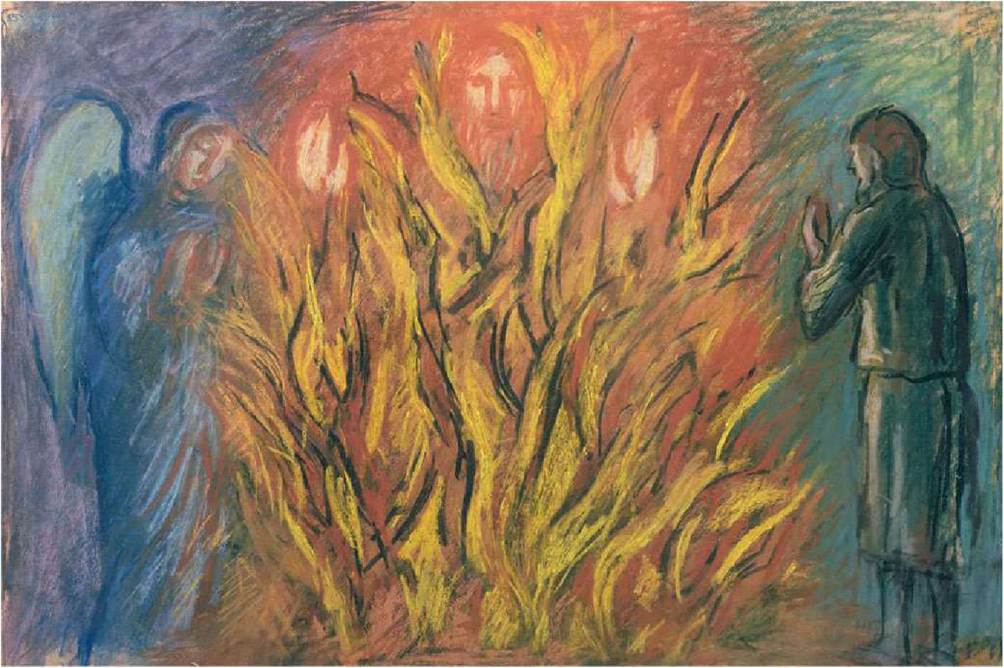
Moses and the Burning Bush (1990), charcoal and pastel on paper by Hans Feibusch. In the drawing, God reveals himself to Moses in a bush that is on fire but not consumed by the flames. The event is described in Exodus, the second book of the Hebrew Bible (Old Testament).
More on the topic Religious Questions and Challenges:
- Brodd Jeffrey, Little L., Nystrom B., Platzner R., Shek R., Stiles E.. Invitation to World Religions. 4th edition. — Oxford University Press,2022. — 1196 p., 2022
- CONCLUSION
- The Meaning of Welfarism and Non-welfarism
- Youth in Sri Lanka
- Tribal People in Kerala
- Hare C., Neo D. (eds.). Trade Finance: Technology, Innovation and Documentary Credit. Oxford University Press,2021. — 417 p., 2021
- BREAKING NEW GROUND
- Oman
- Malta