The History of Confucianism and Daoism
As you may recall, the earliest time in Chinese history for which we have both written records and archaeological evidence is the Shang Dynasty, whose traditional dates are 1600-1046 все.
The head of the Shang spiritual world was Shangdi, the ultimate benefactor of the royal house. Eventually, around the end of the second millennium все, the Shang Dynasty was toppled by the Zhou. The Zhou founders replaced Shangdi with Tian as the overarching spiritual authority. They claimed their victory as a mandate they received from Tian, ostensibly because of their moral worthiness. Early Zhou society was idealized as well ordered and harmonious, presided over by men of virtue.The History of Confucianism
At the time of Confucius’s birth, the entire political system and moral framework put in place by the early Zhou kings was in disarray. Powerful feudal lords jockeyed for position to become the next Tianzi, the son of Tian, and to replace the current Zhou king. The more capable and ambitious among them actively sought the service of talented men outside the hereditary aristocratic circles, thereby creating upward social mobility for some among the commoners. Conversely, powerful lords could become commoners overnight as a result of their defeat by their rivals, creating a downward social spiral as well.
These critical social developments gave rise to the increasing prominence of a class of experts and specialists known as shi (men of service). Drawn from lower aristocratic or commoner backgrounds, they entered the employ of feudal lords and imperial rulers. The shi performed two major categories of duties: military and civil. The military men of service, the knights, were referred to as wushi, whereas their civilian counterparts, the scholars and ritualists, were known as rushi, or simply ru. Ru were scribes and record keepers, masters of religious ceremonies, as well as diviners and spiritual professionals.
To perform their duties well, ru had to acquire mastery of history, poetry, religious rites, divination, dance, and music.Confucius was just such a ru who was born into a family of former aristocrats in the feudal domain of Lu (located in present-day Shandong Province in north China). His father died when he was still an infant, so he had to do menial work as a young man to support himself, his sickly older brother, and his widowed mother. He apparently had an extraordinarily inquisitive mind and a voracious appetite for study, especially of the ancient texts of history, rituals, and poetry. By the age of thirty, he gained respect as an expert ru. His service in government was limited to a number of minor posts, but his greatest accomplishment was in his vocation as a teacher.
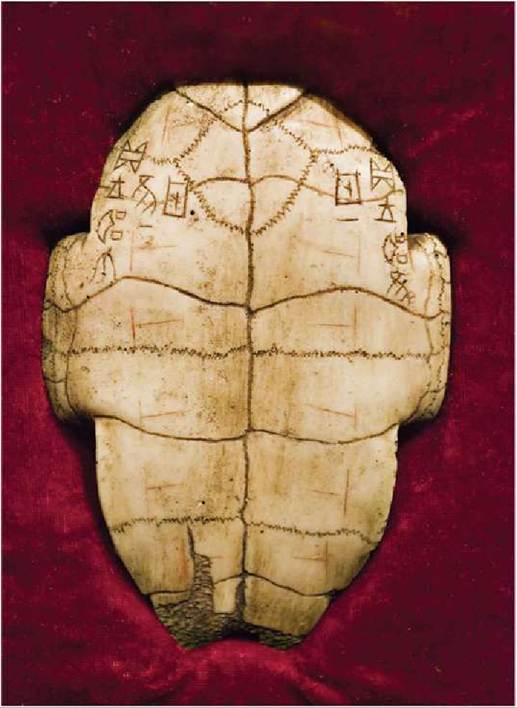
A Chinese oracle bone made of tortoise shell.
After age fifty, as he realized that the feudal lord of his native Lu did not value his service, Confucius left with a number of trusted disciples in tow and headed for other feudal domains. His hope was that other lords would embrace his ideas and would implement his political blueprint for restoring order to the world. For the next thirteen years he traveled all across northern China, but he was met with disappointment everywhere, at times suffering much indignity, deprivation, and even physical danger. In the twilight years of his life, he returned to his home state of Lu with his political ambition unfulfilled. He devoted the remainder of his life to teaching, writing, and editing the ancient texts. Confucius died in his early seventies.
Toward the end of his long life, Confucius gave a telling summary and assessment of his intellectual development, as recorded in the Analects:
At fifteen I set my mind on learning
At thirty I had become established [as a ru]
At forty I was free from doubts
At fifty I knew the decree of Tian (Tianming)
At sixty my ears became attuned [to what I heard from Tian]
At seventy I could follow my heart’s desires without transgressing what was right
—Analects 2:4
This intellectual and spiritual autobiography of Confucius illustrates the trajectory of his development from scholar to spiritual figure.
His biography shows that he was a frilly human figure with no claim to supernatural origin or power, and he was the consummate representative of the ru tradition and an exemplary teacher. Eventually, however, Confucius would be honored as a sage and the founder of China’s most important philosophical and religious tradition.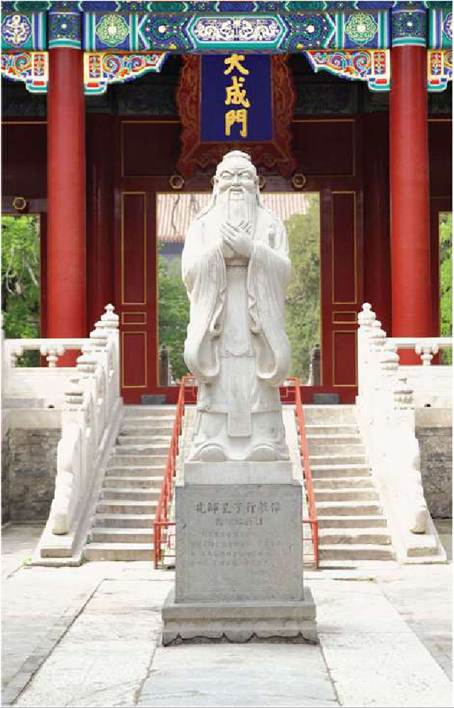
Statue of Confucius at the entrance to the Confucian Academy in Beijing, China.
Later Defenders of the Faith
After Confucius’s death, the Chinese world took a turn for the worse. Warfare among the feudal states became more frequent and brutal. The centuries between Confucius’s death in 479 and 221 все are known as the Warring States period in Chinese history. During this time, Confucius’s original vision of moral cultivation and benevolent government seemed impractical and quixotic. Internally, the Confucian tradition was rocked by self-doubt and resignation, as his ru followers became mere functionaries for the feudal lords, enjoying little influence or self-esteem. Externally, rival traditions such as Daoism and other more pragmatic schools competed for attention and attacked many of the Confucian ideas.
Into this picture came Mencius (371-289 все?), the second most important figure in the Confucian tradition. As the self-declared ardent defender of the faith, he articulated views that would be revered as definitive interpretations of Confucius’s teachings. His ideas would become orthodox for most later Confucians.
A younger contemporary of Mencius was Xun Qing (310-238 все?), or Master Xun (Xunzi), who initially and for a span of several centuries exerted far greater influence on the Confucian movement than Mencius did. Xun Qing’s rationalism and pragmatic approach to rituals and learning had given a decisively secular and worldly bent to the Confucian tradition, resulting in a noticeable neglect of its religious nature. His view of human nature as evil also contradicted the Mencian version.
Nevertheless, Xun Qing shared with Mencius an abiding faith in the transformative influence of moral cultivation and the perfectibility of humanity through self-effort. Eventually, however, later Confucians rejected Xun Qing as heterodox, and the text bearing his name was never recognized as a Confucian classic.Confucianism as Orthodoxy
When China was unified by the Qin (traditionally spelled Ch’in) state in 221 все, the Confucian tradition was initially a target of state persecution. Its call for benevolent government and individual moral autonomy was rejected by the First Emperor of Qin as dangerous and subversive. But the Qin Dynasty soon fell, replaced by the Han (206 BCE-220 ce), a much more hospitable regime for Confucian teaching. By the middle of the second century все, the Confucian tradition finally surpassed all its competitors by becoming the state-designated orthodoxy, in recognition of its usefulness in fostering effective governance and enhancing social cohesiveness. Yet its orthodox status also necessitated fundamental changes in its orientation. From a teaching that called for high-minded personal moral cultivation and benevolent government, Confucianism in the Han Dynasty became a scholastic tradition, a means to bureaucratic advancement, and a tool for state control and patriarchal authoritarianism. In fulfilling these roles, Confucius was showered with grandiose titles by subsequent generations of Chinese rulers who scrambled to outdo one another in showing their adoration of him, culminating in the breathtakingly exuberant title of “Ultimate Sage of Greatest Accomplishment, King of Manifest Culture” given to him by an emperor in 1308. “Temples” dedicated to Confucius were built in all the administrative and political centers throughout the empire. Nevertheless, these temples served more as memorials, such as those dedicated to Thomas Jefferson or Abraham Lincoln in the United States, than as places of worship, and Confucius himself remained by and large an exemplary human figure worthy of veneration, rather than a god promising salvation.
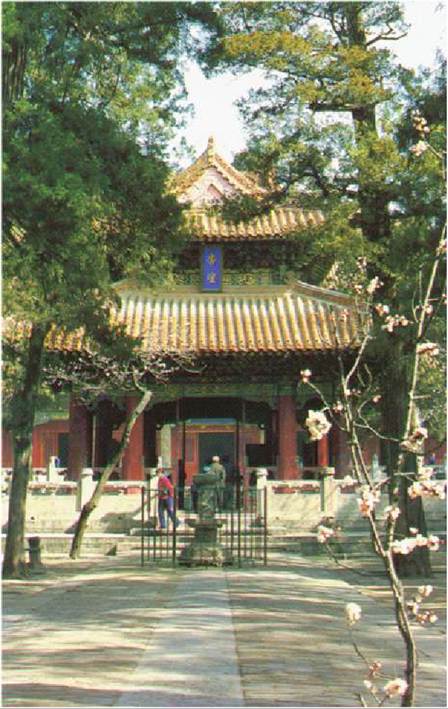
The Apricot Platform (Xingtan) is traditionally identified to be the location where Confucius lectured to his students.
The Neo-Confucian Tradition
Although Confucianism served nominally as China’s orthodoxy from the second century bce to the beginning of the twentieth century ce, a span of over 2,000 years, it coexisted with Daoism and Buddhism during that entire period and at times was even overshadowed by them. Its refusal to address issues pertaining to the supernatural and its neglect of matters in the afterlife made it less appealing in a tumultuous and uncertain age. The vacuum was conveniently filled by Daoism and Buddhism. Since the twelfth century ce, however, through a revitalization movement known in the West as Neo-Confucianism, it regained the initiative over its Daoist and Buddhist rivals through the embracing of their metaphysical and cosmological assumptions, and became the predominant religious tradition in China until the modem era. Indeed, as advocated by its most eloquent representative, the scholar Zhu Xi (1130-1200), its new scriptural corpus, the Four Books, composed of the Analects, the
Mencius, the Great Learning, and the Doctrine of the Mean, would constitute the main curriculum upon which the civil service examination of late imperial China would be based. Between 1313 and 1905, all aspiring scholars and government officials in China had to study, and were examined on, their mastery of this set of canonical works, which provided the basis of their worldview and their outlook on life. Others within the Neo-Confucian movement would challenge Zhu Xi’s interpretations, both during his lifetime and beyond, notably Wang Yangming (1472-1529) three centuries later. These scholars differed primarily in what they viewed as the best way to attain the same Neo-Confucian goal of “inner moral cultivation and external skillful management of society and state” (neisheng waiwang).
However, personal moral perfection and universal transformation of the human community remained their shared religious quest.Confucianism in the Modern Age
Beginning in the fourteenth century, as China entered the late imperial period, the Confucian tradition became fossilized and rigid. The examinations were formulaic wordplays instead of genuine expressions of moral insight or sound administrative proposals. The entire Confucian tradition was turned into a mere tool of state control and social patronage. Political autocracy, patriarchal authoritarianism, and social exploitation were all carried out in its name. But it was since the mid-nineteenth century that Confucianism suffered its most precipitous decline. This process began after the Opium War of 1839-1842, in which China was handily defeated by Great Britain. Other foreign powers quickly followed suit to demand enormous concessions from a weakened and disgraced China. For China’s patriotic young generation of intellectual elite, this humiliating development exposed the shortcomings of their Confucian heritage. Confucianism was blamed for China’s political, social, and economic backwardness. As a result, the New Culture movement that began in the second decade of the twentieth century made Confucianism their main target of assault. “Down with Confucius and sons!” was now the popular call for rebellion against the tradition. Indeed, the birth of the Chinese communist movement was in part attributable to this rebellious mode of thinking. From the perspective of the radical revolutionaries, Confucianism was a reactionary ideology of the ruling elite in China’s feudal past that should be cast into the dustbin of history.
But the obituary for Confucianism appears to have been written prematurely. Despite repeated and sometimes violent attempts to rid China of the harmful influence of Confucianism, the “anti-Confucius” campaign of the Cultural Revolution period (1966-1976) on mainland China being the most glaring example, the tradition has survived. As the opening vignette demonstrates, Confucianism as a religious tradition is still very much alive in contemporary China. The central importance of the family, the persistence of ancestral remembrance, and the value placed on education and self-improvement are evidence of the resilience of the Confucian ethos among many Chinese, and even East Asians in general. Some argue that the economic and industrial progress of the “Four Dragons” of Taiwan, South
Korea, Hong Kong, and Singapore since the 1980s, and a similar development under way in China as well, might have been brought about by the Confucian heritage in these East Asian countries.
At the same time, an emergent group of “New Confucians,” both inside and outside China, has been active as advocates for the revival of the Confucian teaching on philosophical and religious grounds. This group finds a new relevance for the Confucian tradition in the postmodern world on the ground that it expresses values of universal significance. These new defenders of the Confucian faith seek to rearticulate Confucianism for our time in the same way Confucians of the past had rearticulated it for theirs. Their reinvigorated advocacy has brought about genuine interest in the universal relevance of Confucian ethics and religiosity among some Western scholars. One notable group is the “Boston Confucians,”- who argue that Confucian teachings should be an integral part of the dialogue on contemporary social, political, and moral issues.
Equally notable is the new popularity enjoyed by Confucianism in China within the past two decades, in part promoted by the Chinese government. Academies devoted to the study of the Confucian tradition have been established, instruction on and the memorization of the Analects for school-age children are widely promoted, and even TV programs dedicated to the explanation of the relevance of Confucian teaching to contemporary Chinese society are eagerly viewed by a growing audience. And ceremonies commemorating the birthday of Confucius are now led by high-level central and local government officials. When China hosts major international athletic meets, such as the 2008 Beijing Olympics, Confucian themes are featured prominently to showcase Confucianism as the quintessential core of Chinese consciousness. “Confucius Institutes” have been sponsored and funded by the Chinese government at universities in many Western countries to export China’s “soft power” and to enhance China’s positive image.
Video: Confucian Revival in Communist China
Confucianism as Pan-Asiatic Tradition
Confucian texts had found their way beyond China no later than the turn of the Common Era, along with China’s outward expansion both culturally and territorially. But it was in the form of Neo-Confucianism that this religious and philosophical tradition had exerted its most significant impact on China’s neighbors such as Korea, Japan, and Vietnam.
GLOBAL SNAPSHOT
Confucianism in Korea
Soon after its elevation to orthodox status in Han Dynasty China (206 bce-220 ce), Confucianism found its way to the Korean Peninsula where, since the beginning of the Joseon Dynasty (1392-1897 ce), Confucianism had also become the orthodox ideology of the Korean state, strongly supported by the court and the official-scholar elites. Today, Confucianism’s influence in South Korea remains vital. Unlike their fluctuating fate in China, Confucian values have retained their strong presence in South Korean society. Ancestral and familial devotion is an integral part of Korean ethics. As well, educational endeavor, evidenced by the severe competition for entrance into prestigious schools from kindergarten to college, is a national sport unsurpassed in other parts of Asia, including China, Japan, Taiwan, and Singapore. Private academies devoted to Confucian studies can be found throughout the country. Indeed, one’s filial obligation to the family is often a powerful motivating force to strive for academic success.
A national effort has been made in Korea to preserve and promote the filial concept as the foundational principle of the country’s morality. Since 1973, May 8 has been designated Parents’ Day, when the Ministry of Health and Welfare gives out Filial Piety Awards to exemplary individuals who perform extraordinarily meritorious duties for their parents. In November 2016, the National Assembly also passed a Filial Piety Law to ensure good treatment of aging parents. Politicians and celebrities tout their filial devotion with no reserve or embarrassment.
Meanwhile, ancestral rites are carried out in the countryside to enhance the bond between the living and the dead. An example can be found in the Son lineage in Yangdong, a UNESCO World Cultural Heritage site famous for its preservation of Confucian lifestyles and architectural styles. At the ancestral house built in 1457 ce by the founder of the lineage, Son So (1433-1484 ce), a high official in the Joseon court, the current members of the clan annually gather to commemorate their ancestors of the past six centuries. Dressed in traditional gown and hat, they offer food and wine, read recitations, and prostrate themselves in front of the ancestral tablets. Confucianism is alive and well in South Korea.
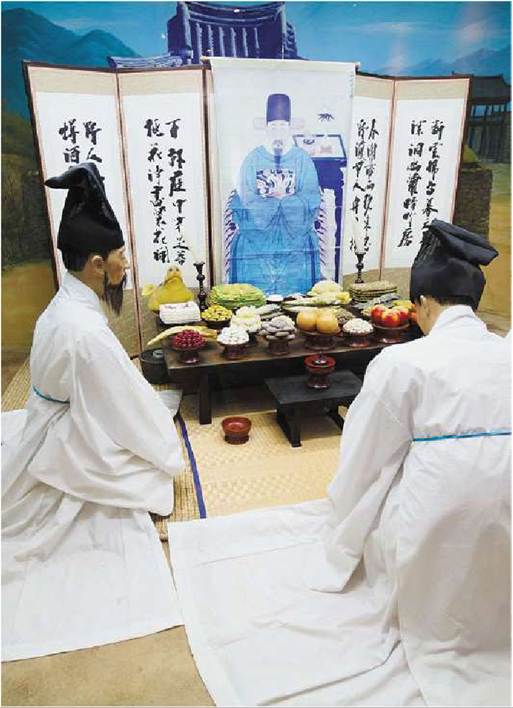
Ancestral worship at the Naganeupseong Folk Village museum, South Korea.
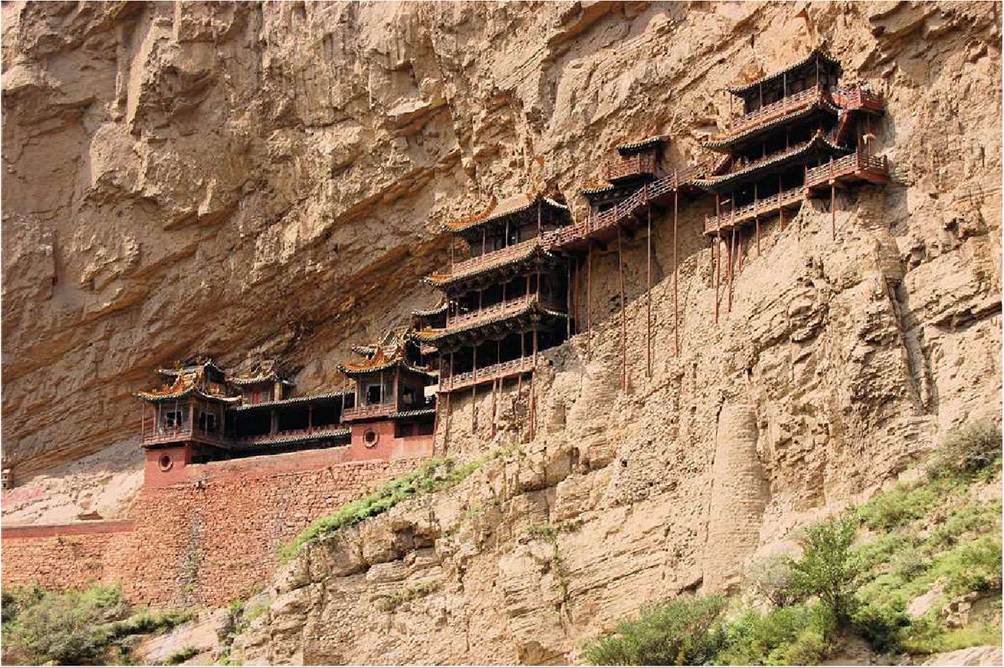
The Xuankong (Hanging) Temple near the City of Datong in China’s Shaanxi Province. Built more than 1,400 years ago, it hangs on a mountain cliff hundreds of feet above the ground through the use of crossbeams inserted deep into the vertical rock surface. Honoring Confucius, Laozi, and the Shakyamuni Buddha, the Temple exemplifies the harmonious coexistence of the three prominent religions of China: Confucianism, Daoism, and Buddhism.
Thanks to the dynamic influence of Zhu Xi and his intellectual successors, Confucianism became the dominant philosophy and state orthodoxy, beginning with the Joseon Dynasty in Korea (fourteenth century), the Tokugawa Shogunate in Japan (seventeenth century), and the Nguyen Dynasty in Vietnam (nineteenth century). The social organizations, bureaucratic cultures, and religious assumptions of these Asian neighbors of China echoed much of what existed in China during its late imperial period (fourteenth to twentieth centuries).
The History of Daoism
As you have learned in the section on teachings in this chapter, Laozi and Zhuangzi, traditionally considered founders of Daoism, were shadowy figures whose books bearing their names were actually anthologies containing divergent strands of thought. At best they could be considered proto-Daoists. Alongside them were mysterious shamans who claimed that they had secret formulas for dietary regimens and alchemical concoctions that would bring about impressive health benefits and even immortality. In addition, numerous other early commentators of the Dao contributed to the formation of a “Daoist school” or “Daoist tradition” no later than the second century все.
The Deification of Laozi
A crucial development that led to the rise of Daoism as an organized religion was the deification of Laozi. Sometime between the second century все and the second century ce, Laozi came to be revered as a human incarnation of the Dao. Remarkably, a belief arose that the Dao could now intervene in human affairs by directly and personally imparting teaching to save the world through its human form. As the Dao incarnate, Laozi was the object of worship. In a text entitled Laozi bianhuajing {Scripture of the Transformations of Laozi), compiled around the middle of the second century ce, the various incarnations of Laozi over time were recounted. One such incarnation was in the form of a messianic figure dedicated to the salvation of the world; the title Laozi assumed in this case was Taishang Laojun, the Venerable Lord of the Most High.
Even more significantly, Laozi as Taishang Laojun could give instructions to selected individuals on the esoteric secrets of the Dao as part of his scheme to save the world. This deified and messianic Laozi thus turned the Daoist teaching into a divine revelation on salvation, which has since become a major tenet of organized Daoism. Once Laozi was venerated as the Dao incarnate, as well as the dispenser of redemptive instructions, Daoism became a salvational faith. A whole pantheon of gods and spirits, both in nature and within the human body, came to be worshiped as physical manifestations of the Dao and as agents of deliverance.
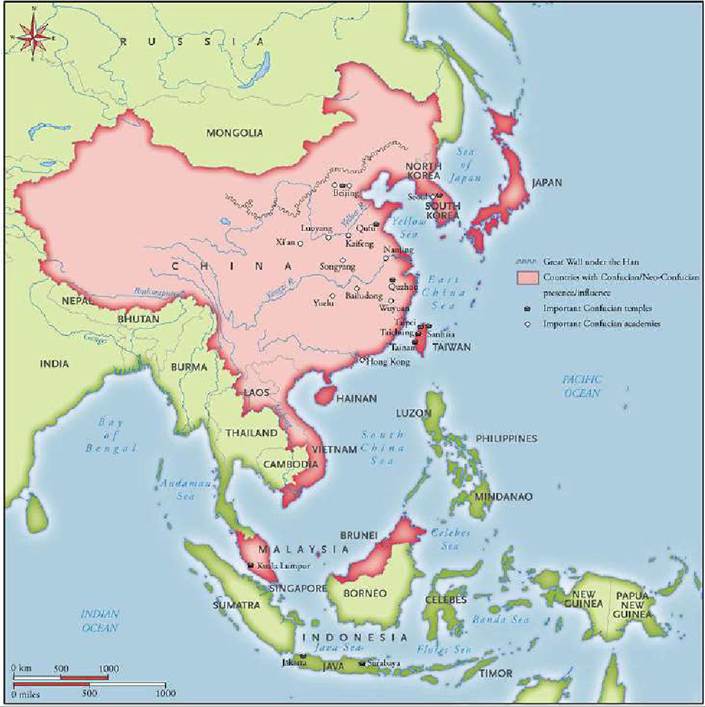
Confucian influence in East Asia.
Beginning in the middle of the second century ce, Daoism became an organized and large- scale movement among the common people« In the year 142 ce, a man by the name of Zhang Ling (or Zhang Daoling) allegedly had a fateful encounter with the deified Laozi, who indicated to him that the world was in great trouble and that he, Zhang Ling, would be taught the right knowledge and proper practice to save it. Zhang Ling was to adopt the title of Tianshi (Celestial Master; see the section on the teachings of Daoism in this chapter), and the teaching he was to transmit would be called Orthodox Unity.
Zhang Ling supposedly transferred the Tianshi title to his descendants down through the ages until the present day (in Taiwan). The movement would be known variously as “Celestial Master,” “Orthodox Unity,” or “Five Bushels of Rice,” the last derived from the amount of contributions members were expected to make to the organization at their initiation. During the second half of the second century ce, the movement acted as a theocratic shadow government, providing material aid and physical healing services to its membership, in addition to offering a vague hope of messianic salvation. A contemporary and parallel movement, alternatively known as “Great Peace” {Taiping) and “Yellow Turbans” {Huangjin), took the messianic message more seriously and rebelled against the government in an attempt to usher in a new age. This movement was ruthlessly suppressed, even though the dream of Taiping would live on.
Later Daoist Historical Development
The Celestial Masters made an arrangement with the government in 215 ce whereby it abandoned its theocratic base in southwestern China and migrated closer to the political center in the north. But soon the Han Dynasty fell, and the subsequent short-lived regimes failed to maintain their power in the face of devastating invasions by nomadic non-Chinese groups such as the Huns, forcing the political and cultural elite to flee south toward the Yangzi River basin. The Celestial Masters followed this southward migration and became popular there as well, setting up its headquarters on the Dragon and Tiger Mountain (Mount Longhu) in Jiangxi Province in southeast China. During the ensuing Period of Disunion, three centuries when China was politically divided between north and south, Daoism entered a most creative period.
First, the Confucian elites gave new philosophical interpretations to both the Daodejing and the Zhuangzi that downplayed, if not totally eliminated, the religious elements on meditative transformations and magical physical transmutations in the two texts. Then someone who was much more closely related to the Celestial Masters, a certain Ge Hong (283-343 ce), who styled himself the “Master Who Embraces Simplicity” (Baopuzi; see his earlier mention in the section on the teachings of Daoism), vigorously asserted the possibility of attaining physical perfection in the form of immortality through various techniques involving alchemy.
But the most significant development in Daoism was in the area of brand-new textual revelations and ritual reforms. Responding both to the competition offered by a rapidly expanding Buddhism and to the need to distinguish itself from the “uncouth” and “coarse” practices of popular religion, Daoist leaders from aristocratic families created new texts and devised new rituals that they claimed were revealed to them through ecstatic encounters with an ever-growing number of Daoist deities.
In the south, the Shangqing (Highest Clarity) and the Lingbao (Numinous Treasure) set of texts and rituals began to emerge almost simultaneously in the fourth century ce. While the Shangqing emphasized individual experiences of spiritual fulfillment through meditation and mental visualization, the Lingbao focused on ritual precision and use of talismans for the purpose of universal salvation, though the two overlapped considerably as well. In the north, similarly intense and creative activities also took place under the claim of new revelations from Taishang Laojun, the deified Laozi. A Tuoba (a people outside of the Great Wall) ruler, Emperor Taiwu of the Northern Wei Dynasty, was touted as the “Perfect Lord of Great Peace” and declared that the ideal world had arrived. This was a deliberate effort made to reclaim the aspiration of taiping proposed by the Yellow Turbans in the second century ce.
Common among the various Daoist groups of this period was the belief in and anticipation of an impending cataclysmic disaster that would radically transform the existing world. There was an anxious, yet exciting, expectation of the imminent arrival of a savior-like figure who would protect the devout followers from harm and ensure them a safe journey to the world to come—a perfect world populated by the faithful alone. This eschatological (vision of the end of time) and apocalyptic (revelation of a secret divine design) feature of the Daoist movement resembles many millennial traditions in other cultures.
Because of the proliferation of revelatory texts and the diverse array of rituals, the Period of Disunion also witnessed the first attempts made to classify and standardize them. The texts on revelations and rituals were organized into “three caverns” (a conscious imitation of the Tipitika canon of Buddhism) and “four supplements.” This form of classification would constitute the framework of the ultimate Daoist canon, known as the Daozang (Treasury of the Dao). The most complete version of this work was printed in 1445 ce in 480 sections, 1,120 titles, and over 5,300 volumes.
During China’s medieval period, lasting from the seventh to the fourteenth centuries, organized Daoism enjoyed imperial patronage and became very much a part of the cultural life of the elite. Along with a popular Buddhism and the nominal state ideology of Confucianism, it was one of the “three teachings” of the realm. Its emphasis on nature and a free spirit informed much of the art and literature of the time. The highly valued monochrome landscape paintings and cursive calligraphic art of the elite scholars of this time reflected central Daoist values.
Several new orders also gained prominence during this time, the most influential among them being the Quanzhen sect (Complete Perfection). Founded by a man named Wang Zhe (1113- 1170 ce), this school of Daoism embraced elements from both Confucianism and Buddhism. From Confucianism it took moral values, and from Buddhism it adopted monasticism and clerical celibacy. In addition to the Daodejing, the Confucian Classic of Filial Piety and the Buddhist Heart Sutra were given the highest prominence by this tradition. Quanzhen Daoism is one of the only two Daoist groups that are still active today, with its headquarters located in the White Cloud Shrine in Beijing. The other group is the Celestial Masters, with its current leader residing in Taiwan.
During the late imperial period in Chinese history (fourteenth to nineteenth centuries), Daoism was put on the defensive by the triumphant Neo-Confucians. Its clergy was tightly controlled by the state through the highly regulated issuance of ordination certificates. As a religious tradition, it was eclipsed by Confucianism. Although the Confucian elite grudgingly acknowledged the “philosophic” brilliance of the Daodejing and the Zhuangzi, they regarded organized Daoist groups as nothing more than a corrupted form of pristine, original Daoism. Organized Daoism was marginalized as superstition, unworthy of elite attention. This contempt for Daoism continued beyond the imperial period, was intensified in the early twentieth century, and was adopted as official policy under the communist regime in 1949.
The New Culture movement of the 1910s and 1920s regarded both Daoism and Confucianism as unwanted vestiges of China’s feudal past. The Cultural Revolution (1966-1976) that did so much damage to Confucianism also proved devastating to Daoism. Many historic Daoist shrines and sites were destroyed or sacrilegiously damaged, and all performances of Daoist rituals and liturgies were banned. For all intents and purposes, Daoism as an organized religion ceased to exist in mainland China. Yet the tradition survived amid China’s nebulous folk religion. It also continued to exist, often robustly, outside China among Chinese communities in Taiwan, Hong Kong, and Southeast Asia.
Since the late 1970s, however, a Daoist revival of sorts has begun. Daoist ceremonies are once again openly observed in China, and a new generation of Daoist priests has been trained to carry on the tradition and to rebuild the shrines. Academic study of Daoism, primarily by Japanese and French scholars at the beginning, and now joined by Americans and Chinese themselves, has created new understanding of the tradition from the point of view of both doctrines and practices. Some of the scholars have actually become ordained Daoist priests of either the Celestial Master or the Quanzhen tradition to access more accurate and authoritative interpretations of Daoism.
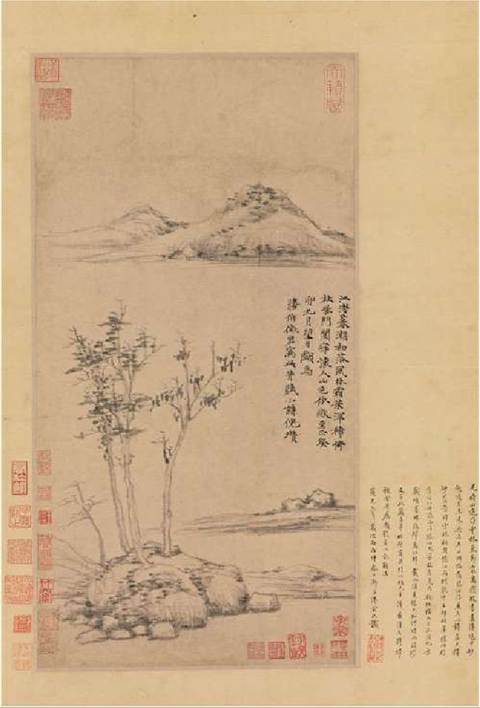
This painting, Wind among the Trees on the Riverbank by Ni Zan (1306-1374), is best known for the quietude and balance in nature it expresses. China, Yuan Dynasty (1271-1368), dated 1363.
GLOBAL SNAPSHOT
Daoism in Feng Shui and Martial Arts
Daoism’s global reach is evident in two popular practices worldwide: the New Age art of building-siting and interior design known by the Chinese name “feng shui,” and martial art exercises practiced fortheir promised benefits in health, mental sharpness, and selfdefense. As you may recall, a central concept in Daoist teaching is qi, the vital force and life energy that links all life forms to nature. Feng shui, meaning “wind and water,” is based on the belief in the efficacy of qi to allow humans to live and thrive in their natural environment. Similarly, Chinese martial art forms such as taiji (traditionally spelled “tai chi”), Wudang fists, and qigong (cultivation of qi) call for the harnessing of qi in reducing stress, calming the mind, and protecting oneself from attackers.
By siting a house, a tomb, or a business in an auspicious spot where positive qi is deemed to flow unobstructed, feng shui practitioners believe they will enjoy good fortune and good health. Conversely, they also consider rearranging furniture, mirrors, and doorways in certain directions, or changing the interior partitions of one’s dwellings to be effective in warding off evil influences and averting disasters. Hong Kong Disneyland is known to have moved its main gate by 12 degrees to accommodate the feng shui sensitivities of the local theme park attendants.
The popularity of Chinese martial arts in movies and in exercise gyms, particularly when they feature themes of the soft overcoming the hard, the yielding winning over the aggressive, can be attributed to the global acceptance of the Daoist teachings of the Dao as passive and nonassertive. Bruce Lee, who captivated a worldwide audience through his several classic movies exemplifying the grace and power of Chinese martial arts, summed up his philosophical outlook with the words “Be water,” a very Daoist metaphor. Similarly, the dance-like movements of taiji and the subtle strength of qigong meditational steps have attracted a global following as well.

A Hong Kong building with a hole to allow the smooth flow of qi.
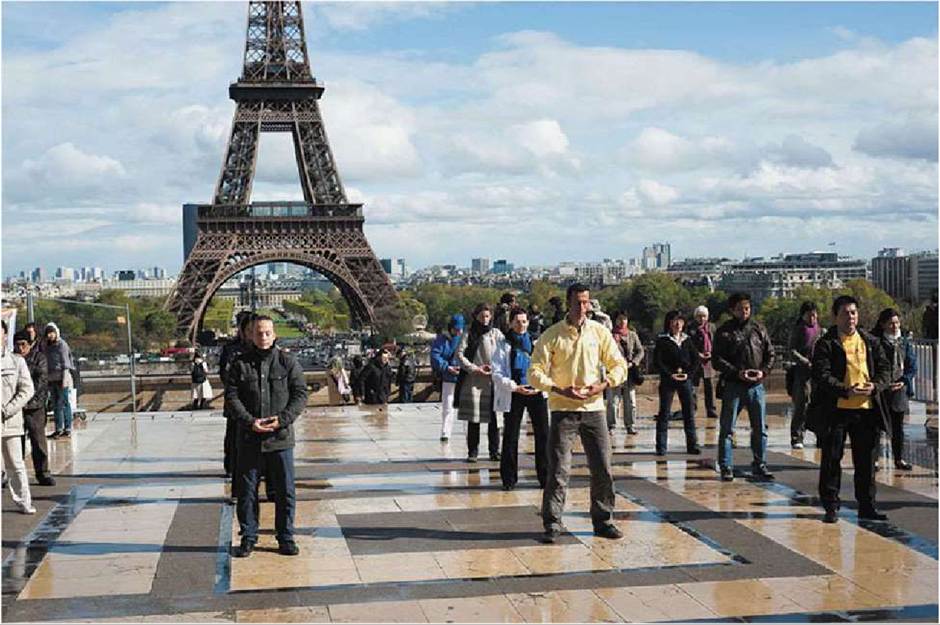
In Paris, France, people gather to practice qigong and taiji exercises.
\>
Daoism as a Pan-Asiatic Tradition
Like its Confucian counterpart, Daoism is not confined to the Chinese mainland. The proto- Daoist texts of Laozi and Zhuangzi had certainly reached Korea no later than the Goryeo period (918-1392), even though Buddhism was the dominant faith of the time. By the ensuing Joseon Dynasty (1392-1897), when Confucianism was the state orthodoxy, Daoism in the form of shamanism, mountain worship, and immortality practices had become an integral part of Korean folk religion. Even today, the national flag of South Korea contains the Taegeuk symbol of yin-yang complementarity and four of the eight divinatoiy trigrams. Similarly, in Japan, Daoist practitioners have combined with certain Buddhist groups and indigenous Shinto cults to form specific folk religious traditions since the Tokugawa period (1600-1868). Specifically, the Shugendo (shamanistic mountain ascetics) and the Koshin religious practice of controlling the decaying agents of the human body to prevent them from shortening the human lifespan display unmistakable Daoist influences. In Southeast Asia as well, Daoism has found its way into the beliefs of the Xiantian Dao (Way of Prior Heaven) of Malaysia and the Caodai (High Power) tradition in Vietnam. Both are movements promising deliverance from the current age of decadence and corruption.
Political authorities have embraced both Confucianism and Daoism to legitimize their rule and to impose order on society. How did these religions fare when compared with other major world religions?
\,
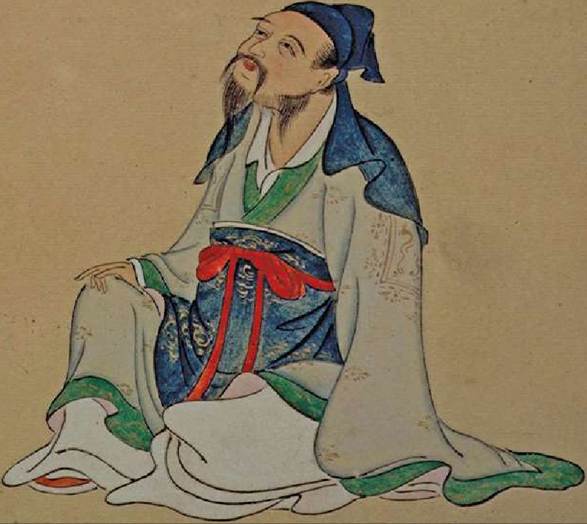
This painting of the poet Li Bo (Li Bai, 701-762) shows him as a Daoist immortal.
Self-Assessment 8.2
[Please note: You must be using an online, browser-based eReader in order to view this content.]