Women in Daoism
Because of the feminine emphasis of the Daodejing, it can be assumed that Daoism’s treatment of women is generally better than that of Confucianism. Yet the situation is more complicated than it might first appear.
The positions and roles of women in organized Daoism have to be examined in the larger context of Chinese society, which until recent times has indeed been patriarchal and sexist. It is therefore not surprising that women only play limited roles within the Daoist clerical hierarchy. Even today, the vast majority of Daoist priests are male.And yet it is also undeniable that because of women’s greater sensitivity to the spirits and their keener communication ability with the invisible world, as well as their supposed exemplification of the divine Dao, they do have access to the roles and positions denied to most women in Chinese society at large. Women’s special power to intercede with the deities often makes some of them more outstanding and influential practitioners of Daoism than men.
A Daoist movement known as the Celestial Masters (Tianshi; see more details in the section on the history of Daoism in this chapter) identified five categories of women suited to be Daoist practitioners: young unmarried women; women unable to marry because of their inauspicious horoscopes; women forced into marriage; rejected (divorced) wives; and widows. All these were vulnerable individuals to whom the Celestial Masters offered an escape and a way to assert their worth. In the Tang Dynasty (618-907 ce), women from aristocratic families became Daoist nuns in substantial numbers, either between marriages or as widows. In addition, imperial princesses and secondary wives often received ordination as Daoist priestesses.
Equally noteworthy is the fact that some women were actually founders of Daoist sects. Most well-known among them were Wei Huacun (252-334 ce) of the Shangqing (Highest Clarity) tradition and Zu Shu (most active during 889-904 ce), who initiated the Qingwei (Pure Subtlety) tradition. Sun Bu’er (1119-1182 ce) was a famous female disciple of the founder of the Quanzhen (Complete Perfection) sect who became a senior leader in the movement with the power to teach and ordain other female practitioners. (We examine these other Daoist groups more closely later in this chapter.)
No comparable number of women can be identified as prominent Confucians. It is thus accurate to conclude that women generally fare better in Daoism than in Confucianism.
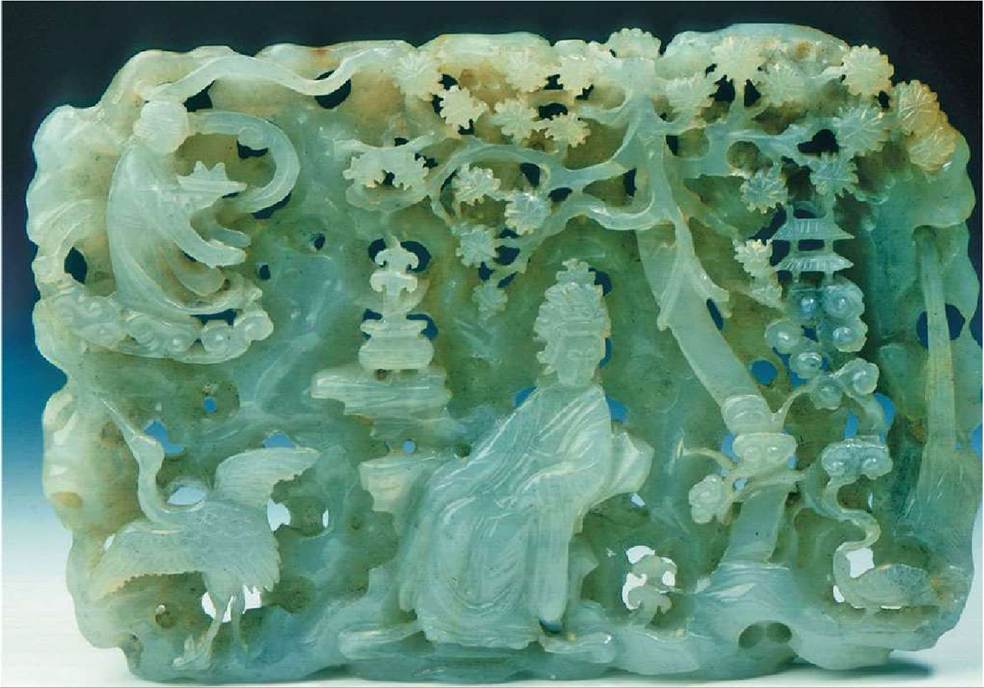
Xiwangmu (Queen Mother of the West) is one of the most prominent female Daoist deities. She rewards her devout followers with immortality by feasting them with magical peaches.
Self-Assessment 8.1
[Please note: You must be using an online, browser-based eReader in order to view this content.]