The Teachings of Daoism
As asserted earlier, Daoism evolved out of the same ancient Chinese religious mindset as Confucianism did. But instead of regarding Tian as the Absolute Ultimate, as the Confucians do, Daoists from the beginning hold Dao to be supreme.
It should be recalled that the Dao is also central to the Confucian tradition. However, the Daoists articulate a very different understanding of the Dao. It is this alternative apprehension of the Dao that serves as the point of departure for their entirely different mode of religious experience from that of the Confucians.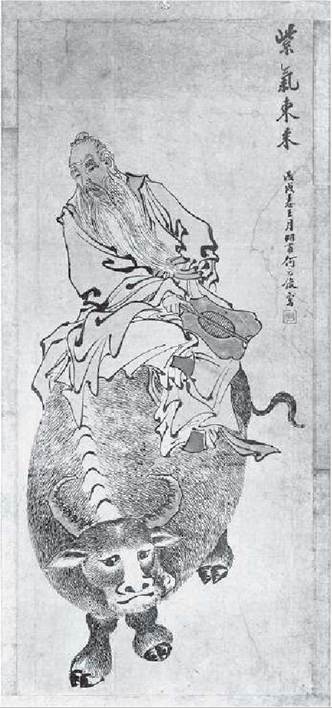
Laozi riding on the back of a water buffalo as he retires into the realm of the immortals.
Laozi (Lao-tzu) and Zhuangzi (Chuang-tzu)
For much of Chinese history, the best known and earliest identifiable Daoists were Laozi (Master Lao) and Zhuangzi (Master Zhuang). Laozi, traditionally alleged to be a mystical teacher of lost rituals from whom Confucius had sought instruction, was in fact more of a composite figure than an actual person and was the reputed author of the Daodej ng (Tao-te Ching; The Scripture of the Way and Its Potent Manifestation), alternatively known as the Laozi. Zhuangzi was an obscure individual reportedly active in the late fourth century bce who was credited with authorship of the second most influential Daoist text, the Zhuangzi. Both texts are more representative of certain modes of thinking than of individual thinkers, as they are in effect anthologies containing different strands of thought rather than coherent and logical teachings of single authors. One point, however, is clear: they are self-consciously antiConfucian in that they express a decidedly alternative understanding of the Dao and of ideal human action. In addition, both the Daodejing and the Zhuangzi also contain descriptions of perfected human beings who possess amazing powers of magic and immortality, a subject that Confucian texts never touch upon.
Both texts suggest that, through intense inner psychic journeying and mystical conditioning of the human body, individuals can acquire impressive powers of transformation and invulnerability to the decaying agents in nature.The Daodejing
The eighty-one-chapter Daodejing, categorized into two sections labeled respectively as “Dao” and “De,” is the most translated and most popular Chinese book in the West. Virtually all the different schools and sectarian lineages within the Daoist movement regard this work as foundational in importance.
In contrast to the Confucian Dao which, as you remember, is the ideal ethical-social-political order ordained by Tian for human beings, the Dao of the Daodejing antedates Tian and acts as the root of the natural order. Here Dao is the primordial entity that exists in an undifferentiated state prior to the coming into being of the myriad things, including Tian and Di, which now stand for nothing more than nature itself. The lofty primacy of the Confucian Tian is supplanted by the nebulous Dao of the Daodejing, as indicated by the following celebrated passage:
There was something undifferentiated and yet complete, which existed before Tian and Di
Soundless and formless, it depends on nothing and does not change
It operates everywhere and does not stop
It may he regarded as the “Mother of the world”
I do not know its name; I call it Dao.
—Daodejing, Chap. 25
In one broad stroke, the entire Confucian cosmological scheme is turned upside down here. It is Dao, not Tian, that gives birth, like a mother, to the myriad things. It is Dao, not Tian, that serves as the primal source of the cosmos. Echoing the cosmogonic (concerning the origin of the cosmos) view of the Book of Changes, the Daodejing gives an even terser summary of the generating process of the cosmos:
The Dao gives birth to the One [Being, Existence]
The One brings forth the Two [Yin and Yang]
The Two give rise to the Three [Tian, Di, and Humans]
The Three engender the Ten Thousand Things [world of multiplicity and diversity]
—Daodejing, Chap.
42 Again, the primacy of the Dao as the procreator of the entire universe and everything in it is unequivocally asserted here. As the ground of all beings, this Dao is compared to a “mysterious female,” “water,” “infant,” and “uncarved block,” all alluding to the beginning of life and form. However, unlike the Confucian Dao, which requires superior human beings (the junzi [men of virtue] and the shengren [sages]) to actualize its ideal design, the Dao of the Daodejing can only maintain its pristine form when humans are not involved and are wise enough to leave it alone. Thus, the ideal course of action for insightful and wise human beings is to observe wuwei (actions without intention) and ziran (natural spontaneity) to allow the Dao to maintain a spontaneous order and optimal state. These two ideal approaches to life are indicative of the Daodejing’s belief in the innate perfection and completeness of the Dao. Wuwei calls for a minimalist and noninterventionist attitude in human action, whereas ziran rejects any artificiality and contrived undertaking as detrimental to the well-being of humans and nature. Ultimately, the Dao in the Daodejing is indescribable and ineffable, for it defies verbalization and precise definition. “The Dao that can be [verbally] expressed is not the constant Dao,” insists the Daodejing in its first verse.Yet the transcendent Dao is, at the same time, manifested in the myriad things through its presence in them as de—the very “potent manifestation” of each thing. In contrast to the de of the Confucians, which is the charismatic power of the moral elite—and morality itself, the de of the Daodejing points to the concrete expression of the Dao in all things. De is the “thingness” of a thing—that which makes a thing what it is. The combination of Dao and de, then, helps to bridge the gap between the transcendent and the immanent for the author(s) of the Daodejing. The Dao is the transcendent ground of being; yet through its expression in the de of the myriad concrete things, it is also fully immanent.
The Zhuangzi
The extant version of the Zhuangzi consists of thirty-three chapters divided into three sections —“Inner,” “Outer,” and “Miscellaneous.” The first seven Inner chapters are generally believed to be the authentic writings of Zhuang Zhou, the putative author. Yet as in the case of the Daodejing, we have only a vague biographical account of the purported author of this text, and little of substance is known about him.
The Zhuangzi is overall a different kind of text from the Daodejing. Whereas the Daodejing is terse and aphoristic in language, the Zhuangzi is effusive and vividly narrative. The Daodejing idealizes the feminine and regards the Dao as mother, but the Zhuangzi refuses to show preference for the female. The Daodejing gives much emphasis to politics and the techniques of rulership; the Zhuangzi is deliberately dismissive of all political concerns. The Zhuangzi tells stories with a witty, playful, irreverent tone that is totally absent in the Daodejing. In terms of basic worldview and cosmological assumptions, however, the Zhuangzi shares much in common with the Daodejing, hence their grouping together by later historians and bibliographers as representatives of the "School of the Dao.”
In the Zhuangzi, the Dao is not only the ineffable transcendent entity that gives rise to all things but also the immanent core that exists in all things, from the loftiest perfected beings to the lowliest broken pieces of tile and even excrement. It is therefore omnipresent, making all things ultimately equal. As such, the Dao transcends all polarities, dichotomies, and dualities that the human mind is inclined to create. Hence the use of the human cognitive and rational approach to apprehend the Dao is futile and even harmful, as it can only be realized intuitively through the abandonment of the intellect. The mind must be able to be free from all conventional distinctions and established views, hence the advocacy of “carefree wandering” (xiaoyao yu) in the Zhuangzi.
In this connection, the discussion of “fasting the mind/heart” (xinzhai) and “sitting and forgetting” (zuowang) becomes pertinent, as both practices dispense with rationality and deliberative cognition in order to arrive at the perfect intuitive understanding of the Dao.Elements of Physical Invulnerability in the Daodejing and the Zhuangzi
Although both the Daodejing and the Zhuangzi are best known (in China and in the West) for their sophisticated philosophical discussions of the Dao, much less known—but no less significant—is their commentary on the physical prowess of the Daoist adepts. They hint at invulnerability to harm, longevity, and even immortality—the very promises of a Daoist religious movement that began no later than the second century ce.
We next explore the impact the two have had on Daoism as a religion. The following passages from both texts are highly suggestive:
Excerpts from the Daodejing
He who does not lose his proper place lasts long
He who dies but does not perish has longevity.
—Daodejing, Chap. 33
I have heard that people who are good at preserving their lives will not encounter wild hulls or tigers when traveling on land, and will not need to protect themselves with armor when in the army. Wild bulls will find nowhere to thrust their horns, tigers will have no place to sink their claws, and weapons will find no point to insert their cutting blades. And why is that? Because in them there is no room for death.
—Daodejing, Chap. 50
He who is richly endowed with de is comparable to a newborn baby: poisonous insects will not sting him, ferocious beasts will not seize him in their claws, and birds of prey will not snatch him with their talons.
—Daodejing, Chap. 55
Excerpts from the Zhuangzi
Far away on Mt. Guye there dwells a divine person whose skin is like ice and snow, and who is gentle and shy like a young girl. He does not eat the five grains; but [only] inhales the wind and drinks the dew.
He ascends the clouds, mounts flying dragons, and wanders beyond the four seas. His spirit is focused, thus he saves creatures from sickness and plagues, and guarantees bountiful harvests.—Zhuangzi, Chap. 1
The ultimate person is spirit-like. Though the great marshes are set ablaze, they will not make him hot. Though the rivers and streams freeze up, they cannot chill him. Though violent thunder splits the mountains and howling gales chum the ocean, they will not frighten him. A man like this rides the clouds and mist, mounts the sun and moon, and goes beyond the four seas. Death and life have no effect on him, how much less will profit and loss?
—Zhuangzi, Chap. 2
The perfected individuals of old... could go up to high places without getting frightened, enter water without getting wet, and go into fire without feeling hot. Only those whose knowledge ascends the height of the Dao can be like this.... The perfected breathe with their heels, while the ordinary men breathe with their throat.
—Zhuangzi, Chap. 6
Blowing and breathing, exhaling the old and inhaling the new, [imitating the postures of] bear strides and bird stretches—these are all undertaken for the purpose of longevity. They are pursued with fondness by people who practice gymnastic calisthenics and body nourishments in hope of [matching] Patriarch Peng’s longevity.
—Zhuangzi, Chap. 15
It is clear these two texts suggest that potent (that is, healthy and long-living) individuals embody the Dao (the holy), and that physical longevity and holiness are closely linked together. As described by the Daodejing and Zhuangzi, the early practitioners of the Dao were people who, through their use of various bodily techniques, acquired powers that enabled them to defy death and to experience the divine. These techniques and powers would very much become the concern of later Daoists. In short, the Daodejing and the Zhuangzi can be perceived as “proto-Daoist” texts by virtue of their distinctive view of the Dao and their reference to various practices and powers that anticipate those of the later organized Daoist groups.
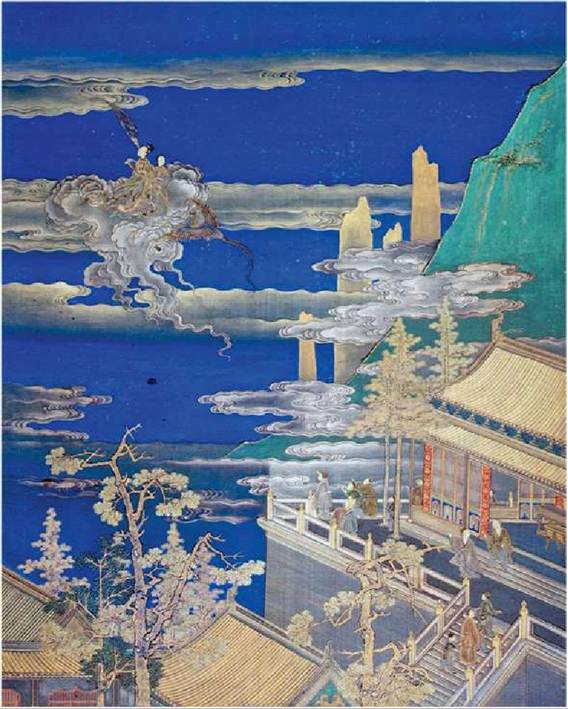
A Daoist immortal flying through the clouds, 1750. Portrayed is the sage mother of Dongling, who studied the Way and could cure illnesses. One day, amid a throng wishing to thank her, she ascended to the clouds.
Immortality and Alchemy
Possibly predating and definitely contemporaneous to Laozi and Zhuangzi were shamans who practiced austerities and world-denying habits that they claimed would earn them magical prowess, physical potency, and longevity. They can be understood as equally “proto-Daoist,” like Laozi and Zhuangzi. One later Daoist preoccupation is with the notion of xian (immortal or transcendent), long a folk religious fascination but articulated most eloquently in the Baopuzi (Master Who Embraces Simplicity), a text authored by the later Daoist advocate Ge Hong (283-343 ce). Central to the concept of xian is the conviction that bodily transformation, good health, longevity, and ultimately immortality can be acquired through proper diet, physical exercise, and drugs. People with the right recipe, formula, or prescription (fangshi) would teach these esoteric techniques and provide ready-made elixirs to those who had the financial resources and the necessary devotion to secure their services.
Inherent in the belief in immortality are the ancient Chinese assumptions about the human body and the measures that can be taken to keep it healthy and even immortal. As you may remember from our earlier discussion, the ancient Chinese believed that the human body is the microcosm that reflects the macrocosm of the cosmos. In other words, there is a direct correspondence and parallel between the human body and nature. All the myriad things in the universe are produced by the interaction of the vital energies (qi) of yin and yang. They also manifest the qualities of the five elemental phases (wuxing) and follow the principle of alternation and constant return, while maintaining balance and harmony with one another. This belief was retained and developed prominently by Daoism and Chinese folk religion. According to this view, there are three central nodal points in the human body called dantian (locations for the production of dan—pill of immortality)—in the head, the chest, and the abdomen—connected by meridian circuits through which the qi flows. And because the body is the cosmos writ small, just as there are gods and deities inhabiting the physical world outside, there are also numerous spiritual beings residing in various organs of the human body.
Based on this whole series of assumptions, the techniques of yangsheng (nourishing life) are developed. First mentioned in the Zhuangzi, yangsheng has the goal of refining the body so that it can overcome its earthly limitations and be in perfect harmony with the Dao, making it last as long as the universe. It involves an entire spectrum of exercises, including deep meditation, controlled breathing, therapeutic gymnastics, dietary regimens, even sexual techniques. All these measures of nourishing life have been practiced by religious Daoists since the second century ce and are grouped under the general heading of neidan (internal alchemical regimens) that result in immortality.
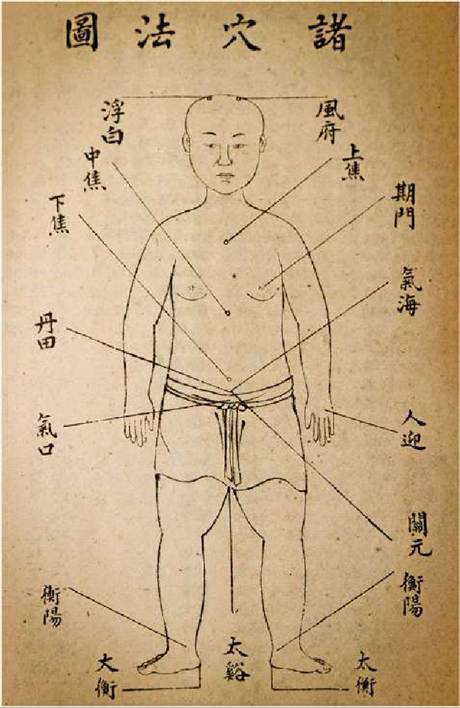
A Daoist view of the vital points in the human body through which the qi flows.
While these yangsheng techniques aim at the regeneration and reinforcement of the human body by making use of what the body originally possesses, the fangshi also focus on the compounding and refining of elixirs with substances (herbal and mineral) from nature» References to “refining gold” and transmuting cinnabar (mercury sulphate) in some later Daoist texts indicate a growing practice of alchemy for the purpose of attaining longevity and immortality. This pursuit of alchemical manufacturing of dan with minerals and plants would eventually lead to the waidan (external alchemical regimens that result in immortality) tradition in Daoism.
All the internal and external alchemical techniques discussed here are intended to produce a new body that grows within the old so that, in time, the old self will be replaced by the new in the same way that cicadas and snakes regenerate themselves.
Daoist Deities
As the Daoist tradition matured, the most exalted god in the Daoist pantheon is believed to be the Yuanshi tianzun (Celestial Venerable of Primordial Beginning), who is in turn head of a trinity of deities known as the Three Purities. Below them are innumerable divinities of both genders who fill up various ranks in a mind-boggling celestial bureaucracy that loosely corresponds to its human counterpart.
The lowliest among the spiritual bureaucrats is the local earth god, while the head of the celestial government is the Jade Emperor. Many of them have divine origins, but many are also former humans whose merits warrant their promotion to godly status. Some of the deities have national appeal, such as Lord Zhenwu (Perfect Martiality) of Mount Wudang, whereas others are more local in influence, including the stove god in each household. One ubiquitous Daoist deity, Lord Guan, is honored by business owners as their protector and benefactor. A human turned god, Lord Guan can be seen in the form of a heroic figure with a red face and a cascading black beard, sporting a long robe and holding a long blade. An altar or alcove containing a figurine of him can be found in most Chinese restaurants in North America, where he is worshiped as a patron deity.
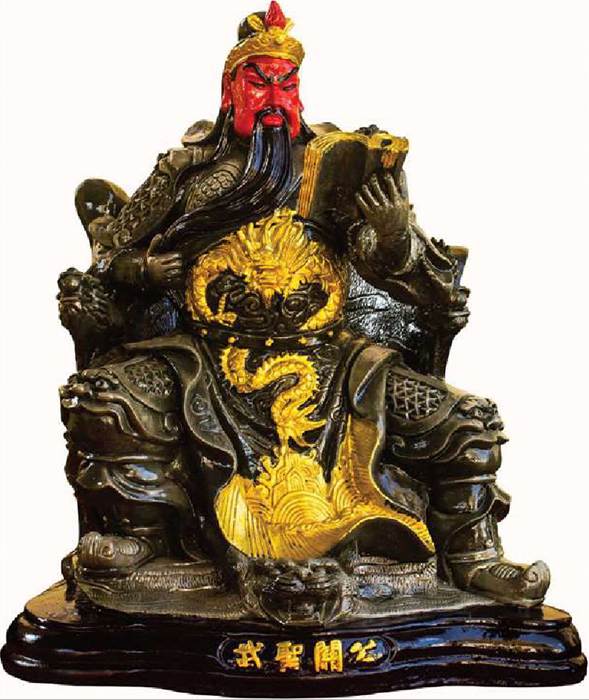
Figurine of Lord Guan as seen in many Chinese restaurants.
Daoist deities not only reside in the heavens, on earth, in the underworld, and in the homes, but also inside the human body. They are supposed to protect all the major internal organs from the decaying effect of unwholesome food and old age. The entire pantheon of Daoist deities can be accessed and appealed to through ritual performance for assistance in warding off evil, improving health, guaranteeing harmony in family and community, and attaining immortality.