Confucianism and Daoism as Ways of Life
The two Chinese religions discussed in this chapter are not just collections of precepts and beliefs, developed over a long history. More importantly, they are lived and practiced traditions.
It is in the living and practicing of the two traditions that their true meaning and value can be gauged.Confucian Rituals
From the very beginning, the Confucian tradition has put great emphasis on ritual as a crucial expression of humanity. As “moral behavior,” rituals teach people to conduct themselves with dignity and decorum, making them authentically human. As “holy rites,” rituals enable humans to communicate effectively with the spiritual powers and to interact harmoniously with one another. It is in the latter more overtly religious sense that Confucian ritual is addressed in this section.
In addition to the mundane rituals of familial and social interaction with other human beings in accordance with the prescribed rules outlined in the classic texts, the most important aspect of religious ritual in Confucianism in the premodem period was the sacrificial presentation, or the making of offerings to the spirits, including ancestors, in the form of animals, other food and drink, even jade and silk. These presentation rituals were performed at different levels— the state, the community, and the family. The grandest of the rituals were, of course, conducted at the state level. And chief among the state rituals were those connected with sacrifices to Tian and Di— and to Confucius once his teaching was exalted to orthodoxy.
Sacrifice to Tian and Di
Tian, you should recall, had been the source of legitimate political power since the Zhou Dynasty. As son of Tian, the Chinese ruler carried out Tian’s mandate to exercise his imperial prerogatives over the entire realm under Tian. The worship of Tian thus became the ruler’s exclusive privilege and obligation.
Later, with Confucianism imbued with yin-yang cosmological ideas in the Han Dynasty, Tian, the yang element, was paired up with Di (earth), the yin element, and worship of Di was added, though with much less pomp and ostentation.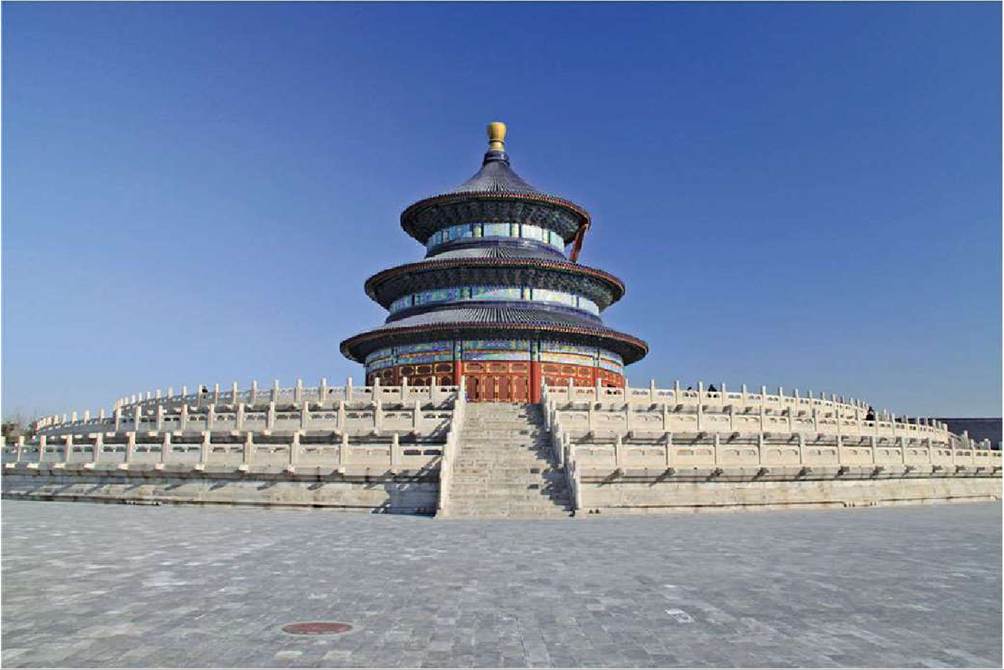
The Temple of Tian (Tiantan), where the Chinese emperor prayed to Tian on behalf of his subjects and in his capacity as “Son of Tian,” is now a popular park in Beijing.
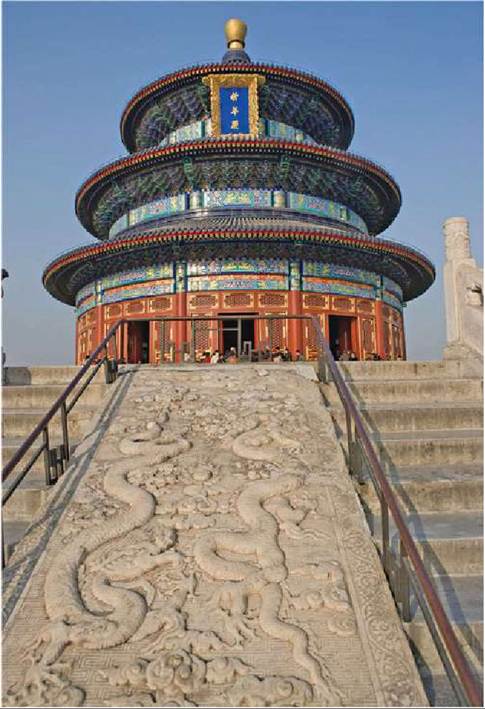
The Hall of Praying for an Abundant Harvest (Qi’nian dian), Temple of Tian (Tiantan), Beijing. The whole complex was built in 1420 under Emperor Yongle and restored in 1530 and 1751. Here the emperor celebrated the sacrifice to Tian for a good harvest. The decorated ramp between the two stairways was reserved for the emperor’s palanquin.
VOICES:
An Interview with Jason Ch’ui-hsiao Tseng
Jason Ch’ui-hsiao Tseng is a man from Taiwan with a master’s degree from an American university. He engages in educational exchange for Chinese students wishing to study in the United States.
Do you consider yourself a Confucian or a Daoist?
I do not consider myself exclusively one or the other. Both have influenced me deeply, and I regard their teachings as equally valid and complementary.
How is that possible, as their teachings often conflict with each other?
They are not in conflict. They merely represent the polar opposite of the other. They complete each other. For most Chinese, there is no necessity to choose one or the other. We think of them as the two sides of a coin—without both there is no coin. The two together constitute our native Chinese religious outlook. As a matter of fact, we also consider Buddhist teaching a third way of guiding our religious life. These teachings are generally not jealous of one another. They do not demand total exclusive devotion. They provide meaning to different aspects of our lives.
There is religious pluralism for most Chinese.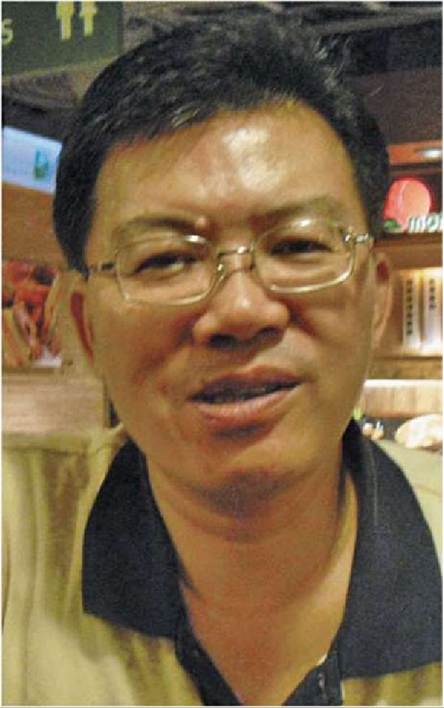
Jason Ch’ui-hsiao Tseng.
How is that so?
We do not believe that one teaching alone corners the market. As a respectful son and an upright citizen, I embrace Confucian values. They teach me to put family and society ahead of myself and to value education as the most important undertaking to improve myself. In my views on how my body works, how my health can be maintained, how different ingredients should be used to achieve balance in my food, and how I can relate to the spirits in the invisible world, I follow the Daoist teaching. And Buddhism gives me hope for a good afterlife. Together they make me a complete person.
In late imperial China, the worship of Tian and Di took place annually. On the day of the summer solstice, the emperor made a sacrifice to Tian at the Temple of Tian (Tiantan) located in Beijing’s south side. Correspondingly, on the day of the winter solstice, worship of Di was conducted at the Temple of Di (Ditan) located at the northern end of the capital. The rituals involved nine steps, including purification of the participants, performance of dance and music, reading of prayer documents, and offering of sacrifices.
Sacrifice to Confucius
The state cult of Confucius began in the Han Dynasty with the designation of Confucianism as orthodoxy. The descendants of Confucius were first given a hereditary fief, and later the Master himself was given increasingly laudatory titles and ducal honors. Temples commemorating Confucius were ordered to be built in every county and major city throughout the empire. In time, wooden tablets commemorating some of his prominent students, as well as those of successive generations of Confucian worthies such as Mencius and Zhu Xi, were installed in these temples. Although the frequency and elaborateness of the sacrificial rites conducted at these temples varied with time and locale, the traditional birthday of Confucius (the twenty-eighth day of the ninth month) was generally observed.
These rites involved dance and music accompanied by drums and bells, proclamations and didactic lectures given by local dignitaries and government officials, and offerings of incense and animals.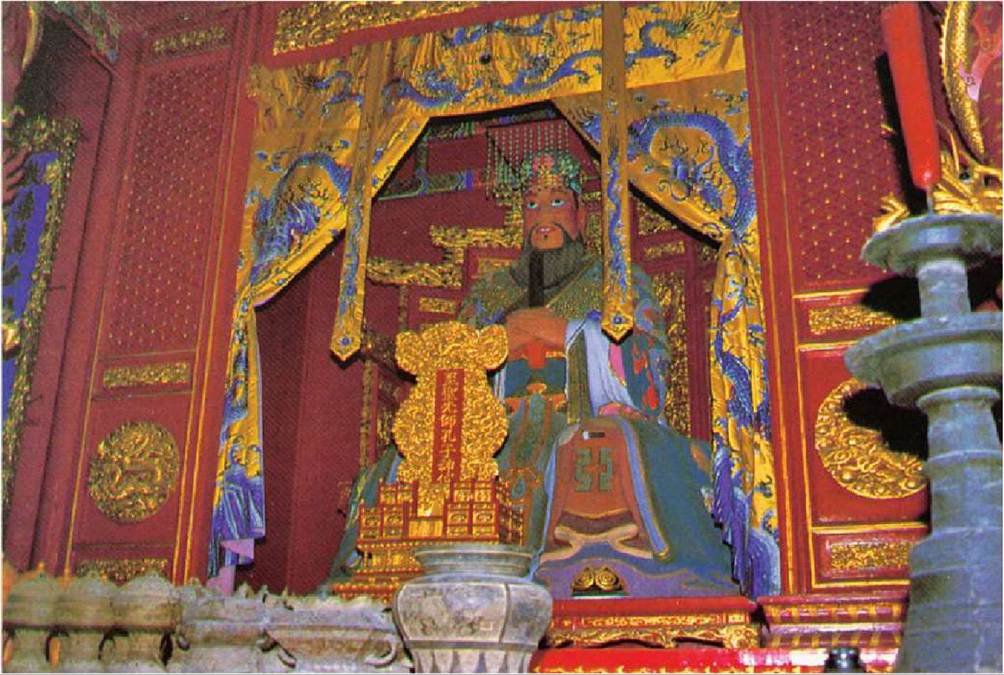
Confucius serves as an object of veneration and commemoration. He is the “Utmost Sage and Late Teacher,” as the tablet in front of his statue declares.
The most magnificent Temple of Confucius is located in his native county of Qufu, not far from Mount Tai in present-day Shandong Province. Built and maintained at state expense, the Qufu Confucian Temple has a main building with a palatial design supported by dragondecorated pillars, all meant to accord the Master the highest honor comparable to that of a ruler. Stone steles are engraved with the calligraphy or essays of various emperors in Chinese history, all lauding the moral and cultural accomplishments of the sage. This Confucian Temple in Qufu was a pilgrimage site for generations of scholars and aspiring literati and is still popular among tourists today.
Family Rituals
The custom of commemorating and honoring ancestors in China goes back to the dawn of recorded Chinese history. But Confucianism, with its focus on xiao (filial piety), lent further theoretical support to the practice. The Confucian teaching maintains that one’s filial obligation to parents and ancestors is the core of one’s humanity. Thus, while the state monopolized the worship of Tian/Di and the educated elites controlled the sacrifice to Confucius, all people could participate in the family ritual of honoring parents and ancestors. Sacrifice to the ancestors is especially important because it gives the descendants a sense of belonging and continuity and thereby a religious appreciation of the chain of life that links them to their forebears as well as their descendants.
In the Family Rituals, compiled by the Neo-Confucian scholar Zhu Xi, detailed step-by-step liturgies are provided for ceremonies associated with ancestor worship.
Chapters describe daily “looking in” on the ancestors; more elaborate semimonthly “visits”; “reports” on major family events such as births, weddings, and deaths; and formal “offerings” on festival days and seasonal sacrifices. The following is a summarized version of Zhu Xi’s instructions for the rites of making seasonal offerings to the ancestors.7In the preparatory phase, the date for the sacrifice is selected by divination performed in front of the ancestral shrine in the preceding month. Then, three days before the event, the designated leading man and woman will each lead family members of their respective gender to perform purification rituals in their designated quarters, men in the outer and women in the inner. The men also make the main hall sparkling clean and arrange the place settings for each generation properly. The women will set the incense burner and incense box, as well as prepare wine racks and containers, along with meat plates for the ancestors.
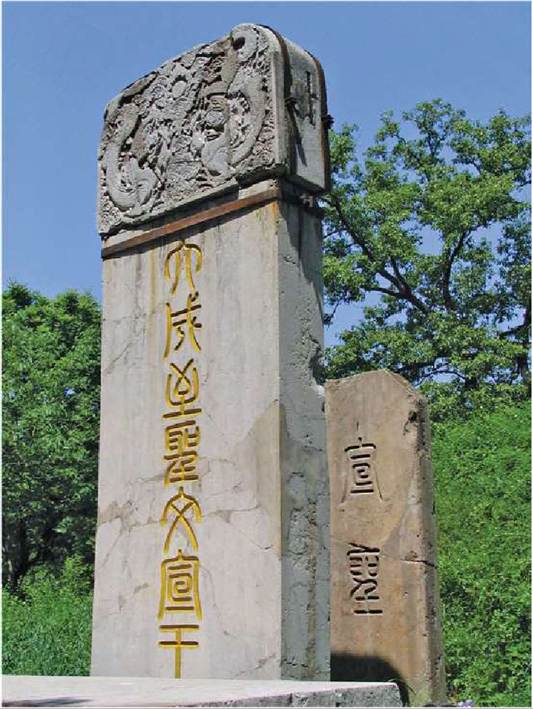
Confucius’s tombstone boldly declares that he is the “Ultimate Sage of Greatest Accomplishment, King of Manifest Culture.”
On the day of the event, when the sun is fully up, the wooden tablets containing the names of the different generations of ancestors, separated by gender, are moved to their proper places in the main hall. Then the spirits of the ancestors are greeted, and food is offered to them three times. The ancestors are entreated to eat the food and are given privacy to do so, with everyone from the presiding man on down exiting the main hall, and the door is dosed. After a suitable interval, the master of ceremony coughs three times to announce his intention to reenter; then he opens the door, and everyone else comes back in. Tea is offered to the ancestors to supposedly deanse their mouths. Then the presiding man receives the sacrificed food from the master of ceremony. With reverence, the presiding man bows and prostrates himself to taste the food and drink the wine. Then the entire group takes leave of the ancestral spirits, returns their tablets to their original locations, and clears away the offering tables. The presiding man supervises the division of the sacrificial food to be consumed by all the family members later that day. This brings an end to the ritual of the ancestral sacrifice. You may notice that the scene of qingming observance at the beginning of this chapter has similar rituals.