Daoist Practices
Whether it is the amazing feats of the immortals and perfected beings in the Daodejing and the Zhaungzi, or whether it is the physical-spiritual regimens and alchemical techniques of the later Daoists, it is always understood and expected that the beliefs need to be put into practice to be truly meaningful.
Promoting communal harmony, delaying and stopping physical deterioration, and attaining actual immortality involve a whole spectrum of undertakings and practices.Daoist Communal Festivals and Liturgies
To ordinary believers—those who have no hope of going through the rigor and expenses of pursuing immortality—the Daoist religion as practiced by the Celestial Master sect offers the promise of health, long life, even collective salvation. Participation in collective rituals called zhai (fasts) was a major undertaking in this tradition. Lasting several days each, these fasts involved abstinence from food, public performance of penance for past moral transgressions, submission of written memorials to request pardon from the deities, and communal prayers for the salvation of the faithful.
VISUAL GUIDE
Confucianism and Daoism
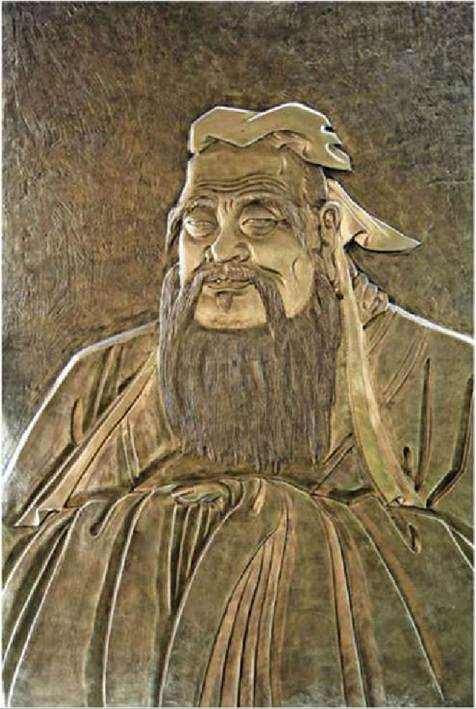
This is an iconic image of Confucius as a learned scholar and an exemplar of human moral accomplishment. Traditionally, the Chinese did not see religion as a separate realm of activity. Hence, the pursuit of scholarship and the enactment of moral behavior within the family and community were very much part of their religious experience.
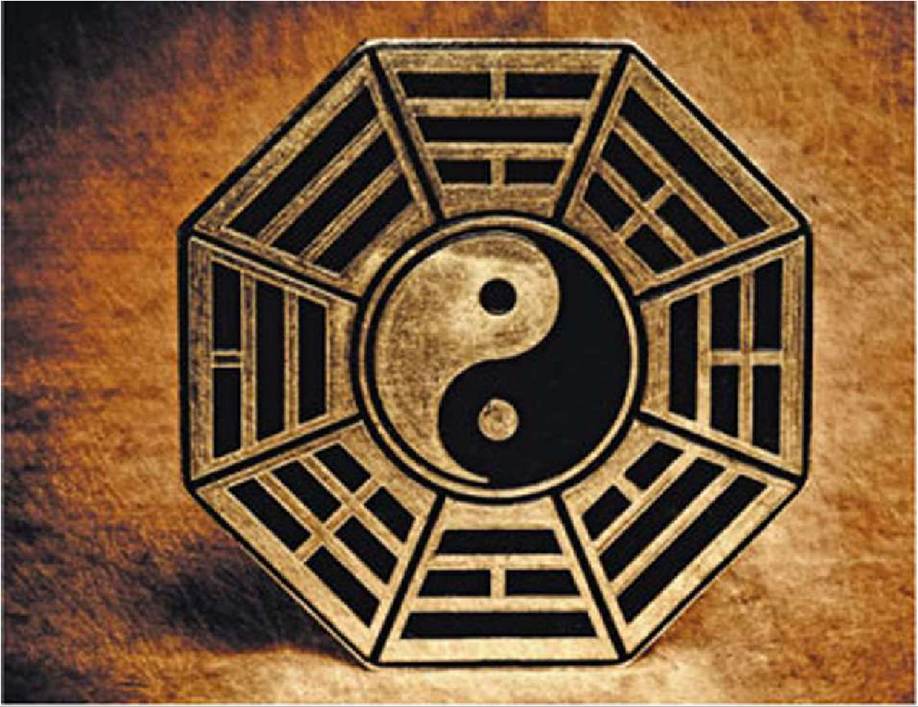
This yin-yang symbol surrounded by the eight trigrams reflects the Chinese belief in the complementarity of opposites and the harmonious unity of the cosmos. More than any other visual symbol, it represents Chinese religiousness.
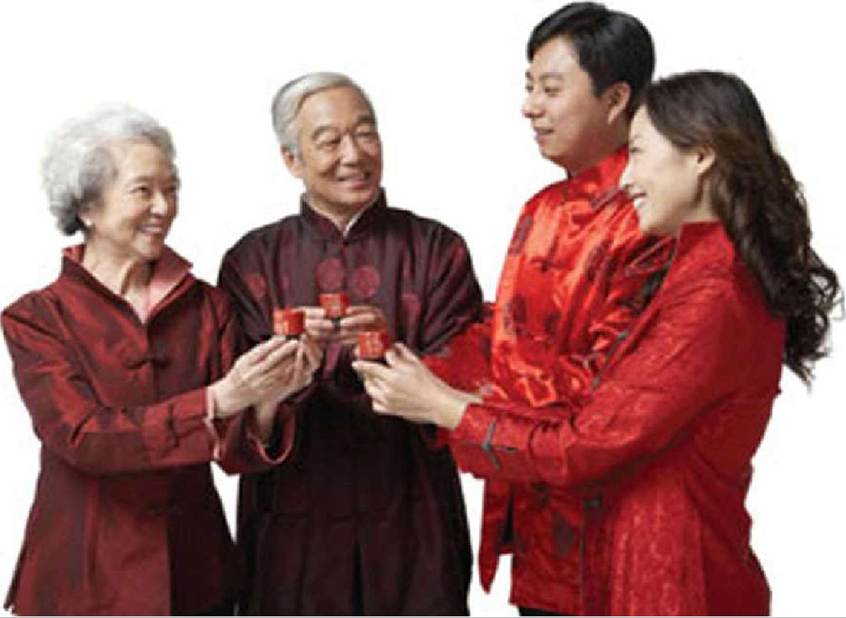
Family cohesion and respect for elders are central Confucian values.
A daughter and her husband pay a visit to her parents on Chinese New Year’s Day to renew her kinship tie with her natal family.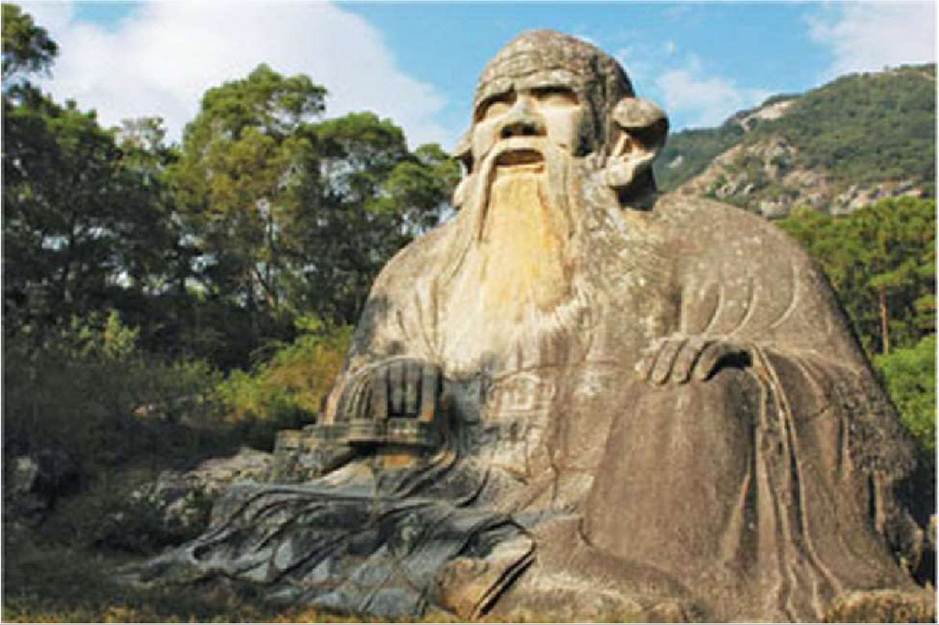
Statue of Laozi carved out of a huge rock in Fujian Province, China. This legendary founder of Daoism symbolizes wisdom and irreverence for conventional thinking. He is understood as the yin to Confucius’s yang, and the image of passive acceptance of what nature has ordained to Confucius’s active attempt at improving society.
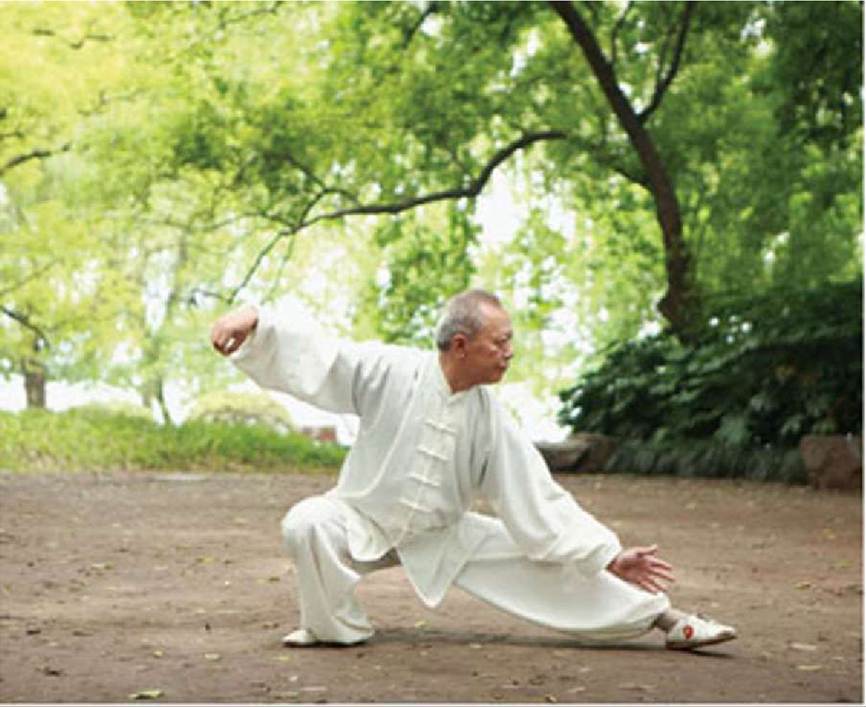
Chinese taiji (commonly spelled “tai chi”) exercise is perhaps the most representative expression of Daoist beliefs in the human body as a microcosm of the universe. Through harnessing the qi of nature and bringing it into the body for attaining balance and improving health, the taiji master demonstrates the intimate relationship between humans and the cosmos.

Acupuncture is a good expression of the Daoist belief in the circulation of qi in the human body. By inserting the needles into critical nodal points in the qi circuitry, pain can be diverted and the rejuvenating energy of the body can heal the sick parts.
The Fast of Mud and Soot in China’s medieval period reflected the general tone of zhai rituals. With hair disheveled and face smeared with soot, believers prostrated themselves like condemned criminals before a raised altar to ask for forgiveness from the gods. Consumed by their agitated emotions, many fell to the ground and rolled about amid loud wailings. Such public acts of penance were performed to earn pardon and spiritual merit. Another liturgical ritual was the Fast of the Yellow Register, during which the participants performed penitence for their ancestors going back seven or nine generations. The names of deceased ancestors, entered in registers, were read by the officiating priests and were then considered to have gained postmortem immortality.
In this way, the filial obligation of the faithful was ritually expressed. Even today, communities and families practice Daoist fasts and eat vegetarian meals at designated times to atone for transgressions they may have wittingly or unwittingly committed, as well as to achieve better health.Another communal ceremony, the jiao (offering), is popular also in the present day. This public liturgy is usually performed by Daoist priests on behalf of the entire community to petition the gods to bestow good fortune, health, and prosperity on all. Sometimes labeled as a rite of cosmic renewal, the jiao brings together the community to participate collectively in a religious ritual that is loud, colorful, and dramatic. Depending on the needs of the community, a jiao is conducted at periodic intervals (ranging from once a year for the affluent communities to once every several decades for the less well-to-do communities) or as special thanks to the deities for having successfully protected the entire community by, for example, warding off an epidemic.
A jiao ceremony usually lasts several days. The dates are chosen for their astrological auspiciousness. Daoist priests are contracted to perform the ritual with efficacy and precision. Prior to the official dates of the ceremony, the priests submit “memorials” to the celestial bureaucracy of the gods to give notice of the scheduled jiao. Then the location at which the liturgy takes place, usually both the inside and the outside of the largest local temple or shrine, is marked off by hoisted lanterns to signal the enclosure of the sacred space. Afterward, the local deities are invited to take their honored seats within the enclosure; their statues or wooden tablets are carried there by community elders. The procession of the deities through the community is accompanied by lion or dragon dances, made even more boisterous with lots of firecrackers. Then the ritual proper begins in earnest.
Reenacting the beginning of the cosmos in a ritual called fendeng (spreading the light), the chief Daoist priest, in full vestment, blows on a buffalo horn and rings his “thunder” bell, to the accompaniment of an entire music ensemble, and repeats the forty-second chapter of the Daodejing by announcing that “the Dao gives birth to the One [Being, Existence]; the One brings forth the Two [Yin and Yang]; the Two give rise to the Three [Tian, Di, and Humans]; and the Three engender the Ten Thousand Things [world of multiplicity and diversity].” Entering a meditation-induced trance, the priest transforms his body into the body of the Dao.
He takes prescribed steps that are dancelike, spins on himself, and sanctifies the ritual enclosure by requesting the dispatch of heavenly troops to guard the place. At the same time, to placate the wandering ghosts in the neighborhood and to warn them against intrusion into the sacred ground, he provides a feast for them while lecturing them on the reasons for their suffering.At some point during the ceremony, the names of every member of the community will be posted on a roster and read aloud by the priests to signal their financial and spiritual support of this elaborate and expensive event, as well as to ensure that they will receive their share of the benediction of the gods. There is great interest among the community members in checking the posted name list to make sure that the names are written accurately and that they have not been inadvertently left out.
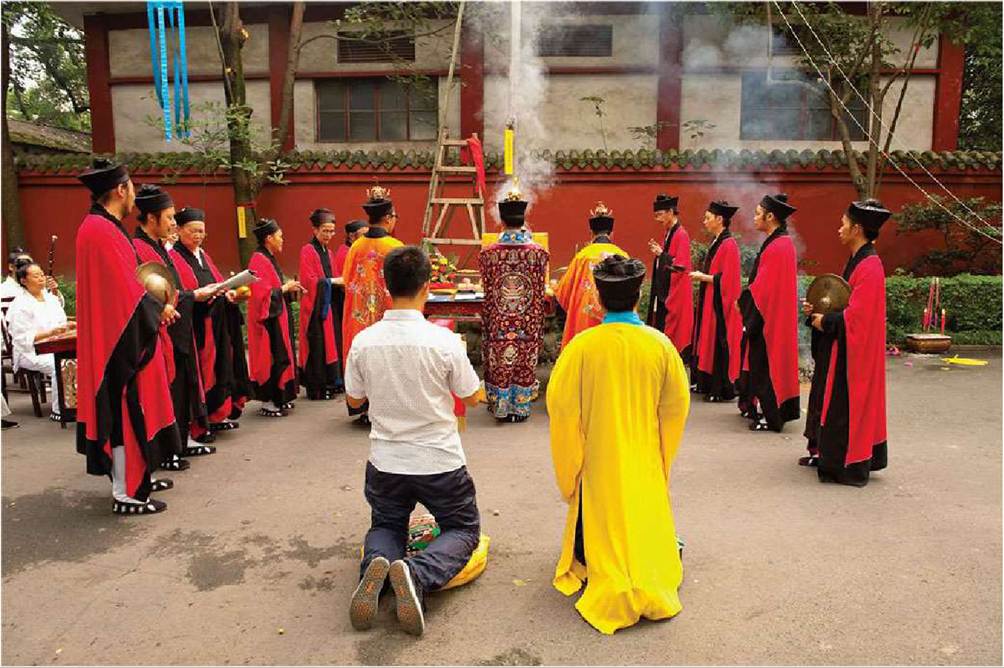
A group of Daoist priests perform a ritual service for a member of the community.
The climax of the ceremony occurs when the highest of the Daoist deities, the Three Purities and the Jade Emperor, are invited to take part in the ceremony. Piercing prepared talismans with his sword, the chief Daoist priest bums them with great dramatic effect to appeal to the august deities. Once the gods are properly seated, a blanket pardon of every immoral act committed by every member of the community between the last jiao and the present one is announced. In grateful response, the community performs a public charitable act of “releasing life”—setting cages of captured birds free and returning to a stream buckets full of live fish. On the last night of the ceremony, a grand feast for all ghosts trapped in hell is hosted by the community. Once again, the Daoist priests exhort the ghosts to behave themselves and to refrain from wreaking havoc in the lives of the living. Balance is restored among the worlds of humans, gods, and ghosts. The rite concludes with sending off the celestial gods and the local deities, distributing food and buns to the spectators, and performing operas for the entertainment of all.
More on the topic Daoist Practices:
- Daoist Practices
- For archaeology, access to prehistoric religion must lie in religious practices, notably practices that leave discernible traces.
- Optional Religious Practices
- Obligatory Religious Practices
- Daily Devotional Practices
- EARLY RELIGIOUS PRACTICES
- Violence in Religion
- The Sahariya’s Religion and Practices
- Bibliographic Essay
- The History of Confucianism and Daoism