8 Chinese Religions: Confucianism and Daoism
Jeffrey Brodd
California State University, Sacramento
Layne Little
University of California, Davis
Bradley Nystrom
California State University, Sacramento
Robert Platzner
California State University, Sacramento
Richard Shek
California State University, Sacramento
Erin Stiles
University of Nevada, Reno
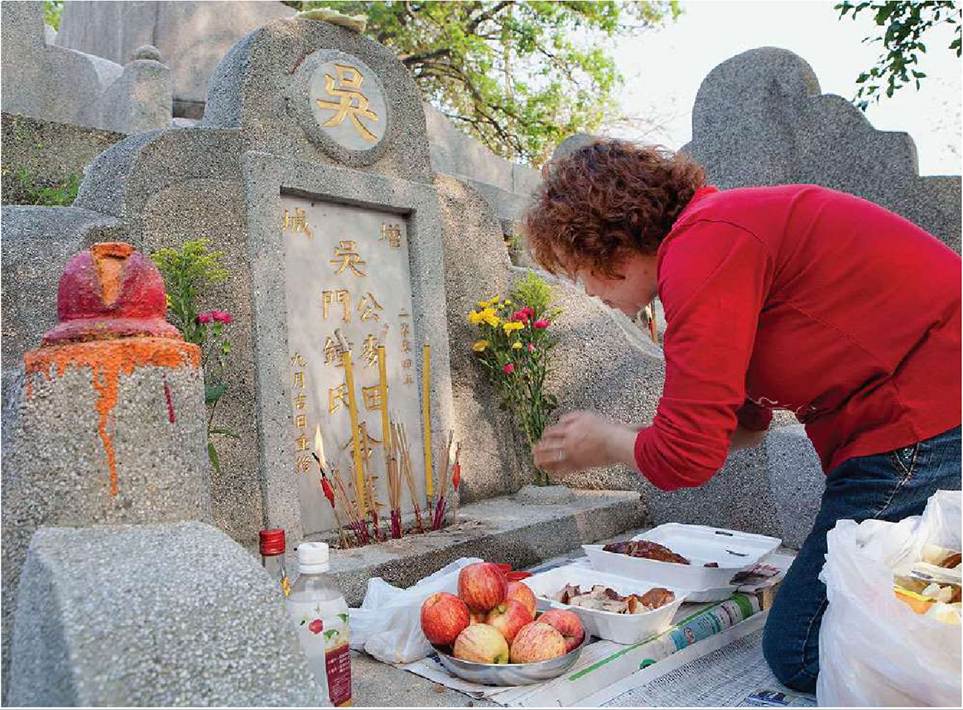
Woman making offerings in front of her ancestor s tomb.
TODAY IS QINGMING, a “pure and bright” day (the literal meaning of this Chinese compound word) that arrives once a year, 105 days after the winter solstice. It is a day for all Chinese families to remember their dead relatives and ancestors by visiting their graves. Spring is definitely in the air. The days have been getting longer and warmer. The rice seedlings, standing in neat rows in anlde-deep water in the paddy fields, wave gracefully in the gentle breeze. Their luxuriant greenness is most pleasing to the eyes of Chen Liang, a peasant from southern China in his early fifties. He and his two sons have been working hard in the past couple of months to plow and flood the paddy fields, seed the nurseiy plots, and then transplant the young seedlings one at a time into their current location.
But today there will be no work in the fields. Qingming marks the renewal of spring. It also celebrates the rekindling of the kitchen fire. Two days earlier the old fire had been put out, so only cold food had been served. Chen Liang and his wife get up today at the crack of dawn to light a new fire in the kitchen. Leftovers from the previous days’ cold meals are wrapped in rice pancakes and fried, making “spring rolls” that many Chinese restaurants the world over serve regularly on their appetizer menu. They prepare for an important family gathering at the ancestral graves of the Chen clan.
During this annual event, family members gather at and sweep the graves of their relatives and ancestors to renew their kinship ties with both the dead and the living. Plates of fruits, freshly steamed chickens, a whole roasted pig, bottles of wine, bundles of incense sticks and bright-red candles, and strings of firecrackers, as well as piles of make-believe paper money and paper clothing for the dead, are all ready to be carried to the lineage burial ground just outside the village.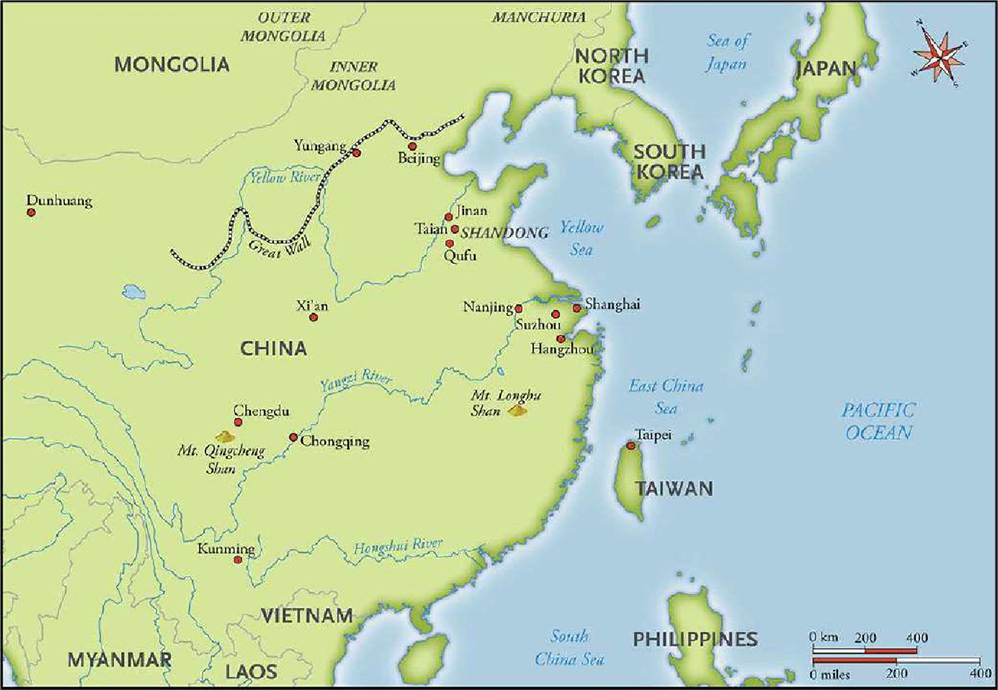
Important Confucian and Daoist sites in China.
Click here to learn more in an interactive map.
At the gravesite, where several generations of the Chen clan are buried, Chen Liang meets up with his three brothers, his five cousins, and their families. The children, numbering more than twenty, are all dressed in brightly colored clothing, giggling and playing. They help remove overgrown weeds, clean the tombstones, and arrange food in front of the tombstones. Then, by generation and birth order, all members of the Chen clan bow before their ancestors, address them in silent prayers, offer them wine and food, send them clothing and stacks of underworld money by burning paper imitations of them, and set off firecrackers to scare off wandering ghosts unrelated to the family.
Afterward a picture is taken of the entire gathering in front of the graves. The families divide up the fruits and the meats to be consumed later back at their respective homes. The men linger to talk about the weather and the crops, the women catch up on family news, and the children play.
Gatherings similar to that of the Chen extended family are replicated millions of times throughout China in observance of qingming. It is through this activity of remembering the ancestors and reaffirming kinship relations that the Chinese act out one of their most basic religious beliefs. At the core of this ritual is the Confucian notion of filial piety (honoring parents and ancestors) and familial cohesiveness in Confucian teaching.
Equally on display is the Daoist (Taoist) attentiveness to changes in season and in nature, as well as the practice of warding off unwelcome ghosts through thunderous explosives. From this single family gathering we see that Confucianism and Daoism can coexist quite harmoniously among the Chinese, with no sense of incompatibility or mutual exclusivity.TIMELINE
Confucianism and Daoism
| Era in Chinese History | Confucianism | Daoism |
| Shang- Zhou dynasties (c. 1600- 256 BCE*) | Ancient Chinese religion Beginning of ru tradition | Ancient Chinese religion Shamans |
| Spring and Autumn (c. 722-481 BCE) | Confucius (551-479 BCE*) | World-escaping recluses and hermits |
| Warring States (c. 480-221 BCE) | Mencius (371-289 BCE*), Xunzi (c. 310-238 все*) | Zhuangzi (365-290 все*), Daodejing (earliest extant ed. c. 300 все) |
| Early Han Dynasty (206 bce-9 ce) | Confucianism declared orthodox (136 ce); Five Classics designated | Worship of Xiwangmu (Queen Mother of the West) |
| Later Han Dynasty (25-220 CE) | Confucian classical commentaries and Scholasticism | Laozi deified as Taishang Laojun. Tianshi (Celestial Master) movement founded by Zhang Daoling (142 ce), Laozi bianhua jing (Classic of Laozi’s Transformations) (170s*) |
| Period of Disunion (221-589) | Confucian texts introduced to Korea and subsequently to Japan | Shangqing (Highest Clarity) movement (fourth century), Lingbao (Numinous Treasure) Movement (fourth century) |
| Tang Dynasty (618-907) | First stirring of NeoConfucianism | First attempt at compiling canon State patronage of Daoism Daoism merged with Chinese folk religion |
| Song Dynasty (907-1279) | Neo-Confucianism: Zhu Xi (1130-1200) | Quanzhen (Complete Perfection) movement founded by Wang Zhe (1113-1170) |
| Yuan Dynasty (1279- 1368) | Four Books designated as civil service examination curriculum (1313) | |
| Era in Chinese History | Confucianism | Daoism |
| Ming Dynasty (1368- 1644) | Wang Yangming (1472-1529), an alternative Neo-Confucian view to Zhu Xi’s Confucianism became state orthodoxy in Joseon Dynasty (1392-1897) Korea Confucianism also became state ideology in Tokugawa Japan (1600-1868) | Daozang compiled (1445) Daoist sacrificial rituals and notions of health influenced both elites and commoners in Korea, Japan, and Southeast Asia |
| Qing Dynasty (1644— 1911) | Civil service examination abolished (1905) Confucianism became dominant ideology in Nguyen Dynasty Vietnam (1802-1945) | |
| Early twentieth century | Chinese intellectuals rejected Confucianism as feudalistic and reactionary | Chinese intellectuals criticized Daoism as superstition |
| Chinese Republic (1949- present) | Cultural Revolution (1966- 1976) devastated Confucianism. Confucianism gradually recovering since 1980s | Cultural Revolution (1966-1976) devastated Daoism Daoism gradually recovering since 1980s |
Note: Asterisks indicate contested or approximate dates.
Click here to learn more in an interactive map.
Click here to compare to other Chinese religions.
In this chapter you are invited to step into the religious world of the Chinese and to see how these two native Chinese religions both rival and complement each other. (Even though Buddhism is the third main religious tradition in China, we only give passing notice to it in light of its alien origin and its totally different worldviews; see Chapter 5 for a complete treatment of Buddhism.) By focusing on the teachings, history, and practices of Confucianism and Daoism, you can appreciate the true religious nature of the two traditions as well, even though in content and expression they may differ from most other world religions.