The Teachings of Confucianism and Daoism
Before Confucianism and Daoism arose, an ancient religion already existed in China. This ancient Chinese religion took shape no later than 1600 все, fully a thousand years prior to the rise of the two traditions.
Both Confucianism and Daoism may be regarded as two divergent outgrowths of this ancient Chinese religion, with Confucianism focusing on interhuman relationship, whereas Daoism emphasizes the relationship between humans and nature. In order to understand Confucianism and Daoism, therefore, this ancient Chinese religion needs to be examined first.Ancient Chinese Religious Views
The Book of Changes, the Yijing (traditionally spelled I Ching, believed to have been compiled by the end of the second millennium все), represents the earliest expression of the Chinese religious mindset. It conveys a worldview that has been described as “organismic,” meaning that every single component of the cosmos belongs to an organic whole and that all the component parts interact with one another continuously. Unlike the foundational texts of most religions, the Book of Changes does not include a creation myth. This absence of a creation myth may be attributed to the dominance of the spirit of honoring ancestors in China since antiquity. When most of the spirits who populate the supernatural world are believed to have been former human beings who share the same attributes as the living, the sense of mystery and “otherness” of a creator being may be difficult to envision. Instead, from an original state of “undifferentiated chaos” (Jrundun),1 two polar yet complementary energies known as qi (“breath,” “energy,” or “force”) emerged. One is called yang (literally the southfacing, sunny side of a mountain) and the other yin (the north-facing, shady side of a mountain). Representing all binary entities and concepts (such as day and night, male and female, hot and cold), yang and yin interact and alternate ceaselessly to form a continuum or spectrum, generating the myriad things in the process.
In this kind of a worldview, nothing exists outside the cosmos. This absence of a “wholly other” transcendent creator in the early Chinese cosmological myth has significant implications. That is, the classical Chinese view uses the metaphor of procreation or giving birth, not creation or fashioning something out of nothing, for the beginning of the universe. In this ancient Chinese view, the idea of an almighty god preceding and existing outside of creation is simply non-existent. Correspondingly, the notion of an active evil dedicated to undermining the plans of a supposedly benevolent creator is also absent. In other words, there is no frighteningly personified devil competing with a benign god to win the hearts and minds of humans. In this world without sin (at least sin as understood by the Abrahamic faiths of Judaism, Christianity, and Islam), humanity is released from an acute sense of guilt. Instead, harmony and balance are good and preferable. Disharmony and imbalance are not.
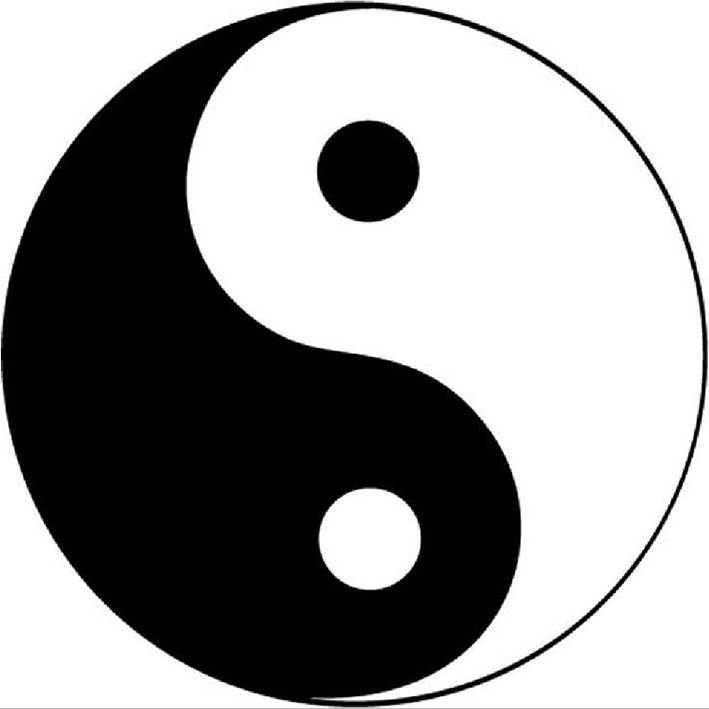
The yin-yang symbol best represents the Chinese religious mentality. This worldview recognizes differences but also harmony among the differences.
The cosmic tango of yang and yin, spontaneous and unceasing, is manifested in the wuxing (“five elements or phases”), the five paradigmatic states of metal, wood, fire, water, and soil. These five states or elements correlate with many categories in nature. In the human body, they correspond to the Five Viscera (heart, liver, spleen, lungs, and kidneys); in the sky, they are the Five Planets (Venus, Jupiter, Mercury, Mars, and Saturn) then known to the Chinese; and in human sensations they are the Five Colors (red, blue, yellow, white, and black) and the Five Flavors (sour, sweet, bitter, spicy, and salty). These five states are at the same time mutually nurturing and mutually destructive. Water sustains wood, wood feeds fire, fire reduces everything back to ashes (soil), soil produces ores (metal), and ores melt into liquid (water).
Conversely, water douses fire, fire melts metal, metal chops down wood, wood draws nutrients from soil, and soil blocks water. Ultimately, like the swinging of the pendulum, what drives this dynamic process is the principle of alternation: when one extreme is reached, it reverts to the other. Such is the way the cosmos operates.Notice in the image that the two halves of the circle are not perfectly divided right down the middle. Instead, they are interlocked and mutually penetrating. Each half also contains the seed of the other. Thus, the entire cosmos is involved in a ceaseless flow of alternation and change.
Human Body and Soul
As fundamental energies of the cosmos that constantly interact with each other, yin and yang form solid matter when they coalesce and become immaterial when diffused. Their interplay can manifest in concrete and materialistic things, as well as in subtle and spiritual entities. It is in this context that the constitution of human beings can be understood.
All humans have a physical body, the physical manifestation of the interplay between yin and yang. But all humans also have an immaterial aspect, subdivided into hun and po. Hun reflects the yang component, being light, pure, and upward-rising, whereas Po indicates yin, being heavy, turgid, and downward-sinking. Hun and po, introduced into the physical body when the fetus is gestating, together make up the spiritual aspect of the individual. For lack of a better term, they constitute the soul matter of the individual. As long as they stay with the human body, with only short and temporary absences during the dream state or when in a coma, the individual remains alive. At death, however, hun departs from the body permanently, rising skyward, and po settles down on earth alongside the interred and decomposing body. Both hun and po eventually dissipate and become reconfigured in different proportions to form future beings.
The Spiritual World of Gods and Ghosts
After death, as long as the energy remains to keep the current identity of hun and po intact, the spirit of the deceased lingers.
Though only a pale shadow of its former self, the spirit of one who dies at a ripe old age and is properly cared for by the descendants may become shen, a benevolent power that protects and brings benefit to the living. In contrast, the spirit of one who dies tragically or prematurely, and one who is not given a suitable burial or sacrifice, will become gui, a vengeful and malevolent ghost who visits disasters on people. Shen is a generic term for all kindly deities and gods whose power and efficacy are sought to fulfill people’s wishes for health, wealth, progeny, and status. Conversely, gui refers to all spiteful ghouls, demons, and ogres who wreak havoc in people’s lives. Motivated both by longing and fear, the Chinese from ancient times to the present strive to cultivate good relations with both shen and gui. This, of course, is in addition to their primary obligation to commemorate and honor their ancestors. Thus, the line of demarcation between the spirits and humans cannot be sharply drawn, as there is no separate "sacred” realm in ancient Chinese religious beliefs. Humans can indeed possess or exhibit qualities that in other cultures or beliefs may be considered spiritual, or even divine.Political Implications of Ancient Chinese Religious Beliefs
During the Shang Dynasty, the earliest verifiable historic period in China to date, whose traditional dates are 1600-1046 bce, the spirits of the ancestors were sometimes asked to carry messages to a higher deity for decision and response. This higher, more authoritative deity was Shangdi, the Lord on High, who was the most powerful god in the Shang spiritual world and who also happened to be the ancient ancestor of the Shang imperial house. This Lord on High was the controlling power in the cosmos, but by no means its creator. Along with the spirits of the ancestors, Shangdi monitored the behavior of the royal descendants, dispensing rewards and meting out punishments as appropriate. It was precisely for this reason that the Shang rulers needed to maintain close contact and good relationship with Shangdi and the other ancestral spirits, for the spirits were their source of kingly power.
This power was termed de, commonly translated as “virtue” but more accurately as “potency,” which may be more appropriately understood as the charismatic power the king possessed. With de the Shang king ruled with authority and legitimacy.But sometime near the end of the second millennium bce, a former minister of the court staged a rebellion that overthrew the Shang Dynasty and founded the next regime, the Zhou Dynasty (1122-256 bce). This power shift was rationalized primarily in religious terms. The defeat of the Shang, as the victorious Zhou founders explained it, was in fact sanctioned by Shangdi, who now had a different name and, as it turned out, was in fact a different kind of deity. Shangdi was now known as Tian, literally, “the sky,” but more properly “the force above.” (Regrettably, most books and articles written in English on Chinese religion and philosophy translate Tian as “Heaven,” which is both inaccurate and misleading. In this chapter, we continue to use the term Tian rather than any English equivalent in order to avoid any mistaken notion of Tian being a paradise-like location.)
Tian was believed to be the source of all things in the universe (not as a creator, but rather as a procreator), the ultimate divine entity that provided order throughout the cosmos. More significantly, Tian was also a “will” that would support only the morally deserving as king. This made Tian radically different from the former Shangdi, who was understood to be partial to the Shang kings and amenable to their “bribery” through offerings. Tian was not swayed by claimed blood ties or sacrificial presentations; instead, it insisted on moral uprightness as the only condition for its award of political authority and legitimacy, which was labeled ming, or Tianming. This was the “mandate” or “charge” given by Tian to the person and the imperial line that was to rule on Tian’s behalf. Moreover, this ming could be revoked and withdrawn and could be transferred to another person or family any time its provisional holder was found wanting in moral standing.
Known as “geming” (the revocation of the “ming”), it sanctions and justifies revolution—the withdrawal of the current regime’s mandate to rule. Shang’s last ruler, who, according to the Zhou founders, was a corrupt and immoral individual, was no longer fit to exercise Tianming, hence his removal from power. To this day, this Chinese term means a violent overthrow of the existing government.According to the religious mindset of the Zhou, Tian’s workings in nature and in the human world are its Dao, its “way” or “path.” It is the Dao of Tian that provides order and regularity in nature and in human society. By following and obeying this Dao, both the natural and the human worlds would reach their optimal potential. This implementation of the Dao of Tian is the duty and obligation of the human ruler. As the chosen deputy of Tian in the human world, the Zhou king (and all subsequent imperial rulers in China) called himself Tianzi (“Son of Tian”}, the person who had been entrusted with the power to rule Tianxia (“domain under Tian,” that is, the entire known world). The king was therefore not just a political leader exercising power over both territory and people; he was also a religious figure who served as intermediary between Tian and humanity, as well as the natural world. To fulfill his roles as both king and priest, the Zhou ruler had to observe a set of behavioral practices collectively referred to as li (“rituals” or “rites”). It was the correct and sincere performance of li that would convince Tian of the ruler’s moral worth, ensure Tian’s continuous favor, and guarantee the ruler’s power through his de, his “potency.” Li covered every aspect of kingly behavior—from matters of state to relationships with ancestors to conduct on important familial occasions such as marriage and funerals and even involving military campaigns. It would in time govern all the ritual conduct of the king’s ministers as well, as their proper behavior also contributed to the stability and legitimacy of the regime.
Ancient Chinese Texts
Such prescribed rites for the king and his ministers would later be codified into a text known as the Record of Rites (Liji). However, the beliefs in the source of kingly power and the underlying assumptions of imperial moral obligations are fully addressed in two other texts: the Book of Odes (Shying) and the Book of History (Shujing). The Book of Odes is an anthology of poems and ballads expressing the sentiments of both nobles and commoners, whereas the Book of History consists primarily of recorded activities and pronouncements of kings and aristocrats. Another work, the previously mentioned Book of Changes (Yijing), contains early Chinese views of cosmology and the supernatural. Collectively, these texts, which existed in some form after the founding of the Zhou regime, provide most of the information on the ancient Chinese religion from which Confucianism and Daoism would evolve. The Confucians, in particular, would revere these texts as classics and as sacred texts. The four just mentioned, along with the Spring and Autumn Annals (Chunqiu), purportedly compiled by Confucius himself, would in time be designated as the Confucian Five Classics. The Daoists, while fully aware of the authority of these texts, especially the Book of Changes, would create their own corpus of scriptural works focusing more on the constitution of the human body, the basic elements of nature and the cosmos, and the ideal human relationship with the spirits, as you shall see in later sections.