3.0 A CREATED LITERATURE: EXTISPICY IN THE ERA OF WARRING STATES
The Old Babylonian era in which extispical texts first appeared was one which suffered from chronic warfare, and divination and diviners figured prominently in the courts and councils of the warring states of nineteenth- and early eighteenth-century Babylon, Mari, and Larsa.
In my view, the divinatory craft was appropriated by competing Amorite courts, hungry for legitimizing devices. What we have missed in presuming a further antiquity to the corpus is that the redaction of divinatory arts into a technical literature was more a product of state competition and warfare, not the reification of a genuine set of Sumerian practices, precepts, or (least especially) observations. The project to deliberately encode and control this commonculture form enabled Old Babylonian kings to define alternative access to divine knowledge. These practices remained garbed in the clothing of a traditional craft, yet operated on new protocols of secrecy and deliberately blurred generic distinctions between magico-ritual, religious, legal, and scholarly traditions,[124] the influence of all of which have been noticed in extispicy and vice-versa. In this sense, the law codes of the same period (indeed, of the same 5ub-period of the Old Babylonian) should be seen as parallel projects, undertaking to establish ultimately unverifiable claims of authority through a legal voice.70 See Koch, this volume, p. 43.
It is not my opinion that divinatory texts formed a “secret code” of some kind. It is my opinion that the flexibility, secrecy, and privileged nature of the practice and the practitioners provided a screen behind which political objectives could be achieved without criticism. I turn my attention now to some characteristics of Old Babylonian liver divination that argue not only against third-millennium origins, but for a deliberate composition in the courts of the warring states.
I focus first on three issues related to the technical literature itself, and then turn to two aspects of the social and political world of Old Babylonian divination:3.1 Deliberate archaisms in liver models and omen compendia
3.2 Low comparability between and among extispical corpora
3.3 Military and political character of the OBE omens
3.4 The “secular” position of Old Babylonian diviners and divination
3.5 The information war and the “secrecy paradigm”
3.1 DELIBERATE ARCHAISMS IN LIVER MODELS AND OMEN COMPENDIA
Third-millennium orthographies and sign-forms make some appearances in Old Babylonian liver-omen texts. A few such features appear in the earlier Mari liver models71 and more in the Larsa technical literature,72 but in general are not so much a feature of the later Sippar compendia represented by OBE.73 Since these features appear together with younger Old Babylonian forms within the same texts or between “duplicates,” their inconsistent use has prompted puzzlement: were these features genuine relic forms preserved by scribal tradition?74 Old Babylonian scribes were of course not only well practiced in copying tablets from the Sargonic and Ur III periods, but in reproducing antique forms and deploying them in specific contexts (perhaps most famously in the Codex Hammurabi). At a minimum we can say that archaisms were used, in Roth’s words, to “magnify the authority of the composition.”75 It seems plausible that duplicates might appear in both archaic and younger cursive scripts,76 but the preservation of such a miscellany of archaic forms in mixed-style points toward the deliberacy of an archaizing purpose.77 Archaic forms were more likely ornamental to new compositions, not surviving relics of earlier ones.
Another area in which archaization shows up is in the extispical termini technici themselves, which employ an artificial Sumerian jargon.78 The zones and marks of the liver first appear almost entirely in Akkadian, but shift to an almost exclusively Sumerian terminology by the end of the Old Babylonian period: in the earliest phase of terminologies (Old Babylonian I), only one of fifteen terms (ka e.gal) was expressed ideographically; by the third phase (Late Old Babylonian), only one of ten terms (tlranu) remained in Akkadian.79 Far from reflecting an original technical vocabulary, anatomical similes like ki.gub, kal, or ka e.gal had no terminological use in the third millennium.
The artificial nature of the terms is complemented by the failure of Old Babylonian extispicy to perpetuate pre-existing anatomical terms — notably the word for “liver” itself (bar).80 * A newly invented cryptolect had been preferred over an accepted terminology.It is not an end in itself to observe the existence of archaisms as formal features; one must ask why the scribes chose to use them. Along with the use of historical kings in the omens and the conscious insertion of an artificial “omen” in the Ibbi-Sin letter, 81 it seems probable that the “antiqued” nature of extispical texts was window dressing meant to add to their authority. A deliberate attempt was made to present the technical literature as a genuine, transmitted antique — an intention scholarship sometimes reproduces in accepting its antiquity — and it is precisely this intentionality that points toward the original composition of the technical literature in the Old Babylonian period.
3.2 low comparability between and among extispical corpora
The lack of intertextual connections between extispical technical texts and their ephemeral literatures has been briefly noted above (section 2.0), but we should look more systematically at the low comparability between the Old Babylonian technical texts themselves:
1. between the Sippar corpus and other extispical traditions,
2. between the major types of contemporary technical literature, and even
3. between the variants and duplicates themselves.
I do not pretend to offer a full comparative analysis of this massive body of primary literature (about 3,193 published Old Babylonian omens82), but some general observations
are in order. It becomes clear on reading through the specialized literature that, while some part-parallels and partial duplicates can be located within the many thousands of lines of omen texts, the number of direct duplicates across all three[125] of these comparable categories is simply too low to support the idea that any major effort was invested in actually copying omens.
While it is true that some duplicates and varied parallels exist, two points may be made.First, duplicates and omens are in the vast minority within an enormous technical literature whose signatures, if anything, are unique expressions. Most omens are not parallels or duplicates, even though much of what has been written about omens has focused on duplication.[126] When one peruses Starr 1983 or Jeyes 1989, for instance, one could gain the impression that a great deal of overlap exists between the primary sources they study because a great deal of ink in the notes is reserved for investigating links between extispical texts (notwithstanding the contrapuntal commentary on solecisms and hapaxes). This is a perfectly understandable feature of a scholarship which hopes to understand these most obscure practices by using allied information wherever it may be found. Yet in service of this goal, methodological concerns about anachronism are often suspended in the presumption of a greater background of copying; the likenesses are part of a greater unity of likeness, as it were, and the unalikenesses are seen as heterogeneously unalike.
Second, a definitional problem has persisted in referring to “duplicates” which has promoted an artificial appearance of overlap: the majority of claimed “duplicates” are omens reproducing or approximating only the apodosis or protasis of other omens. In my view, while this may indicate a literary or oral borrowing, it is not a duplicated omen per se: the comparability exists only on the level of signifier (protasis) or signified (apodosis), not on the level of the sign (omen). What we see is the emulation of literary motifs, not the copying of actual observations.
How much comparability should we really expect between these texts? Too stringent a definition, too literal a comparativism, runs the risk of overdefining a threshhold between “real” copying and a “phony” scribal erudition. Still, we ought to be able to see a much greater degree of overlap than we do if we are to preserve the idea that what was being recorded in these texts were, even partially or secondarily, observed and repeatable phenomena.
In wanting some evidence that some texts were employed as the source material for other texts, weto these 2,562 compendious omens, we know of some 37 published Old Babylonian extispical reports (see Koch-Westenholz 2002: 130 for a catalog; the reports contained in the relevant Mari letters might also be added to our totals), which range from as few as 10 to as many as 23 observations each, averaging around 16; from this I derive a working total of 592 more ominous passages. Finally, the published Old Babylonian liver models, which number around 39 (38 referred to by Meyer 1987: 11, and at least 1 more subsequent to his work; Jeyes 1989: no. 19), in many cases specify as few as 1 ominous sign; for the sake of convenience, I use the estimate of 39 to arrive at a total of 3,193 published omina. A full one-to-one analysis of these units would involve more than ten million comparisons!
83 It would be irrelevant and anachronistic to consider, for our historical study of the Old Babylonian
are much more disappointed than satisfied. What is more in evidence are contemporaneous text series whose material was drawn out of the heterodox oral traditions of individuals and/ or guilds who shared a common-culture craft.85
The differences between the Old Babylonian “northern” (i.e., Babylon and Sippar) and “southern” (i.e., Larsa) extispical traditions have long been noted, and there is little use in comparing two text traditions that were perhaps not fundamentally comparable.86 Yet, taking the north-Babylonian compendia from Jeyes 1989 as a more manageable but still sizeable sample — 402 omens are substantially preserved on eighteen tablets87 — it is striking how few observations are true duplicates or parallels. We can also point to the high incidence of hapaxes and unique phrases within the OBE texts. Extispical texts are filled with arcana and strange turns of phrase, of course, but I am not speaking of interpretive problems: at least nine terms or phrases are not otherwise known in Old Babylonian extispical literature,88 and fourteen more are not known from extispical literature of any time or place.89 Given that the same sample produces only one genuinely duplicate omen (see below), this already suggests more differences than similarities to other corpora.
Forty-seven OBE omens are partial duplicates or parallels: that is, protases and apodoses that are duplicated or paralleled outside the corpus, but without their partner clauses. In fifteen of those forty-seven cases, duplicates or parallels of OBE protases can be found elsewhere — but married to mismatched apodoses;90 twenty-six apodoses are known in other texts, but now without the protases attached.91 Only five full omens among 402 are duplicated within the same OBE texts,92 and only one has a contemporary Old Babylonian parallel, where the
sense of the omen is identically intentioned (though not worded) — and significantly, it is a “historical omen” of Akkad, for which an oral rather than scribal tradition is not difficult to imagine.93 Neither in part nor in whole do the other 349 OBE omens have evident parallels or duplicates anywhere outside the corpus.
Jeyes took passing note of both “partial duplicates” or “partial parallels,”94 but the significance of these oddities has never been satisfactorily explained. Indeed, the problem becomes even stranger when we consider “partial duplicates” within the OBE corpus. Not enumerated above are six partial duplications of protases or apodoses in other OBE texts: in three cases we find the protasis duplicated without the apodosis; in two cases, the apodosis without the protasis; and in one case we find both halves of an omen duplicated — but split between two different omens!95 What seems impossible is to imagine a scribe who would borrow at will an extispical observation or its result, and freely marry it elsewhere if copying was the intellectual project. To refer to “duplicates” or “parallels” without a more stringent definition implies copying and observationalism, whereas what we see is re-editing and (by a standard of observationalism) outright original composition. To recap: of 402 OBE omens, there is one verifiable (if very general) parallel, but the other fifty-two known “duplicates” are partial duplicates which would of course violate the principles of causation that would be encoded in observational record-keeping. Whatever else this editing process can be called, it cannot be said that faithful transmission of data was a concern of the editors; creativity and reconfiguration of omens far outpaces genuine copying.
There also seems a very low incidence of comparability between Old Babylonian extispi- cal reports (of which thirty-eight are known96) and compendia, though, once again, a full study is beyond the scope of this paper.97 A modest experiment, however, suggests the result: using four Late Old Babylonian extispical reports as a sample,98 we find forty-three individual observations that are preserved or dependably restored, thirty-four of which are the aberrant types that appear in compendious texts.99 Among these, only one of those reported observations can be found within the protases of the OBE compendia (and it is the very common “there was a path to the left of the gall bladder”).100 Since these four reports are all Late Old Babylonian, all
from northern Babylonia, and half from the same divination archive as the OBE compendia, is it not reasonable to hope, if the reports were written to be “keyed” to the massive compendia, that more than one might be found among the 402 OBE omens?101 Alongside the extremely low incidence of duplication and the high incidence of “partial duplication,” the fact that the reports match up so poorly to the compendia does not lend much credence to the idea that a process of observation and verification was in use.
What small overlap exists between extispical series from different places, between technical types, between even duplicate texts of the same type from the same place, suggests much more of a common-culture tradition and scribal familiarity from use than it suggests these texts were a core source material for a scholarly project of continued observation. Of course, cuneiform literatures are entirely characterized by variability between recensions, allied text types, local traditions — but minor variations versus comparabilities as low as the ones outlined above have to suggest vastly different editorial processes. One crucial clue lies in the dates alone: no extispical report to our knowledge is dated before Ammisaduqa 2 (1645 B.C.), while compendia were in production from at least 1822 B.C. and mostly finished by 1712 B.C.102 * The compendia and the reports really belonged to different historical epochs, composed for different purposes (see section 4.0).
3.3 MILITARY AND POLITICAL CHARACTER OF THE OBE OMENS
The formal aspects of extispical texts outlined above point away from the idea that even the earliest-visible stages of the project involved disinterested, scholarly observationalism. Yet if this was not its purpose, what was? One approach would be to return to look at the subject matter of the ominous apodoses; a topical analysis of the omens from OBE reveals a primary concern with political and military intelligence.
The concerns of the OBE texts are most economically represented in tabular form (see table 1). Type A subsumes those apodoses which are concerned with interstate competition: military action (A/),103 geopolitical affairs (A2, including diplomacy, court intrigues, territorial dispositions), and the political affairs of “the prince” (i.e., the king, NUN/rubum in northern Old Babylonian texts), especially news of and for him.104 Although the subjects of domestic traitors, usurpers, border garrisons, etc. are not explicitly “interstate” concerns, they do reflect the competition between the royal courts of Mari, Esnunna, Larsa, Elam, etc. Type B are those apodoses whose contents are either obscure and unintelligible (B/) or simply too broken (B2) to place in either Type A or Type C. Type C apodoses, finally, are those
Table 1. A brief typology of apodictic concerns in the extispical compendia published in OBE (Jeyes 1989)
Type A: Apodosis concerns interstate competition: Military action (Ai), geopolitical developments (A2), “the prince” (A3)
Type B: Apodosis may belong to either Type A or Type C due to uncertain meaning (Bi) or broken text (B2)
Type C: Apodosis concerns matters other than statecraft: signs from the gods (Ci) and non-state affairs / results divers
As = Ammisaduqa
Ha = Hammurabi
Si = Samsuiluna
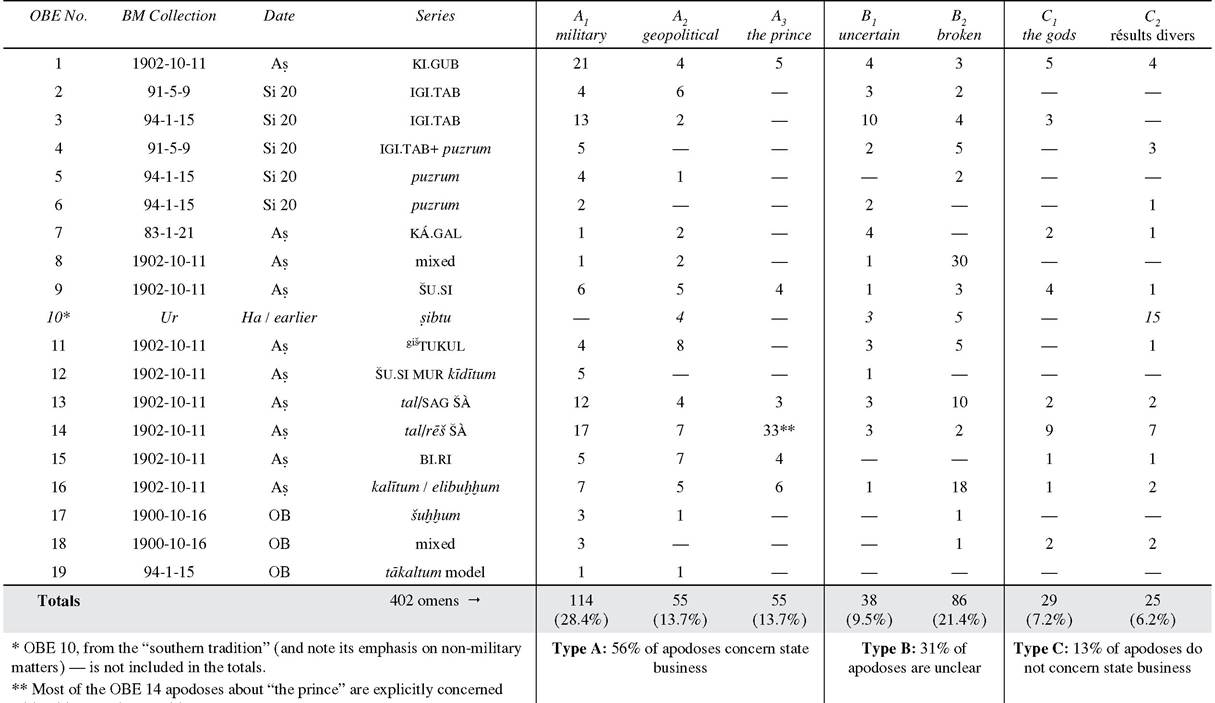
with military and geopolitical matters.
246 SETH F. C. RICHARDSON
concerned with subjects that seem more epistemic in their intent to explain signs throughout the world at large — as an open system of knowledge, not a fixed or closed one.105 Type C includes signs of the gods which do not clearly indicate whether the concern is either state or private business (Cx),106 and the results divers which more apparently have no connection to the state business of Type A omens (C2). Some examples:
Ax OBE 1 rev. 12': “my raid will search for much booty in the enemy’s country”
A2 OBE 9 obv. 21': “they will revolt against [the king] in the council”
A3 OBE 14 obv. 37: “the prince will get his advisers from his palace servants”
Bi OBE 3 iv 6': “(or:) couriers”
B2 OBE 7 12': “[... ] the fall of [... ]”
C/ OBE 3 iv 7': “the presence of Istar”
C2 OBE 1 obv. 3': “the son of a herald will die”
The results are quite lopsided: with almost a third (31%) of the apodoses of an undetermined nature (Type B),107 108 the remaining subject matter is overwhelmingly concerned with state business (Type A with 56%, Type C with 13%, a 4:1 ratio). Of the omens whose subject matter can be clearly discerned, the focus is emphatically on the expedition of the army, palace coups, harem intrigues, on the fall of cities rather than on predictions of curses, abundance of the harvest, medical conditions, etc.
The most insistent concern of Type A omens is for two areas of action out of the direct sight of the king: the success of the army in the field, and stability within the loyalist class. The interest in military action is not hard to spot: omen after omen fears the “fall of the army while attacking” (OBE 1 obv. 15'), that the “army will not reach its destination (OBE 2 obv. 15'), that “the enemy will strike at the core of your army” (OBE 4 rev. 13'), that “you will lead away in captivity the population of the city you are besieging, but another will enter it” (OBE 13 obv. 8') — information so specific that it borders on the tactical.
Loyalty is the other pre-eminent concern of the texts. Betrayals endangered the Amorite monarchies on many fronts: among the king’s populace, officials, military, vassal kings, even the dynastic family itself. An emphasis persists throughout the compendia on tracking the movements of both people (logistically) and allegiances, in which the deceptions of friends are a prominent feature: “a servant of the king will slander him” (OBE 13 rev. 8'); “the sons of the prince will rise against their father with malevolence” (OBE 14 obv. 20); “the proletariat
(hupsum) will rebel” (OBE 14 obv. 24); “his courtiers will kill him” (OBE 11 obv. 3); “an envoy telling dangerous lies will arrive” (OBE 13 rev. 12'-13'); “defection of a diviner” (OBE 14 rev. 48).
These concerns are very much of-the-moment: the omens are not really concerned with the far-flung future and “fortune-telling,” but with a shifting status quo. They are consistent with what we know of Sumerian extispicy, that it was used to reveal what already existed, though hidden or unrecognized — not what would come to pass in the far future.108 Our readings of many ancient Near Eastern omens and prophecies already expect that their authors intended them as messages about the present (often with reference to the past), couched in a future tense, ex eventu in their voice. In this connection, one should note the indistinction or ambivalence between the Akkadian verbal present and future tenses, and that the apodictic verb is also known to appear in the stative, the perfect, or even the preterite.109 * The presentist nature of extispical knowledge is now also forcefully underscored by HeeBel’s study (this volume), which establishes that the “stipulated term” for which extispical readings were valid were limited to a maximum term of three years, and most often for much shorter periods of time.
The formal aspects of causation and future tense should not take our eyes from the content: Old Babylonian extispicy tried to determine courses of action for the conduct of statecraft in the here-and-now, having to do with the immediate outcomes of present conditions, in war, in diplomacy, in staffing. In reading an omen that said to the king “they will revolt against you in the council,” we should understand that the real message was not to predict some future revolt, but to give notice that the council was at that moment or incipiently disloyal and plotting. That the omens took political and military intelligence as their subject matter should nevertheless not, I believe, direct us toward a strictly functional view of extispicy — that it had an exclusive, primary, or dispositive role in determining policy — but that it served a function parallel to civil and military channels of intelligence and political pressure. The paradigm of information-gathering for leaders of states at war is not to construct a single and infallible source, but to construct multiple, overlapping, and even competing branches to advise leadership.110 Part of this structuring is functional (in the sense that it increases intelligence and offers verification),111 part political (in that it polices and builds an image of total state knowledge), part hegemonic (in that divination specifically braids in and blurs distinctions between religious, military, political, and cultural forms of authority).
3.4 THE “SECULAR” POSITION OF OLD BABYLONIAN DIVINERS AND DIVINATION
The subject matter of the texts then match up very closely to the sociopolitical position of divination in an administrative economy fueled by secrecy, intrigue, and a concern for the secure transmission of information. In spirit, the technical literature better resembles the intelligence technologies of states at war112 than, say, scholarly projects like medieval hagiographies or Enlightenment encyclopedias.113 In this respect, the palace orientation of divination is probably reflected in what we know of third-millennium extispicy; while it is anachronistic to describe divination as “secular,” I use it here to mark as erroneous any idea that its origins were essentially part of Babylonian religion.114 * While earlier liver divination indeed concerned temples, there is little evidence for it as part of temple cult: that is, ex- tispicy was used to choose chief priests and sites or dates for temple-building by kings, but there is little indication that it was used by cult personnel. From earliest times, diviners had primarily been agents exterior to the temple household used by the palace for verification. The communicative mode of temple cult was sacrifice, but sacrifice was a distinctly secondary gloss on Old Babylonian extispicy. The communicative mode of extispicy was professional interpretation, and its incorporation of Babylonian gods and use of sheep and goats as media / materia magica resulted from orthopraxy, not orthodox theology.
In general, diviners appear in third-millennium contexts which are not cultic, and divination is also absent from divine hymns. No reference is made to divination in either royal letters or hymns to Utu (the god most commonly associated with divination), nor in temple hymns mentioning Utu of Sippar or Larsa,115 nor indeed for any other gods.116 I am aware of no incantation or ritual text from the Old Babylonian period (or earlier) which sets the work of the diviner inside a temple, nor any instance in which the title mas.su.gid.gid is further clarified by an extended title “of Temple Name.”117 The gods, meantime, are in sparse attendance
within the lines of the omen literature: to be sure, they are routinely called upon at the outset of extispical reports, and the compendia do enumerate the occasional “sign of Istar,” but these features do not indicate institutionalism any more than a “weapon of Sargon” indicates specific historical knowledge about the dynasty of Akkad.118 Secondary extispical literature (that is to say, not the technical literature, e.g., the “prayer of the diviner”) may mention Samas, but never other priests, shrines, or temples. Rarely do the omens take cultic personnel as their apodictic subjects (see section 2.1); instead, in addition to military personnel (see section 3.3), they are concerned with councils, courtiers, cupbearers — the civil, military, and domestic servants of the Crown.119
Readers will already be familiar with the extensive network of diviners employed by the Mari kings, despatched to the courts (petty and great) of greater Mesopotamia. More than forty-five diviners are known by name from the court of Zimri-Lim alone, posted in more than two dozen foreign palaces, fortresses, and towns.120 * From the kingdom of Babylon, diviners are also primarily seen to be engaged in state business having to do with diplomacy and military matters, a picture derived not only from the technical literature,121 but also from letters and administrative texts.122 One may summarize the functional role of diviners in the vast majority of texts as being in service to the king in a variety of ways related to intelligence — as diplomats and spies in foreign courts, on the march with armies, in private council to kings, in charge of fortresses.123 Diviners’ chief concern with interstate affairs is also evident in terms of the environments in which they moved: the compendious texts discuss the cityscapes of palaces, gates, walls, harems, and storehouses — but not temples — and landscapes far beyond the city walls: garrisons and strongholds, borderlands, army bivouacs, battlefields, roads, and the open country. These latter places were, by the urban orientation of Mesopotamian theology, de facto relatively unprotected by the gods, spaces across which movement of goods and personnel was a dangerous business.124 By a geography of knowledge, one would better
contrast than compare temple religion (where truth was to be found with the god, in his cella, at the very heart of the city) to extispicy (where truth was to be found by a professional, inside a sheep, from the transhumant zones of the countryside).
Most critical to this study is that Old Babylonian diviners served these roles in an era of prolonged and aggravated crisis than that they were “secular” figures per se. The existence of divination as an already accepted form of para-knowledge made it an ideal vehicle for the ideological re-inventions and circumventions of the day. To make a categorical distinction between the “secular” and “sacred” would fall afoul of a modernist dichotomy that would have mystified an ancient Mesopotamian; yet to write a primarily “sacred” valence back into a history of Old Babylonian divination would be a correspondingly severe mistake. If we do not credit these actors with the intellectual, social, and political ability to consciously manipulate traditional signals for their immediate needs, we miss an opportunity to see how the forms that remain, dried in clay, began as impressionable substances in the hands of master scribes.
3.5 THE INFORMATION WAR AND THE “SECRECY PARADIGM”
Why should divination, first attested as a craft in the Early Dynastic period, only now in the Old Babylonian take on this new entextualized aspect? Why should the paradoxical dimensions of secrecy and a written tradition develop simultaneously after a thousand years of practice? An episode from the Mari letters first drew me to reflect on this apparent paradox. ARM 26/1 101-04 are letters from agents of Zimri-Lim on a diplomatic mission to Babylon; the last of these complains of Hammurabi’s violation of secrecy protocols in favor of attaches from Ekallatum:
The servants of Isme-Dagan (king of Ekallatum)... have ousted the lords of the land and they themselves have become the masters of Hammurabi’s council. He listens to their advice. Once or twice, when (Mari diviners)... read the oracles and reported on them, [these men] were not asked to leave. As they were present, they heard the message of the oracles. What other secret is there beside the secret report of the diviners? While his own servants do not hear the secrets of the diviners, these men do!u5
Both the process and results (sometimes even the practitioner) of liver divination were insistently secret. Divination was highly charged as a secret enterprise: a “secret” (piristum, later nisirtu) in extispical contexts could refer not only to the results of an inspection, but to the spoken word of the diviner, the written reports, the person of the diviner (mukil piristisu),125 126 * even to the liver itself — secrets to be guarded against being “stolen,” “betrayed,” “leaked,” or “seized.”127 Coupled with what we have observed above about the diviners’ place in courts
distant from their king’s;128 about Zimri-Lim’s network of dozens of diviners throughout Syro-Mesopotamia; about their entrustment with troops, fortresses, and other materiel129 — the context of intelligence for divination’s “secrecy paradigm” is difficult to ignore.
Yet though it seems only natural that kings should hold secrets of state together with their advisors, and that those secrets were of a sensitive nature, Hammurabi’s exclusion of the Babylonian councillors in favor of foreign agents in ARM 26/1 104 strikes a more discordant tone. It has been typical to think of divination as a form of knowledge that was sensitive due to its content, that what liver divination did was to passively reveal (rather than actively create and communicate) secrets.130 Yet there has been remarkably little association of divination’s emphasis on secrecy to its military-political subject matter. This reluctance may arise because a functional explanation of extispicy might seem to compromise or reduce the status of a classic Mesopotamian intellectual project, but knowledge forms are too much artifactualized if we do not approach them as historically contingent.
The century in which extispical literature first came to light is the same one in which the courts and scribaria of Mari, Babylon, Larsa, and Esnunna were in such an unparalleled state of political and military flux that the atmosphere may fairly be said to have been revolutionary. In the sphere of ideological production, this revolution saw re-inventions of at least four major patterns of political power and legitimation. Political authority was established on hybrid grounds of both dynastic authority and genealogical descent.131 132 The political envelope of city-state dynasticism was being pushed by the novelty of single cities with multiple dynasties (e.g., Mari, with two competing dynasties, and Larsa, with at least three successive ones) and single dynasties with multiple centers (e.g., Samsi-Adad and sons, Larsa and Jamutbal, Elam’s sukkal and sukkalmah).™· An unstable system of vassalages, peerships, and royals-in-exile had grown up which encouraged a virtual marketplace competition for power. Fourth — and perhaps most relevant to our analysis here — this competition extended well below the level of kings and viziers, to courtly, military, and urban officials, who jockeyed not only for position relative to one another, but even marketed their loyalties between royal courts.133 This is the political culture which forms the backdrop of extispical text-production in the palace sector.
I posit two different functions of the extispical literature in its creative period; these functions intersect in the issue of secrecy. On the level of ideology, extispical texts defined a body of knowledge independent of religious authority, control over which not only permitted kings a direct access to the divine will, but which was inaccessible to other authorities.134 If the state arises by means of its monopoly of legitimate violence — that is, through a generalized,
coercive principle of inequality (Trigger 1985) — it can only do so by first controlling the terms of legitimacy (Kelly 2006). Securing structural inequality thus presupposes control over the terms of privilege, over access to knowledge: what the state finally requires is privileged knowledge, is secrecy.135 Extispicy, through its explicit claims to secrecy but also through its voluminous and exclusive technical apparatus, helped to establish that equality gap for Old Babylonian kingship.
The principle of secrecy operated on a second level of praxis, too: claims of exclusivity allowed kings a very real free agency in the realm of intelligence. Control over extispical knowledge permitted the creation of a loyalist cadre of diviners, parallel to other cadres, who by definition operated on principles of secrecy for intelligence-gathering. This “secrecy paradigm” created opportunities for kings to establish
• internal policing to monitor staff loyalty and information security
• firewalls to encourage but control intra-organizational elite competition136 *
• opportunities for backchannel diplomacy
• free movement of political agents across non-urban and foreign zones
• permanent networks of agents whose activities could circumvent the strictures of courtly politics
The pre-eminence of these secrecy functions is made clear by the Mari “diviners’ oath” (ARM 26/1 1), in which ritual and scholarly concerns go entirely unmentioned: the oathtaker swears not to hide information; to reveal information only to Zimri-Lim; to reveal the identity of diviners who have violated their disclosure oath; to report “evil rebels” who have “hostile mouths,” especially those who have tried to use the divinatory apparatus for their own ends. That is, not only the secrets and the secret-holders were under royal authority, but the process itself.
Divination thus did not merely reflect the subject matter of the Mari letters when it read signs of warring states and secret news, it was the medium through which those struggles were processed. The vertical structures of command in dynastic city-states were simply not sufficient to meet the challenges of a continuous state of internecine war in nineteenth-eighteenth-century B.C. Babylonia. Divination afforded alternate avenues for kings to transmit information securely and quickly in insecure environments peppered with disloyal courtiers, traitors, and spies, and fast-marching armies. At the same time, divination ambiguated lines of control and clamped down on self-interest among internal elites by creating multiple channels of information, cross-checking, and verification.137 The hallmark of this new tool was the simultaneous discursive power of truth and secrecy.
Secrecy is not disharmonious with ritualism, but it does not harmonize so well with the development of a massive literature consisting of hundreds of tablets, ±10,000 written omens, the communication of results in written and dated reports, the development of reference tools like liver models, or the discussion of omen results in letters. The “secrecy paradigm” is best revealed by its absence in two contexts. The first of these is its absence from the school curriculum: although, by our estimate above, some 3,200 Old Babylonian omens survive to this day, not a single extispical school text is known until the Kassite period.138 Extispical knowledge was indeed produced by scribes, but the texts were not taught as a part of Old Babylonian scribal knowledge.
The second is extispicy’s absence from Old Babylonian royal inscriptions. Though the craft had been acclaimed by Sulgi and Gudea139 in ages past, extispicy was absent from this more public literature. Hammurabi (once) and Samsuiluna (twice) speak of “signs” (giskim/ ittu) signifying their legitimate power, but these almost certainly refer to celestial or terrestrial signs, not extispical ones.140 Among all Old Babylonian kings, only Warad-Sin mentions tertu — probably liver omens, but rather vaguely.141 The school curriculum and royal inscriptions addressed different audiences for different purposes, but divination’s absence from both literatures emphasizes its isolation from persuasive efforts to speak through the literati or to the literate public. Old Babylonian kings never boasted or bragged about extispicy because it was not a public discourse of power like temple religion or patronage of ancient literature.142 It was not meant to be publicly legitimizing (as remained the patronage of gods and temples); it was not yet a classical cultural form for junior scribes to master (as were royal hymns).
For whom, then, was extispical literature developed? Again, we should turn to divination’s functional, political environment for answers. Though the need for quick transmission of news from city to city between political agents was paramount, the security of that information was mediocre at best. We know of paired messengers sent to corroborate the contents of letters, a kind of “double-key system”;143 we know of the capture and interrogation of envoys;144 of decoy messages sent to courts in opposite directions at the same time;145 of limitations placed on the movements of even allied ambassadors within the Babylonian cities;146 of hidden
messages and messengers;147 and, as mentioned above, the not-so-discrete method of barring some people from the council chamber while others got to stay in. The variety of means by which to improve and protect intelligence were many, but intrinsically limited to the reliability of people.
In claiming a perquisite of secrecy for their texts and procedures, diviners created “spaces” — legitimized secrecy-complexes of environment, personnel, opportunity, and action — in which the king could gain advice and information from people outside the normal channels of court and council, and sometimes without their knowledge altogether. (What I do not suggest is that divination texts were themselves a “secret code” or the like.) Extispical texts carved out an exceptional, secret space at the highest, most rarefied levels of power; divination’s authority paralleled the military power of generals and political power of viziers, a flexible intelligence protocol developed to keep politburos in the dark and kings in the know. The “antiqued” cultural legitimacy of this new science of communication with the gods protected it as a mysterium, one tool among many enabling the king to move and communicate freely in an environment swimming with other political actors and agents.