Demonic Attack
Generally speaking, demons infect the victim by attacking him/her when the individual finds him/herself in an unprotected situation, that is to say, when he/she is out of his/her “natural” context.
It will be thus in the open field, in the darkness and silence, opposed to the protected space of the city with its sounds and lights, where the demonic encounter usually takes place.22As for the evil Utukku-demon who walks in the steppe,
(And) the evil Alu-demon who envelops (one) in the steppe,
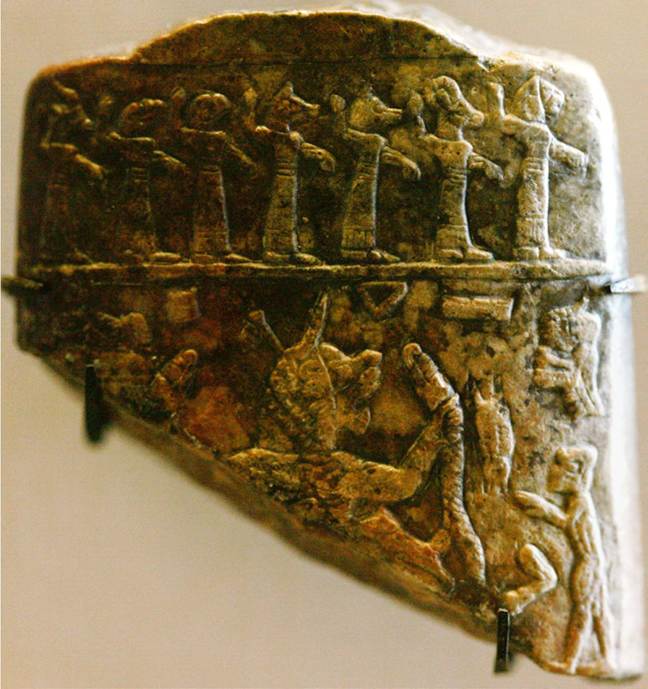
The dangerous Asakku-(demon) who always roams around in the steppe (uh vii, 98-100)[157] [158] However, demons can even penetrate the house in particular situations (at night, for example) by way of slipping through openings such as windows, the door's pivot, threshold, and bolt. (You must) not return [to] the house, Nor will you sit with him at the threshold of the house, Nor go up with him to the roof. You must not lean out of the window to him, Nor strike him down via the ribbed window, Nor cry out to him from the karratu-window, Nor may you look at him through the upper window, Ditto (= nor may enter to him) through the ‘leaning-out' window, Ditto, through the lattice window, Ditto, through the tomb-opening (lit. window), Ditto, through the ventilation-window, Ditto, with fireballs produced by the sun, Ditto, in broad daylight, Ditto, in the daytime, Ditto, in the dark, Ditto, through the well, Ditto, through the bathing cistern, Ditto, through the roof-eaves Ditto, through the bound roof-eaves, Nor must you always slither through the door, bolt, or lock of the house to him. You must not blow in with the wind and heat towards him. You must not enter (the house) with a man going out, Nor may you enter it when he enters. You must neither be present nor occupy (the house), And neither keep returning nor prowling around. (uh IX, 91'-115')24 The human victim may come across[159] [160] demons, apparently by chance, while the latter wait and lurk in dark and unclean places. The encounter and contact with demons is expressed through a series of motion verbs that characterise demonic attack. They stay, sit, go, follow, approach, circulate, draw near, walk behind and in front of their victims; they enter or slip into the house or climb the roof, and stay in the corner or in the niche. May evil ones not approach my body; May they not go in front of me, May they not go behind me, nor enter my house, And may they not clamber up to my roof, nor slip into [my] living room. You may not stand where I stand, Nor may you sit where I sit, May you not go where I go, Nor enter where I enter. (uh iii, 73-76 and 159-162)26 Or (you [= demons]) who keep entering the houses, Or who keep frequenting thresholds, Or who keep going into the toilets, Or who keep sitting in dung heaps, Or who keep seeking out attractive lads and lasses in the street, Or who is the ‘watcher’ of midday, Or who is the inspector of human speech, Or who are always present at the patient’s head, Or who are always sitting at the patient’s head, Or who are always walking at the patient’s head, Or who always eat with him when he dines, Or who always drink with him when he imbibes, [Or who] always frighten any such patient, Or who always terrify any such patient, Or who always scare any such patient, Or who always lash about before the patient, Or who always sneer before the patient, Or who always scowl before the patient, Ditto, who always take a seat Ditto, who always grind your teeth, Ditto, who always stick out your tongues, Ditto, who always open your mouths. (uh xi, exc. y)[161] [162] [163] Once they have engaged their victim, they do not let him/her go, being with him/her always and everywhere: Whether you are the ‘let me eat with him daily'—demon, Or whether you are the ‘let me drink with him daily'—demon, [Whether] you [are the] ‘let me be anointed with him daily'—demon, Or whether you are the ‘let me get dressed with him daily'—demon, Whether you are the ‘let me enter and dine with him'—demon, Or whether you are the ‘let me enter and drink with him'—demon, Whether you are the ‘let me enter and be anointed with him'—demon, Or whether you are the ‘let me enter and get dressed with him'—demon, [Whether you are the] ‘let me eat with him when I'm hungry'—demon, Or whether you are the ‘let me drink with him when I'm thirsty'—demon, Whether you are the ‘let me get anointed with him when I'm lousy'—demon, Or whether you are the ‘let me get dressed in his lap when I'm cold'— demon. (uh iv, i58'-r6g')28 The physical or sensorial contact (eye-voice-touch)29 that the demons establish with the human being triggers the engagement with the target that will ultimately lead to the complete seizing of the victim. You must not place your head upon his head, Your hand upon his hand, Your foot upon his foot. You must not touch him with your hand, Nor incline your neck towards him, Nor raise your eye towards him, Nor look behind you, Nor call out above him. (uh iv, 179’-186’)[164] [165] [166] [167] The incorporeal one pursued her relentlessly. He struck her hand and placed (it) on his (own) hand, He struck her foot and placed (it) on his foot, He struck her head and placed (it) upon his head. (uh V, 185-188)31 Demonic attack, therefore, is described in cuneiform textual records as a gradual approach and spatial progression towards the victim. The aggression starts in the open field or in the street, and it is followed by a process of getting closer to the victim's abode—the house or the bed chamber—until the demon gains possession of the bodies, which usually happens through slipping into the victim's body openings, as if the body were a housed2 However, the texts give more relevance to the physical and aggressive features of demonic attack. In general, the victim is seized and blocked. Afterwards, a series of actions, which recall those of a fight, take place, so that the demon strikes, bites and smashes the victim. The imagery of violence and battle is not accidental but, in fact, demons relate to war in many ways. The epithet “warrior, fierce” (Sum. ur.sag/Akk. qarradu) is used for the Seven demons (Sebettu),33 who accompany the war and plague god Nergal, as well as for other demons. From an iconographic viewpoint, the lifted right arm, which is characteristic of demonic iconography, recalls the aggressive act of attacking. Features of the demons' composite body are metaphors of the physical assault on their victim. The canine or feline teeth-grinding face expresses fierceness. The long nails and the eagle talons are symbols of a tight grip. On a mythical plane the idea of demonic attack as a fight against and imprisonment of the victim is grounded in the motive of figure 5.2 Fragment of a clay plaquefrom the Louvre (ao 7088; by Rama, licensed under CeCILL). the god Dumuzi chased, captured, and led to the Netherworld by the Galla- demons, which is the core theme of the compositions of the god's cycle.[168] (Demons) surrounded him and drained the standing water (in the ditch). They twisted a cord for him, they knotted a net for him. They wove a reed hawser for him, they cut sticks for him. The one in front of him threw things at him, the one behind him loosened the rope a cubit. His hands were bound in handcuffs, his arms were bound in fetters. (Dumuzi’s Dream 156-163)[169] Like Dumuzi, the sick man is chased and seized by the demon and then struck. The victim is paralyzed by the demon's bond and becomes slowly unable to move leading to his/her complete immobilization and deaths6 (Against) him whom the evil Utukku seized, whom the evil Alu seized. (When) evil Fate and Asakku-demon binds (victims), (when) the Utukku- demon binds (victims), Creatures of the land are equally affected. (uh XIII-XV, 149-151)37 (The Utukkus) have struck the shepherd down in the grazing place, The herdsman in the pen, The soldier in the battlefield, The maiden in her apartment, And the children in the playground. By attacking the godless hero's physique, They introduced distress into his body. (uh VII, 73-79)38
More on the topic Demonic Attack:
- Demonic Attack
- Aetiologies of Illness
- Sin, Impurity and Exorcism (4Q560)
- CHAPTER 14 Demons in Lapidaries? The Evidence of the Madrid ms Escorial, h.I.15
- Demonic wails, shouts and chants haunt the monastic literature of late- antique Egypt, wreaking havoc in the lives of monks.
- Song 3 in the Context of 11Q11
- Bhayro Siam, Rider Catherine (eds.). Demons and Illness from Antiquity to the Early-Modern Period. Leiden, Boston: Brill,2017. — xiv, 434 p., 2017
- Demonic Influence and Symptoms of Melancholia
- Picking Up Bad Vibes: Demonic Anti-Music and Spiritual Sickness in Evagrius
- Blaming the Witch