Digambaras and Shvetambaras
Before highlighting those features that distinguish the Digambaras from the Shvetambaras, it is important to acknowledge the many things they share in common, including a general heritage of teachings and similar forms of practice.
Still, the differences are interesting and instructive, helping to illustrate Jainism’s rich diversity.We have noted some differences at earlier points in the chapter. The two sects posit differing dates for the death of Mahavira (527 все for Shvetambaras, 510 все for Digambaras). The Digambaras deny that Mahavira ever married. In keeping with their generally more conservative views, Digambaras do not agree that the nineteenth tirthankara, whom the Shvetambaras know as Malli and the Digambaras as Mallinatha, was a woman.
The most obvious issue differentiating the two sects involves clothing. Digambara (or “sky- clad”) monks, as their name infers (and as we have witnessed in the dana ceremony), go about naked; Digambara nuns do not, donning simple white garments as do their counterparts in other Jain sects. From the Digambara perspective, wearing clothes puts monks back into the ordinary category of the laity. Nuns are not esteemed quite as highly as monks, and in general, Digambara doctrine is more severe than the other sects when it comes to spiritual deliverance of men versus women. In short, women (including nuns, even though they perform the same ascetic practices as monks) are deemed incapable of attaining kevala; they must await rebirth in a male body in order to reach the potential of final deliverance.
VOICES:
An Interview with Girish Shah
Girish Shah was born in the Indian state of Gujarat, which is home to many Jains and to important pilgrimage destinations. He attended college in Mumbai and then left India to attend graduate school in the United States, where he now lives. A founding member and director of the Jain Center of Northern California and the Federation of Jain Associations in North America, Mr.
Shah is dedicated to educating people about his religion.What do you consider to be the most important reason for living a proper Jain religious life?
The goal is to become free of karma. To make your soul and its properties of infinite knowledge, infinite vision, infinite strength, and infinite capacity to character “clean,” you have to get rid of all the karmas that are polluting it. For one to live a religious life it is important to achieve that.... But for me, the more important part of living the proper religious life is that it is the way you will support each other, it is the way you will serve each other. You are helping each other grow, and you are reciprocating, giving back. We need to have empathy toward everyone. Forgiveness is not for those who have done nothing to you; forgiveness is for someone who has hurt you.
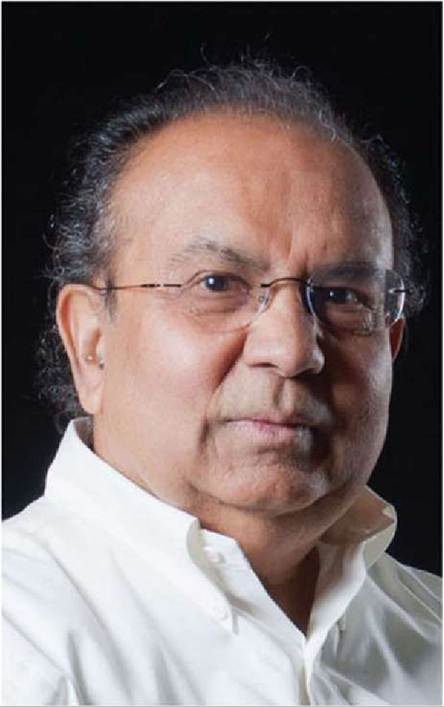
Girish Shah.
Do you consider Jainism to be an atheistic religion?
I think the question is what you mean by “atheistic religion.” If you mean by atheistic religion god the creator and god the controller and god the sustainer; that there is an entity that created the world, that controls the world, that sustains the world, and that judges everybody, then no. We do not believe in god in that sense, but we do believe in the quality of the soul, which is godliness. Infinite compassion—that is the characteristic of soul. The knowledge, the vision, and working with and relating to everybody, comes from infinite compassion. And that has the power, that has the godlike characteristics. It doesn't control anything. Even our enlightened or tirthankaras cannot make me achieve moksha. They can show me the path, but cannot say, such as the gods will say, “I bless you.” There is no blessing. There is no divine grace that anyone can give. Forgiveness has to be done by you, by your own action. The burden is on you completely, but you can achieve it.
Jainism is the religion that says: “I am god” (if we call the tirthankara “god,” which is the common word that we use). No other religion tells you that you can become god. But Jainism says everyone can become god.How important to you are vegetarianism and other forms of ahimsa?
Very important. The idea is to minimize the amount of himsa that you are doing, and so you give up some of these things—at least for the important religious days, if not all the time. Some people will take vows to give up this or that for their entire lifetime. Increasingly I am becoming vegan, knowing that there is so much himsa in dairy. I have not become fully vegan, but hopefully someday I’ll get there. Traditionally, milk was okay, because of the way cows were treated before. Now things have changed, and so we have to evolve and look at it. It’s just sensitivity to it. Here is another example. I ask myself: “Why am I wasting natural resources?” I have a nice home. I have never felt the need to go beyond. This is my first house and my last house. I have no attachment to the house. People say, “Girish, you should be living in a beautiful big home,” and I say, “What beautiful big home? Why do I need one?” It’s all internalizing. I don’t have the need. I have a four-bedroom house; it’s big enough. That’s plenty of space, 1,800 square feet. Why do I need a 7,000-square-foot house, why do I need a 10,000-square- foot house? Just because I can afford it doesn’t mean that I should have it.... This is all part of ahimsa. It’s all part of ahimsa because then you are not wasting your resources. Charity is a form of ahimsa because you are now using money that you made for the benefit of others, for their growth, their progress, their betterment of life. People need to have betterment of life beyond their basic needs in order for them to spiritually think. If you don’t have enough even to eat and to think, you’re not going to have spirituality.
You immigrated to the United States from India.
What do you consider to be the most notable differences between being a Jain in India and being a Jain in the United States?For Jains in India, things are taken for granted, whereas being a Jain here, you have to put up with a lot of issues. Every time I go shopping, it takes a half hour reading the ingredients to see how many animal products are in it. There is no green mark on food packaging here like we have in India, where you can look at it and say, green—it is vegetarian. Also, I can’t walk to places here. In India, you walk to places. You don’t have to use the car. To go shopping, to go to the temple, you walk. Here in California you have to drive, particularly when you drive here in summer, your car windshield is filled with all those butterflies that you’re killing on the way. And so my wife refuses to travel at night. You’re going to get up in the morning and go. You’re not going to kill all those butterflies, just to get there at night.
Another identifying feature of the Digambara sect involves the ascetics’ avoidance of alms bowls as a means of collecting food, using instead only their cupped hands. The reasoning is based in the principle of ahimsa: washing of bowls presumably would bring about greater harm by injuring tiny insects or microbes in the water. The same reasoning supports the “skyclad” practice of monks, for the washing of dirty clothes causes harm. Finally, as previously noted, the Digambaras have their own official collection of scriptures.
A sizable majority of Jains are Shvetambaras. Since about the thirteenth century ce, they have followed their set of forty-five sacred texts as authoritative. Unlike the Digambaras, they use alms bowls when begging for food; they accept the possibility of a woman attaining kevala; and, of course, they wear clothing (monks and nuns alike), consisting of upper and lower white garments.
Interestingly, even Shvetambara texts make clear that Mahavira and his early male followers went about naked.
Gradually, the opinion arose among Shvetambaras that the wearing of clothes was an option. One text from the second or third century ce designates three specific factors making this permissible: embarrassment; causing others to feel disgust; and inability to endure hardships caused by nakedness.5VISUAL GUIDE
Jainism

Jain emblem. The emblem’s outline represents the loka, or universe. The swastika (a Sanskrit term implying “well-being”) is an ancient and common symbol in various religious traditions, Jainism among them; its four arms represent the four realms of life (heavens, human realm, animal realm, and hells). The hand represents ahimsa.
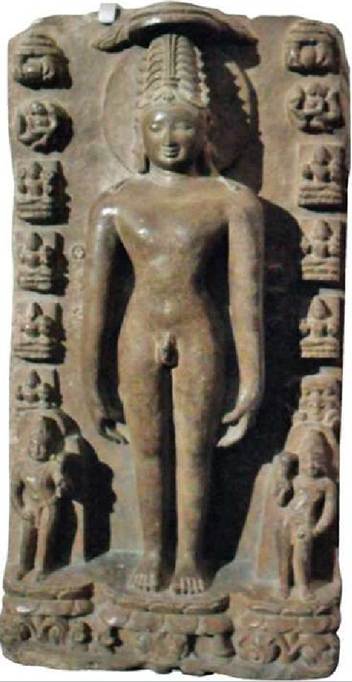
Tirthankara. Sculptures of tirthankaras, like this one of Rishabha, whom Jains revere as the first of the current world cycle, are objects of Jain worship.

Whisk. Shown here with a book of Jain scripture, the whisk is used by ascetics to clear away, and thus to protect, insect life. It symbolizes ahimsa.
Sthanakvasis and Terapanthis
Within Shvetambara Jainism, two distinctive sects, the Sthanakvasi and the Terapanthi, have features that distinguish them somewhat from their parent. Most significantly, both reject the worship of images, which is a common religious practice among the majority of Shvetambaras. Ascetics of both sects constantly wear the muhpatti (“mouth shield”), a cloth that protects insects from accidentally being inhaled as the monks and nuns traverse the land. And both sects allow monks and nuns to travel abroad.
The Sthanakvasis trace their origins to the seventeenth century, the Terapanthis to the late eighteenth century. The Sthanakvasis are relatively liberal with regard to the role of women. For instance, of the over 3,000 Sthanakvasi ascetics today, about five-sixths are nuns, and nuns are allowed to travel unaccompanied by monks.