The Ascetic Life
Through their biographies and teachings, the tirthankaras, “makers of the river crossing,” show the way to liberation to all Jains. However, as neither the tirthankaras nor any Jain deities can bestow salvation, all individuals must make their own spiritual progress and eventually attain their own deliverance.
Moreover, as noted, Jains believe that the ascetic life offers the spiritual path that best replicates the lives and follows the teachings of the jinas. Still, no one expects the average Jain to enter upon this arduous path. Simply having entered into the human realm does not imply that one is ready for the ascetic life. A Jain takes this life on gradually, after having become an accomplished layperson who fulfills all religious duties successfully and with a pure disposition. When the circumstances are right, whether in this lifetime or in a future lifetime, the decision to renounce the lay life and become an ascetic is made.The decision of renunciation is not to be made lightly. The initiation ritual, diksha, marks the point at which the individual becomes completely committed to the ascetic life. Through the centuries, minimum age requirements have been imposed—young adulthood for the Digambara sect, younger for the Shvetambaras (historically, as young as age six, although today only the Terapanthi sect permits the initiation of young children). The ceremony includes a symbolic removal of hair (via the traditional method of being pulled out tuft by tuft) and presentation to the initiate of the whisk and other implements of the ascetic life, such as the alms bowl for Shvetambaras. Diksha is overseen by a teacher, who typically continues to provide guidance to the new ascetic. The ritual marks the symbolic rupturing of the participant’s past and future lifestyles, usually involving total separation from one’s family, although Shvetambara nuns are on occasion allowed to interact with family members.
Ascetics depend on the almsgiving of the Jain laity, and sometimes of Hindus, in order to eat. Usually wandering in groups, they spend eight months of the year traversing the land, and then four months, during the rainy season, with lay communities. By remaining settled during this wet period, the ascetics do not jeopardize the well-being of life forms, which tend to be on the roads in greater numbers because of the rains. So, once again, the principle of ahimsa underlies Jain practice.
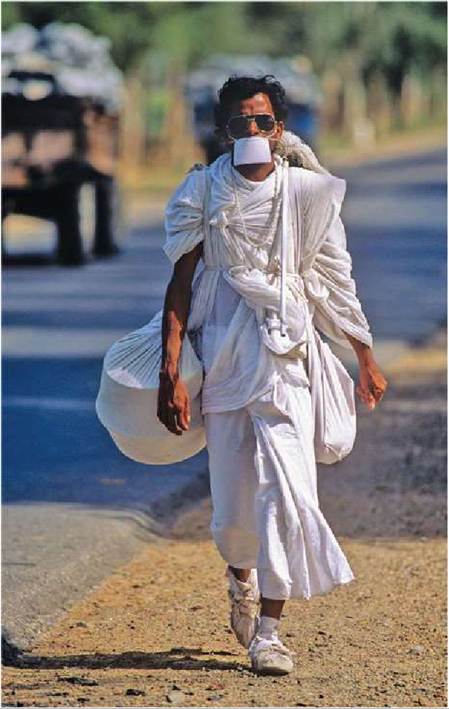
A Jain monk wearing the muhpatti in order to prevent unnecessary harm to airborne insects.
The Five Great Vows
All ascetics commit to five “Great Vows” that serve as the doctrinal groundwork of both their inner purity of intention and their outer purity of action:
1. Avoid inflicting violence (ahimsa) on other life forms.
2. Abstain from lying.
3. Do not take what has not been given.
4. Renounce sexual activity.
5. Renounce possessions.
Jain texts expand on these vows in great detail, elaborating on the subtleties of their content and means of satisfactorily fulfilling them. As you might expect, most attention is devoted to the first vow, as ahimsa is understood to be the foundation of the entire ethical outlook of Jainism. Each of the other four vows is interrelated to ahimsa. For example, the third vow (not to take what is not given) is interpreted to mean, in its most profound sense, not to take a life. The fifth vow is understood also to imply avoidance of violence, for to renounce possessions is to deflect the passion that arises through attachments to them. Passion is thought to be a primary cause of violence.
Ascetic Practices
The basic impulse toward asceticism, so pervasive throughout the history of Jainism, is grounded in two objectives: the avoidance of further dirtying of the jiva with karmic matter and the eventual burning off of the matter that has already tainted it.
Specific practices are prescribed in Jain texts, notably the Six Obligatory Duties, which for the Shvetambara sect are enumerated as follows (the Digambara list differs only slightly):1. Equanimity, achieved through meditation
2. Praise of the tirthankaras
3. Veneration of teachers
4. Repentance
5. Laying down the body (standing or sitting motionless for varying periods of time)
6. Abandonment (renunciation of specific foods or activities for a certain period of time)
The Six Obligatory Duties are to be performed by all ascetics and, ideally, by laypeople as well. The specifics of each duty are developed in the texts. The duty of repentance, for example, involves acknowledging wrongdoings before one’s teacher twice daily and ends with the recitation of a passage well known to Jains: “I ask pardon from all living creatures. May all creatures pardon me. May I have friendship for all creatures and enmity towards none.”-
Perhaps the most startling Jain ascetic practice in the view of outsiders is sallekhana, the intentional fasting of oneself to death. Although this practice was quite common in earlier times and is believed to have been the form of dying adopted by Mahavira and other great ascetics of the past, today it is rare. Insistent that sallekhana is in no way suicidal, Jains argue that, because the act of eating generally involves the risk of harming other life forms, fasting even to the point of ending one’s own life is a highly effective means of warding off karma. In general, an individual’s mindset at the moment of death is considered to be a significant factor for the prospects of rebirth, and so sallekhana, lacking the passion and violence that regularly accompanies suicide and instead fostering a tranquil and meditative state, is thought to provide an ideal means of dying.
Jain laypeople look to monks and nuns as exemplars of Jain ideals. What similar sorts of exemplars are present in other religions?
More on the topic The Ascetic Life:
- Ahimsa and Asceticism: Jainism’s Ideals
- Way of Life
- The Yogi's Way of War
- Theory of the Universe
- Is There an Iconography of Violence?
- Liberation and Salvation
- The Sects of Hinduism
- Women in the Sacred Landscape of Early Christian Narrative
- The tenth leading jurisprudent: Dawud al-Zahiri (270/883)
- RESURRECTION