Divine Twins or Saintly Twins?
Scholars have long debated the question whether the cult of the Dioscuri continued in disguised form in the Christian world.[58] They may have remained as subtext for pairings of Christian saints.[59] It has a certain plausibility to consider saints such as Cosmas and Damian, Sergius and Bacchus, Gervasius and Protasius, and even Peter and Paul, as transformations of the divine Twins.
In the case of the imagery on the lanx, however, a reading of the Dioscuri as specific Christian saints falls short on several points. The symmetrical position of the riders and their horses identifies them clearly as Dioscuri (in spite of the unusual appearance of the vase between them).[60] The cult of Saints Cosmas and Damian arose in Rome a century or so after the time of the African ceramics depicting the Dioscuri. The cult of Saints Sergius and Bacchus, which is rooted in the East, reached the West even later.[61] And while Saints Gervasius and Protasius are Western and contemporary, their legends do not characterize them as riders, nor do the traditions of Saints Peter and Paul. This is not to say that in a different context the argument could not be made for Peter and Paul. There is certainly a connection between the Dioscuri and the fourth-century propagation of Peter and Paul as founders of the Roman church. A Damasian inscription goes so far as to call them the new stars, the nova sidera, and two stars appear on Christian gold glass and bronze amulets (figs. 40, 41).[62] In Naples an early Christian church of Peter and Paul was built on top of a temple dedicated to the Dioscuri (Lenzo 2011). In spite of these tantalizing evocations of the Dioscuri, the imagery on the lanx does not reflect any of the twin saints that are known to us. Not usually mentioned in these dicussions are the shadowy Persian martyrs Abdon and Sennen, who are shown in oriental costume in a seventh century fresco in the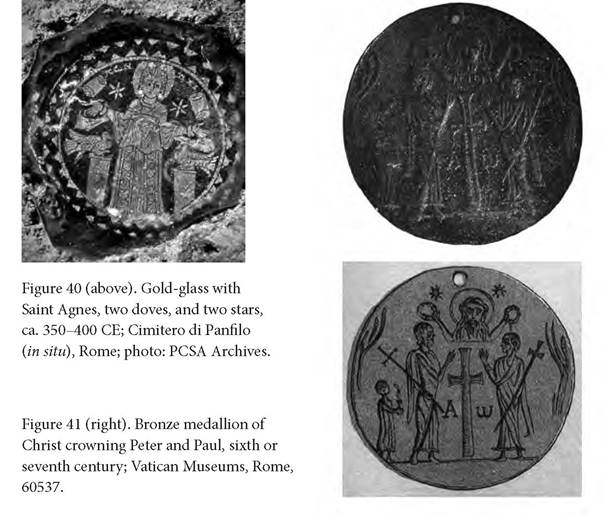
Roman catacomb of Pontianus.[63] Again they lack any documented connection with horses or weaponry, but as “princelings” (subreguli) they might have an affinity with military affairs.[64]
In this context, it should be noted that the Christianization of classical heroes is not a phenomenon limited to the Dioscuri.
The survival of Orpheus in Christian catacombs and Jewish synagogues also manifest this kind of assimilation of mythic figures. Bellerophon also appears in several Christian mosaic pavements of fourth-century Britain; in a mosaic pavement along with a bust of Christ in the villa at Hinton St. Mary and again in the house-church at Lullingstone (Meates 1979).[65] Helios, a full-fledged god rather than a hero, is depicted driving his chariot in the vault of the Christian mausoleum of the Julii under St. Peter's at Rome, and he also appears in synagogues in Palestine.[66] Thus the Dioscuri fit a pattern of inculturation within Christianity as well as alongside it. In spite of the objections of theologians, heroes of nonbiblical origin were absorbed into Christianity in popular religion of the fourth century and beyond.As for the images on the ARS lanx: they are in my view the Dioscuri and at the same time they are viewed as saints.[67] Therefore, the answer to the initial question whether they represent “Divine Twins or Saintly Twins?” is that they represent both. The inscription refers to the Dioscuri as saints, by whose intercessions the faithful will be guided. Since the divine Twins were traditionally viewed as saviors and benevolent guardians, they continued to play this role, at least for a while—old customs tend to die hard. The latter part of the fourth century is unique in that respect, for traditional imagery continued to exist, but by the same token had to be adapted for a new reality and a new understanding.
These rider gods are the Dioscuri—not Peter and Paul, Cosmas and Damian, or Abdon and Sennen—but they are also viewed as saviors in popular consciousness and venerable Roman tradition: the lanxes provide evidence that their saving powers gave them de facto saintliness, at least on a popular level. They continue to have a veiled presence as stars on coins during the reign of the first Christian emperors. Their role is accentuated even more strongly in literary sources, when poets paying tribute to the imperial court hark back to a foregone age.
From the time of Constantine until the beginning of the fifth century, the emperors and their immediate successors could still be compared to Jupiter and his divinized twin sons and could still bask in the legacy of a glorious imperial past. Literary memory and popular beliefs kept the names and the imagery of the divine Twins alive, whether Christian theologians liked it or not. In times of need, people continued to sacrifice to the Dioscuri and, of course, games in their honor were still going on.The answer to whether they were Divine Twins or Saintly Twins may even lie in a down-to-earth consideration of a commercial operation that wanted to have it both ways. It is not inconceivable that the workshop that produced these platters aimed their wares at the broadest possible clientele. They may have wished to please a Christian buyer with the inscribed lanx and the biblical imagery on the rim, while lanxes without inscription, obviously produced in the same workshop, would have been perfectly acceptable to a traditional conservative Roman customer.