The Dioscuri and Their Roman Identification
The Romans identified with the Dioscuri in a rather specific way.[32] They attributed a legendary battle and subsequent victory in the early fifth century BCE at Lake Regillus to the intervention of the Twins.
During the battle the dictator Aulus Postumius asked for the assistance of the Dioscuri and vowed to dedicate a temple to them (Poulsen 1991, 119-46).[33] The myth states that two young men appeared on white horses and fought alongside the Romans. The young men, who were interpreted as the Dioscuri, also appeared on the same day on the Roman Forum to announce the victory and water their horses. Roman tradition continued to commemorate the event and the assistance the Romans received. From the late fourth century BCE onward, a ritual parade of horsemen, called the transvectio equitum, was held at Rome in honor of the Dioscuri. The event took place with much pomp and circumstance to commemorate the legendary battle and to reenact the appearance of the Dioscuri on the Forum. Literary sources tell us that the Roman cavalry made a tour from the Temple of Mars outside the city to the Temple of Castor and Pollux on the Forum (Poulsen 1992b, 59-60).[34]At the place where the Dioscuri were said to have watered their horses there is a source of fresh water, called the spring of Juturna (fons or lacus luturnae; see E. Steinby 1989), Juturna being a Latin goddess or nymph of springs. Some Roman coins from the Republican period depict this event in their imagery (fig. 23).[35] A shrine dedicated to Juturna was built and rebuilt over the spring, and a marble wellhead (puteal) covered with inscriptions was found there (fig. 24; Nash 1989; Claridge, Toms, and Cubberley 1998, 95-97). The fountain and the temple were probably seen as a single sanctuary to Castor and Pollux, for it has been demonstrated that they were restored simultaneously at various times in their history.
Excavators also unearthed a water basin in this area. The basin must have been the stimulus for the image of the cantharus between the horsemen on the ARS platters and bowls. Although the cantharus is a common subject in early Christian iconography, in the context of the Dioscuri on ARS, it clearly alludes to the fons luturnae. If this observation is correct, the iconography on the ARS lanx would indicate a strong connection with the city of Rome and its legendary past.[36]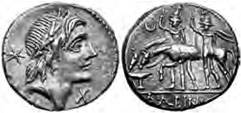
Figure 23. Silver denarius of A. Postumius Albinus; Rome, 96 BCE; obverse: head of Apollo; reverse: Dioscuri watering horses at fountain of Juturna; photo: Classical Numismatic Group, Triton VI, lot number: 637, 14 January 2003.
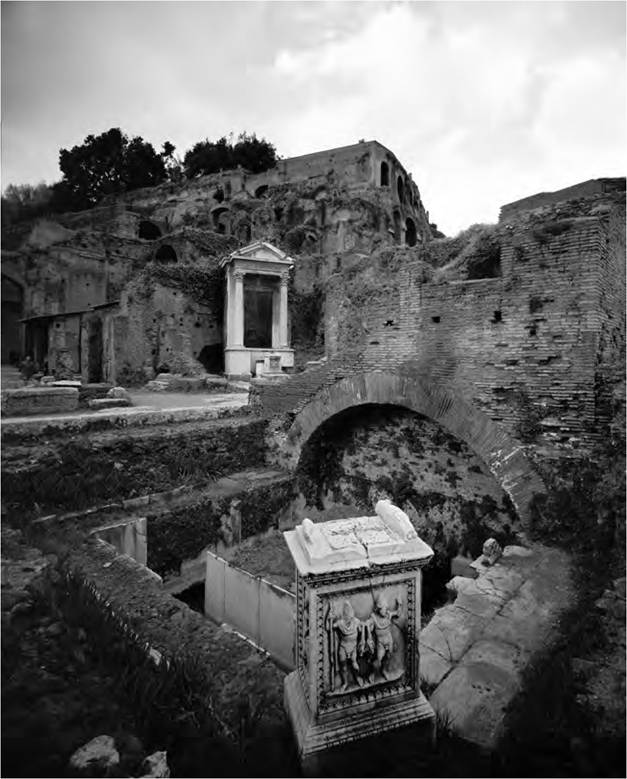
Figure 24. Fountain and aedicula of Juturna, Forum Romanum; photo: Lessing Photo Archive.
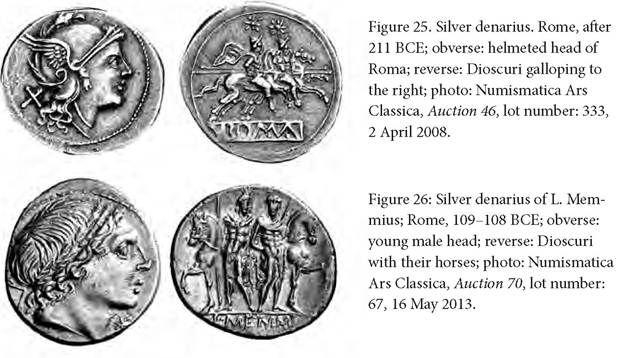
In addition to helping the cavalry on the battlefield, the Romans also viewed the Dioscuri as helpers of travelers and sailors—a role that had long been established in the Greek world as well. The twins would be called on for favorable winds or to escape distress at sea. Thus the central elements in the religious understanding and worship of the Dioscuri were intervention and salvation. A great number of coins from the Roman Republican period bring out this special connection between Rome and its special protectors, the Dioscuri (figs. 25-26).
With the emperor Augustus a new element came into play (La Rocca 1994). The emperor gave a renewed prominence to the twin gods as symbols
of a victorious Rome by making them the patrons of equestrian youth. In this process he elevated his two grandsons (or adoptive sons), Gaius and Lucius, to the first ranks among the young aristocrats. As principes iuventutis and as heirs and successors of Augustus, they came to be modeled after the twin gods.
At the annual transvectio equitum they rode on white horses (like the Dioscuri) at the front of the procession, dressed in glamorous outfits and equipped with silver shields and spears. The scheme allowed not only the young princes to stand side by side with divinity, but it equally reflected on their adoptive father. After the death of Lucius and Gaius, Tiberius and Drusus played similar roles, representing the divine twins, as did Germanicus and Drusus the Younger after them. This imperial imprint given to the cult of the Dioscuri or Castores (as they were also called) persisted throughout the first century (Poulsen 1991, 122-34). Various coins were issued with the reverse depicting either full-fledged images of the Dioscuri or symbolic references, such as the two stars or the characteristic conical caps. The imagery continued on and off in the second and early third centuries, particularly if the imperial households produced real twins, as in the case of Commodus and his short-lived brother (figs. 27-28).[37] In the third century the soldier emperors showed little affinity for the imagery (Poulsen 1992a, 52), but it resurfaced rather strongly in the early fourth century on coins of Maxentius and to a lesser extent on coins of Constantine.[38] From the coinage it becomes clear how strong the symbolic connection was between the city of Rome and the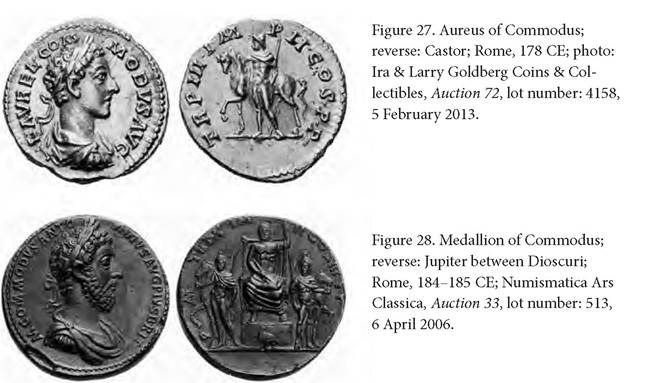
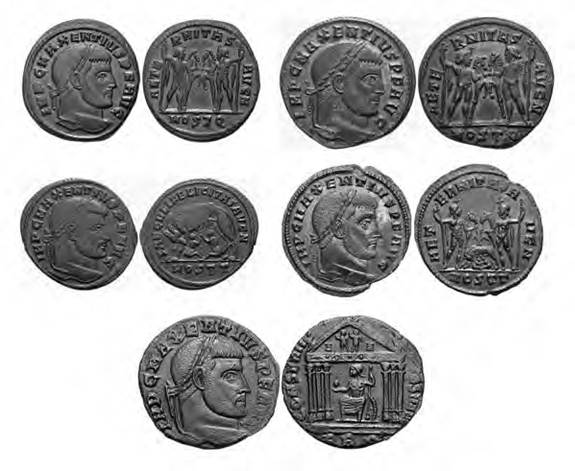
Figures. 29-33. (rows 1, 2, 3). Coins of Maxentius; Ostia mint, 307-312 CE; Dioscuri and horses (a, b, d); wolf and twins (c, d); Follis of Maxentius; Rome, 308-310 CE; reverse: Roma enthroned in temple, Dioscuri in pediment (e); photos: (a) Classical Numismatic Group, Electronic Auction 56, lot number: 164, 8 January 2003; (b) Dr. Busso Peus Nachfolger, Auction 380, lot number: 922, 3 November 2004; (c) Classical Numismatic Group, Mail Bid Sale 57, lot number: 1413, 4 April 2001; (d) Ex Fritz Rudolf Kunker Munzenhandlung, Auction 104, lot 674, October 2005; (e) http://www.beastcoins.com/ RomanImperial/VI/Rome/Maxentius-RICVI-208-RBQ.jpg.
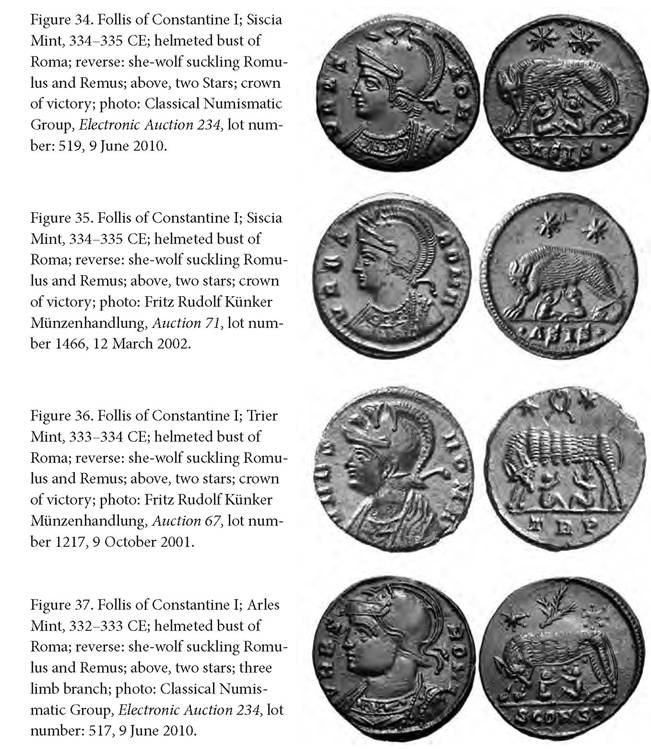
Dioscuri. The point is made most strongly on the coinage of Maxentius, with its doubling of twins—the divine twins paired with the she-wolf suckling Romulus and Remus—and the legend Urbs Roma (figs. 29-33). In this way Maxentius tried to revive and propagate the imperial ideology of a victorious Rome, placing himself in the grand tradition of the emperor Augustus himself (Drijvers 2007, 20).[39] Constantine continued the imagery of the she-wolf and the suckling twins but diluted an overt reference to Olympian religion by replacing the Dioscuri with two stars above the wolf (figs. 34-37).[40]
Various temples in Rome were dedicated to Castor and Pollux, the most famous being the one on the Forum Romanum, of which three columns are still standing; they stem from the reconstruction of the ancient temple at the time of Augustus and Tiberius.[41] As discussed above, the fountain of Juturna stands in close proximity to it. Large statues of the Dioscuri were also erected there, elsewhere in Rome, and in other cities of the empire. According to literary sources, Constantine and his successors decorated the Hippodrome in Constantinople with a collection of antiquities; he also incorporated a temple of the Dioscuri, whose statues could still be seen in the porticoes of the hippodrome 170 years later.[42] In Rome itself larger-than-life-size sculptures of the divine Twins were set up, some of which are still standing in prominent locations.[43] A pair of colossal statues of the Twins dating from the second century was unearthed in 1560 in the old Ghetto of Rome and erected more or less immediately at the top of the stairs leading to the Capitoline Hill (Geppert 1996, 41-46; Presicce 1994, 153-91). Already some decades earlier the Farnese pope, Paul III, had asked Michelangelo to design a project for that area, but building did not begin until 1546 and progressed so slowly that Michelangelo only lived to oversee the beginning of the work.
The piazza was completed in the seventeenth century, but the design remained largely intact. As shown in a sixteenth century print, Michelangelo and Pope Paul III may have had a different group of statues in mind for the plan. On an engraving by Etienne Duperac, one can see another famous group at the top of the stairs, an arrangement that was never executed (fig. 38).The envisioned group was and remains to the present day situated on one of the other hills of Rome, the Quirinale (Nista 1994b, 193-208; Geppert 1996, 64-67,
140-42). These statues received the name the Horse Tamers, and accordingly their surrounding area was commonly known as Monte Cavallo. The group has probably been in that area since antiquity. In the sixteenth century the group was situated in a slightly different place not far from the present location, but on the curve of the road facing it (Gamrath 1987; Lorenz 1979, 43-57). On the other side of the road and in close range the Baths of Constantine were constructed.[44] Their remains were still visible in the sixteenth century, as can be seen in a print by Etienne du Perac dated around 1575 (fig. 39). In some images the vestiges of
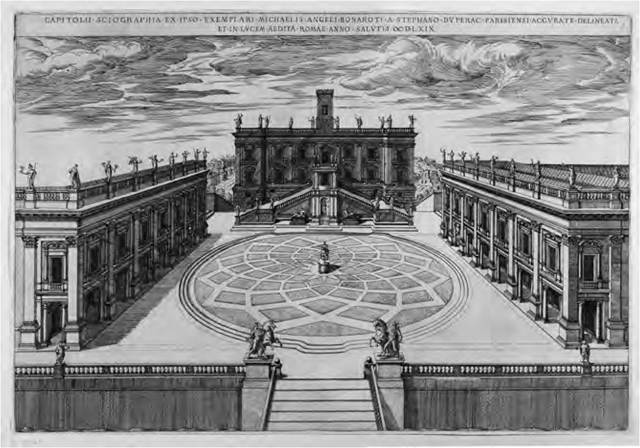
Figure 38. Design for the Capitoline Hill with the Horse Tamers of the Quirinale; Engraving by Etienne Duperac, I vestigi dell’antichità di Roma (Rome, 1575); photo: Lessing Photo Archive.
a construction on which the sculptures of the Dioscuri stood are also visible.[45] Other sculptures were found together with the horse tamers, such as statues of Constantine and one of his sons, plus two reclining river gods. All were moved to the Capitoline, except one of the statues of Constantine, which is now in the entry portico of the Lateran Church. It is commonly thought that the statues of Constantine and his sons might have come from the bath complex on the Quirinale, but the origin of the horse tamers remains uncertain. One hypothesis is that they came from the nearby temple of Serapis (R.
Taylor 2004, 256), while others have connected them with a hypothetical nymphaeum (Lorenz 1979, 52). The sculptures themselves have been dated to the time of the Antonines, but there are no ancient sources that confirm this. A ninth-century pilgrim's itinerary (Codex Einsiedlensis [Einsiedeln no. 326]) described them as “cavalli marmorei,” and in the Middle Ages they received a Christian make-over that identified them not as the Dioscuri but as prophets, while a female figure on a now-lost fountain in front of the group was known as Ecclesia.[46]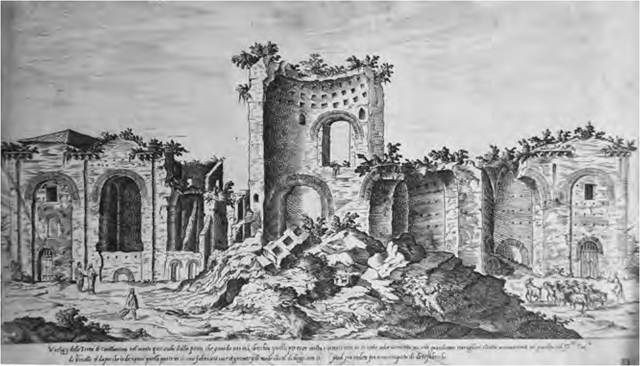
Figure 39. Engraving of the Baths of Constantine by Etienne du Perac, I vestigi dell’antichità di Roma (Rome, 1575).
The close connection between Rome and the Dioscuri also appears in fourthcentury literary texts. In a panegyric of Constantine, the Latin rhetorician Nazarius sang the praises of Constantine’s victory over Maxentius in 312 at the Battle of the Milvian Bridge (Rees 2002). The speech was delivered nine years later to celebrate the fifteenth anniversary of the accession of Constantine, and his fifth son’s admission to the rank of Caesar. The passage of Nazarius reads as follows:
Men say that in one of Rome’s wars two young men on horseback appeared, worthy to be beheld for their beauty as much as for their strength, who were distinguished beyond the rest in the fighting. When they were sought out by order of the commander, and when they were not to be found, men believed that they were divine although they had zealously shared their labor, they spurned labor’s reward... [W]e who have now seen greater things believe in those deeds. Our leader’s greatness wins credence for the ancient accomplishments, but removes the miraculous element. A reckoning of the affairs must be measured by the number of supporters. Once two young men were seen, but now armies: the present instance is surely richer and no less dependable as truth. Faith stands firm, relying upon a twofold argument: this is how Constantine deserved to be helped, and this is how Rome ought to have been saved. (Nazarius, Panegyric IV 4 [March 321]; text Mynors 1964; trans. Nixon and Rodgers 1994). [47]
The divine intervention of the two young men from the legendary past thought to be the Dioscuri has now become the action of an army on a much grander scale. The ancient Roman legend of divine rescue, however, still resonated at the time of Constantine’s victory but was transformed into rescue by a celestial army. This kind of miracle may have inspired other such stories about the rescue of the city of Rome, as in a legend of Leo the Great, the fifth-century pope (Howarth 1994, 130-36). When Attila the king of the Huns invaded Italy and advanced on central Italy, a calamity once again was thought to be at Rome’s doorstep. Pope Leo and part of the Roman senate went out to meet and beseech the king, “trusting in the help of God, who never fails the righteous in their trials” as a chronicler wrote. A later account of Leo’s Vita states that at the height of the meeting the pope was suddenly flanked by the two apostles Peter and Paul, one standing on the right, the other on the left side of the pontiff. In the Renaissance, Raphael immortalized the legendary scene in one of the papal rooms (Stanza d’Eliodoro). In the Vita the apostles are said to be standing; in the painting they are flying, in order to emphasize the celestial intervention, since legends tend to evolve in a rather fluid way.
It is interesting to see that the Augustan ideology of paralleling the imperial successors with the divine Dioscuri and the emperor with the supreme divinity himself had a long afterlife; the image resurfaces as late as the fifth century. In elegant pentameters the court poet Claudianus can still make the comparison between the western emperor Honorius and his sons, who as “the Spartan twins, the sons of Leda, sit with highest Jove.” (Claudianus, Cons. Hon. 203-11; Poulsen 1991, 135).
From historical sources we also learn that the cult of the Dioscuri was still actively practiced during the fourth century in Rome and Ostia (Meiggs 1960, 388-403; Poulsen 1992a, 53). When in 359 a storm kept the grain fleet from entering the harbor of Portus, great unrest ensued among the people, and the prefect of Rome was under pressure to solve the situation. Ammianus Marcellinus tells us that “while Tertullus was sacrificing in the temple of Castor and Pollux at Ostia, a calm smoothed the sea, the wind changed to a gentle southern breeze, and the ships entered the harbor under full sail and again crammed the storehouses with grain.” (Ammianus Marcellinus 19.10.4). At Ostia the divine Twins were obviously worshiped in their capacity as protectors of navigation. Each year on January 27 the Ludi Castorum were held at Ostia, led by the prefect of the city; these games presumably involved horse races (Meiggs 1960, 345). January 27 also happened to be the date on which Tiberius dedicated the Augustan Temple of Castor and Pollux on the Forum at Rome; the timing underscores the connection between the cults in Rome and Ostia (Poulsen 1992a, 53; also Weinstock 1937).
The late interest in the divine twins emerges in one of the luxurious houses in Ostia, the House of the Dioscuri (III.IX.1). In the mosaic of the entrance the Dioscuri stand in a central panel, a figure at their feet, while a large vase (cantharus) appears in several of the surrounding panels. The Dioscuri have their traditional outfit; they wear boots, pilos hats, and a mantle around their shoulders, and they carry spears and sheathed swords. On the basis of the archaeology, the reconstruction and redecoration of the house are dated to the first quarter of the fifth century (Dunbabin 1999, 64-65; Heres 1982, 135-36; 477-85). For our purpose the vases that accompany the Dioscuri in this mosaic are intriguing in connection with the occurrence of the vase on the ARS lanx.[48]
In addition to flourishing in Rome and its surroundings, the veneration of the Dioscuri continued in the Roman provinces as well during the fourth century. Not only do the literary sources and the North African ceramics testify to this, but archaeological evidence comes from other regions as well. In 1950 a well- preserved mosaic was uncovered in the center of Trier. The mosaic can be dated to the third quarter of the fourth century, a chronology that coincides with the earliest ARS lanxes. One compartment of the mosaic shows the egg of Castor, Pollux, and Helen, over which the eagle of Jupiter hovers. The inscribed names “lobis,” “Castor,” “Pollux,” and “Helena” clarify the meaning of the images. Other compartments of the mosaic enclose figures suggesting a ritual banquet; men carry trays of food and hold tools, and girls dance. A compartment has three men who seem to perform a ritual with food. It is generally thought that the hall with the mosaic served cult purposes focused on the Dioscuri, but the details of this cult remain unclear and open to much speculation.[49] A more recent discovery in Tunisia has brought to light another mosaic with the birth of Helen and the Dioscuri (Ben Lazreg forthcoming).
The response of early Christian theologians to the cult of the Dioscuri was not very positive and at times openly hostile, but it also showed a sense of reality; these divinities were not only well known but also widely admired. Church officials realized that it was hard to root out popular beliefs and practices (Kraus 1957; Trout 2003, 533 n.46). Even popular language continued to be filled with suggestive implications; people would swear with the word “edepol,” which was an abbreviation of “per aedem Pollucis” (“by the temple of Pollux” Ps. Augustine, Regulae Aurelii Augustini 1.16 [Heinrich Keil, Grammatici Latini, 8 vols. Leipzig: Teubner, 1855-1880]); another frequent oath was “ (m)ecastor” (“by Castor”). In a letter to Pope Damasus, Jerome openly shows his distaste for the use of such language.[50]
There are many polemical texts from Christian writers against Greco-Roman cult practices, and some of them are directed against the Dioscuri (Trout 2003, 533 n. 46). Lactantius calls them “the most miserable of all mortals, to whom it was not permitted to die a single time.”[51] Nor is Prudentius flattering when he calls them “the bastard sons of a fallen woman.”[52] In spite of the opposition, followers of the divine Twins did not have to hide their allegiance as late as the end of the fifth century. In an address to the Roman senator Andromachus, Pope Gelasius can still express his annoyance at the cult: “surely why have your Castores whose cult you didn’t want to give up not at all provided you with any favorable seas...?”[53] Augustine also reflects on their competition with the Christian community.[54] In a sermon on the Gospel of John, he comments on evil spirits who seduce his Christian flock with amulets, magic spells, and other trickeries.[55] He accuses these spirits of mixing the name of Christ into their enchantments—“venom mixed with honey to conceal its bitterness.” In the same passage, Augustine also recalls the words of a priest of Castor, who used to say: “even the ‘cone head’ himself is a Christian!”[56] In Augustine’s opinion, the only remaining way for evil spirits to entice Christians toward blasphemy was to portray Castor as a Christian. The bishop of Hippo’s suggestion, however, that the Dioscuri were on their way out may have been wishful thinking.[57] The address by Gelasius shows that some seventy years later their attraction was still present and the dispute was still going on.