The Dioscuri on North African Ceramics
In 1862 a local newspaper in North Africa reported that a few years earlier someone by the name of Nicolet, a French army officer, had found an ancient terracotta plate on his property (LObservateur di Blida, 1860).
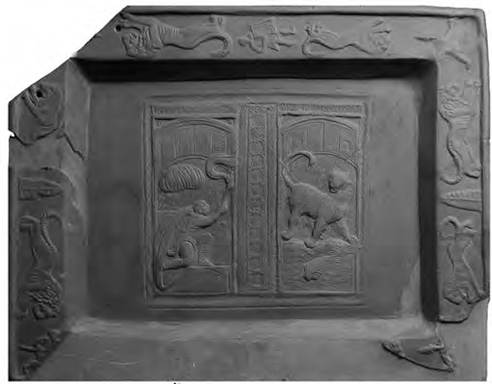
He had discovered other antiquities before, since his house was built on the ruins of ancient Tanaramusa (El Hadjeb) near modern Mouzaia (Mouzaiaville) in Algeria. In great detail the article described the dimensions of the plate, the images of the two Dioscuri in the central field, the figures on the rim, and the appearance of an inscription. Unfortunately, that is all we have; a footnote to the article states that “in the absence of colonel Nicolet, his children broke the plate that was just described.” Fortunately for us, the description of the plate and its inscription made their way into the Revue africaine and into the eighth volume of the CIL, so that although the object was lost the information lives on.[7]Other fragments with the same subject matter have surfaced since. In the 1960s the Dutch expert on African Red Slip (ARS) ware, Jan Willem Salomonson, published other examples (Salomonson 1962, 67-72).[8] Twenty years later the German scholar Jochen Garbsch, who was curator of the collection in Munich, published additional fragments. Garbsch also made a reconstruction of the lost Algerian object, in which the Dioscuri appear with their horses in the central field (fig. 3; Garbsch 1980, 161-97; Garbsch and Overbeck 1989, 178-79).[9] The rectangular platter on which the scene appears is called a lanx. Such platters were commonly produced in ARS; characteristically they have a deep floor, a broad, flat rim, and a low foot. These ceramic wares, which are usually dated between 340 and 430 CE, were modest cousins of more prestigious objects made out of precious material, such as the silver lanx from Corbridge.[10] The reconstruction of the lost Algerian ceramic lanx shows in the central field two rider gods flanking a vase (a cantharus), with an inscription that occupies the upper field and hovers over their heads.[11] The symmetrical position of the Twin Gods is a well-known feature of their iconography, whether it occurs on
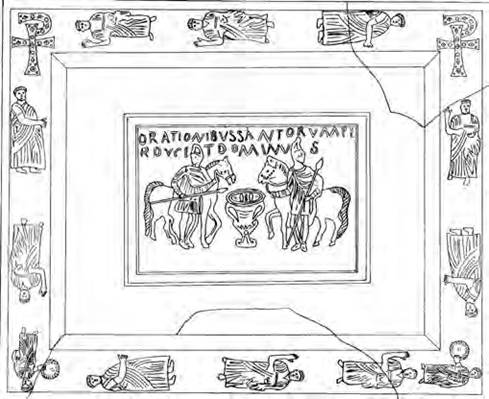
Figure 3.
Reconstruction of a lost ARS lanx from Tanaramusa; drawing in Garbsch 1980, 184, fig. 22.sarcophagi, in relief sculpture, or in freestanding sculpture (fig. 4).[12] There are, however, distinct differences between the late antique images of the Dioscuri on ARS and their earlier, more classical appearances. Traditionally they were almost always depicted naked with a cloak (chlamys) wrapped around their shoulders. They were often shown wearing a conical hat, the pilos, as in a marble head in the Museum of Constantine (Algeria) (cited in Chaisemartin 1987, 22, no. 11). This sculpture characteristically has a hole in the pilos for holding a star, another symbolic staple of the Dioscuri (figs. 5-6). Roman coins make the reconstruction evident. A relief from El Djem, Tunisia provides a North African example (fig. 7) (Moormann 2000, 118, pl. 62a,. no. 143, inv. 12.520).
Various surviving ARS fragments provide support for Garbsch's reconstruction of the Algerian plate (fig. 3). The newspaper article mentioned that the lost lanx had male figures on its border. Other fragmentary borders without the central part show similar male figures—supposedly apostles who are standing in a pose of acclamation (fig. 3).[13] The corners of such fragments
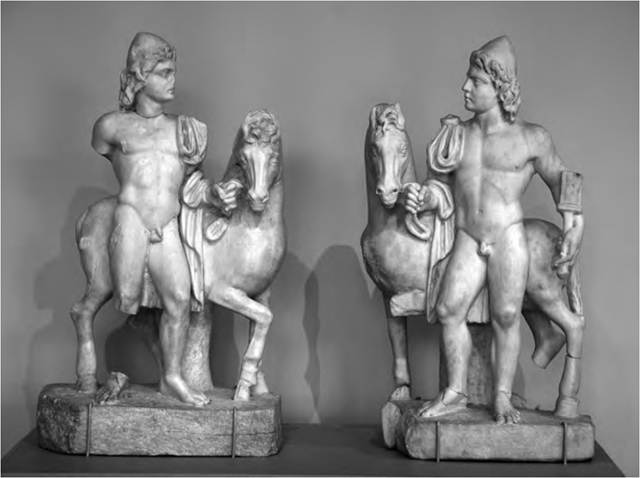
Figure 4. Marble statuettes of the Dioscuri with horses, ca. 200-250 CE; on loan to the Metropolitan Museum of Art, New York, L. 2008.18.1-2.
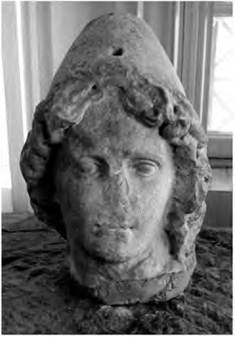
Figure 5. Head of Castor or Pollux, marble from Thasos; Sila, second century CE; Cirta Museum, Constantine, Algeria, 3D Mb 10 (851B).
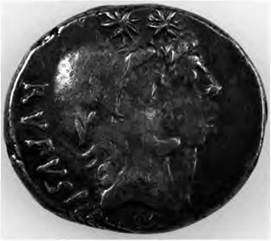
Figure 6. Silver denarius with heads of the Dioscuri, wearing pilei surmounted by stars; minted at Rome by Mn. Cordius Rufus, ca. 46 BCE; photo: The University of Virginia Art Museum, Digital Numismatic Collection.
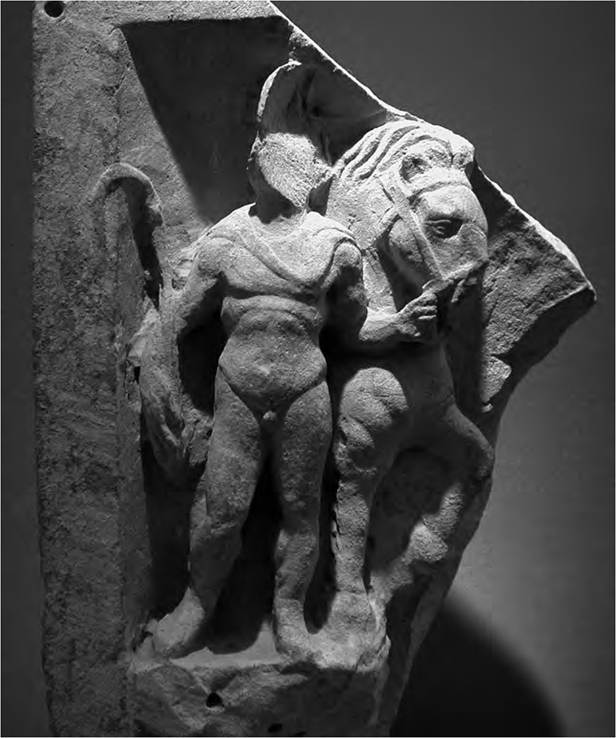
Figure 7.
Fragmentary limestone votive relief with a Dioscurus, El Djem, second or third century CE; Allard Pierson Museum, Amsterdam, 12.520.show monogrammatic crosses and figures holding a wreath. We do not have the connection between the central field and the rim, so the reconstruction remains theoretical. A large fragment in the Benaki Museum in Athens, however, does show the central field with a connecting part of the rim, but this border is different (fig. 8); it has running lions, a cantharus, and a small aedicula on the side (Benaki Museum, inv. 12393a; a second fragment, inv. 12394a; Salomonson 1962, pl. 21, nos. 1 and 2), which we will return to later. The Dioscuri and inscription are paired elsewhere with yet a different rim on the corner of a lanx found in central Tunisia and deposited in the Carthage Museum (Bejaoui 1985, 173-77,
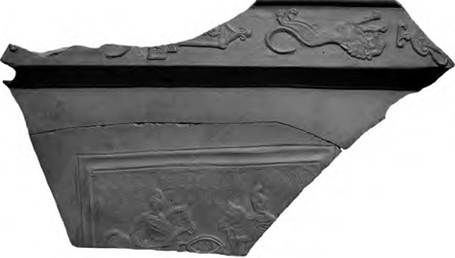
Figure 8. ARS lanx fragment with Dioscuri in the center, 340-430 CE; from Egypt; Benaki Museum, Athens, 12393a.
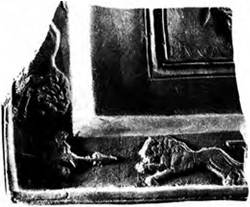
fig. 3). The fragment shows two charging lions and a venator, who braces himself for the attack. A belt around the lion's waist marks him as a prized animal, so that the image depicts an amphitheater scene rather than a hunt in the wild (Herrmann and van den Hoek 2002, 84-85, no. 98). A reconstructed lanx with a similar border of venationes but with a different center is housed in the Museum in Cairo (figs. 9-10; Egyptian Museum, inv. 86116).
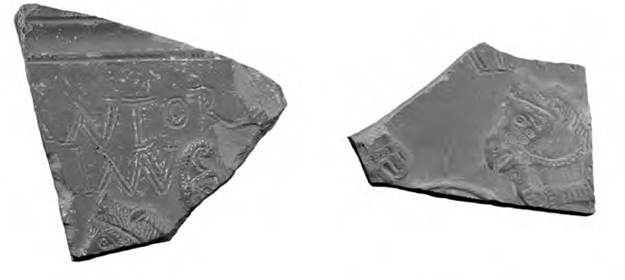
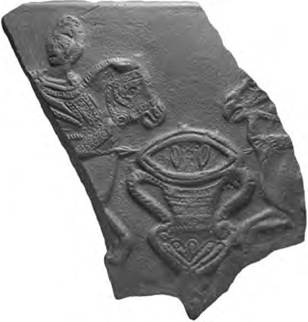
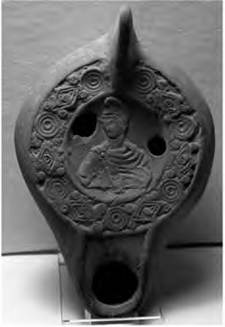
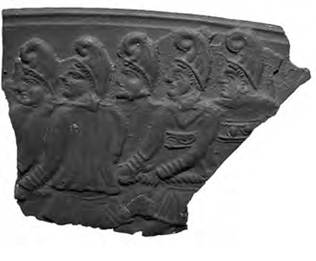
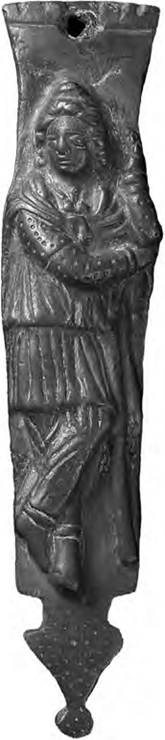
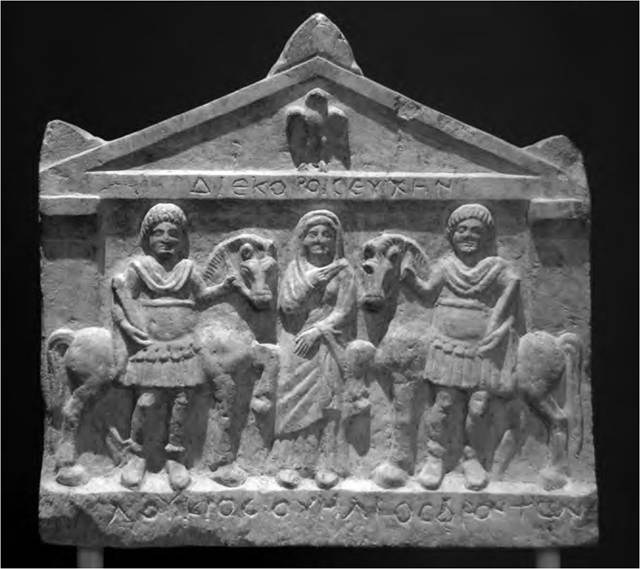
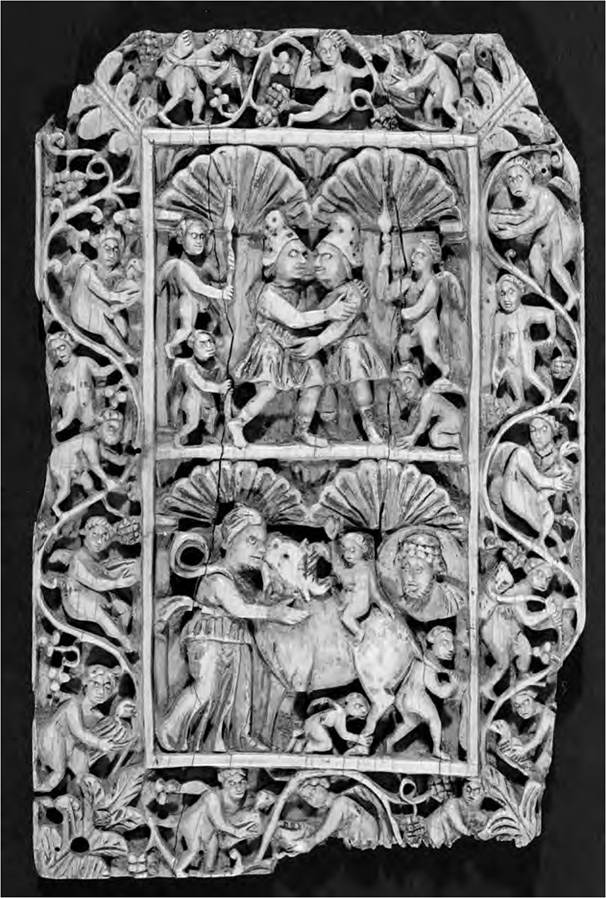
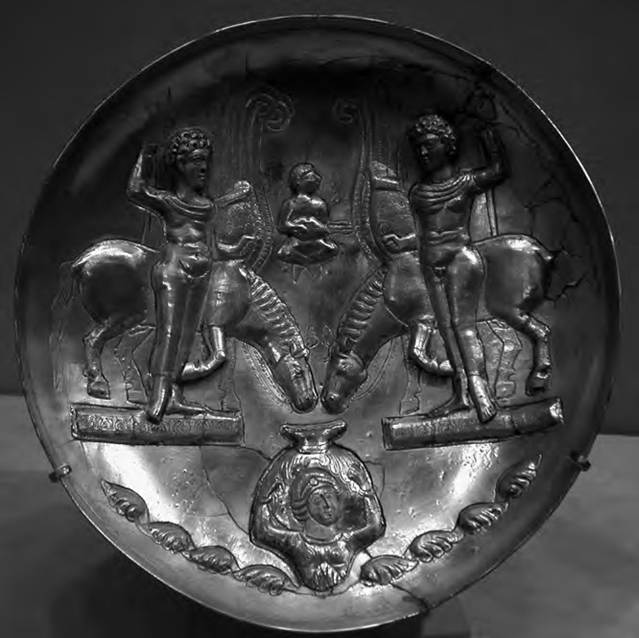
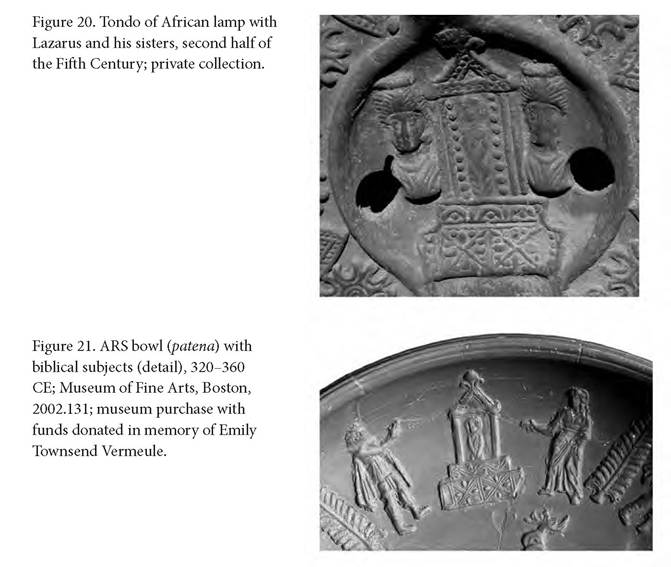
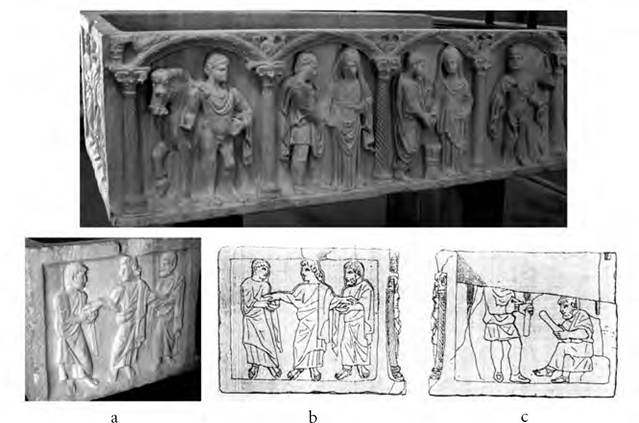
There are other unpublished lanx fragments of the inscribed central part and also fragments without the inscription.[14] [15] A North African lamp of a somewhat later date still has the same image of one of the Dioscuri in its tondo, which shows that the iconographic tradition continued over an extended period of time (figs. 11-14). Perhaps the sharpest image of one of the Dioscuri appears not on a lanx but on a fragmentary bowl (fig. 2).11 Had it been complete, the bowl would undoubtedly have shown another rider on the right side, but nothing seems to have stood between the two, nor is there any inscription above them. The surviving figure is dressed in a long-sleeved tunic, over which a mantle is loosely draped; a large fibula fastens the mantle on his right shoulder. His hat is not conical but floppy and bends forward, the so-called Phrygian cap. He wears trousers that display fine decoration, as does the lower part of his sleeves; this is probably meant to indicate embroidery; his tunic also shows some patterned decoration, which may be a belt. The whole outfit suggests an oriental costume and an oriental identity. There are other oriental-looking figures on ARS, in both a Christian and non-Christian contexts, such as an image of the Good Shepherd and images of the Three Hebrews, or representations of Orpheus, Paris, Mithras, and fishermen pulling up their nets (fig. 15).[16] The motivation for this Eastern invasion is not Figure 9 ARS lanx with Venationes in the Border and Amphitheater Scenes in the Center, 340-430. CE; Egyptian Museum, Cairo, 86116. Figure 10. Fragmentary ARS lanx with venatio scene in the border and Dioscuri and inscription in the center; central Tunisia, 340-430 CE; Carthage Museum; Photo in Bejaoui 1985, 175, fig. 3. clear, but it evidently is modeled on well-known types of figurative sculpture and mosaic representations of Paris, Attis, Ganymede, Orpheus, and the like. These Orientals also occur on small decorative objects, such as a bronze strap handle with Paris in the Museum of Fine Arts, Boston (fig. 16; Comstock and Vermeule 1971, no. 676). Since the Dioscuri almost always appear nude, it is unusual for them to wear anything more than a cloak. There are instances, however, in which they are clothed, particularly when they appear in the periphery of the empire. In Asia Minor (Pisidia), they can be seen wearing armor on coins and reliefs (Robert 1983, 553-78, esp. Figures 11-12. ARS lanx fragments with Dioscuri and inscription, 340-430 CE; private collection, Arlington, VA. Figure 13. ARS lanx fragment with Dioscuri without inscription, 340-430 CE; private collection. Figure 14. African lamp with one of the Dioscuri, fifth century CE; private collection. their sister Helen, while the eagle of Zeus appears in the pediment (fig. 17; Robert 1983, 575-77, fig. 5; Vermeule and Comstock 1988, no. 38). The Dioscuri of Pisidia, however, are not those of Sparta, famous in legend; in a Pisidian rock-cut relief, the armored twins are identified as the Dioscuri of Samothrace (Robert 1983, 574-75). The armored Dioscuri also turn up on bronze plaques flanking Figure 16. Bronze handle or attachment with a figure in eastern costume, 150-300 CE; Museum of Fine Arts, Boston, 64.83; gift of Mrs. Cornelius C. Vermeule Jr.; photo: Museum. Figure 15. ARS fragment of a bowl with fishermen pulling in their nets, 340-430 CE; private collection. Jupiter Dolichenus or Juno Dolichena on the northeastern frontier.[19] Others appear in Gaul or in the Levant, as on coins of Ashkelon in Palestine.[20] The oriental costume of the African Dioscuri is even more surprising than armor would have been. It is alien to the Aegean, whether one thinks of the Spartan or the Samothracian Dioscuri. Figure 17. Marble votive relief with Dioscuri and Helen, ascribed to Pisidia, Asia Minor, second or third century CE; Museum of Fine Arts, Boston, 1993.704; gift of Mr. and Mrs. Cornelius C. Vermeule III in the name of Cornelius Adrian Comstock Vermeule. The central field of the Benaki lanx has another unusual feature in the central field, a cantharus between the horses.[22] As is well known, the cantharus plays an important symbolic role in the decoration and architecture of early Christian churches but not occur in the traditional iconography of the Dioscuri.[23] Figure 18. Ivory panel with the Dioscuri and Europa, sixth century CE; Civici Musei, Trieste, 1335; photo: Fototeca dei Civici musei di storia ed arte, Trieste. Iconographically the closest comparison comes from an unlikely source, a Sasanian plate of the fifth or sixth century in the Metropolitan Museum of Art in New York that has twin figures, winged horses, and a vase (fig. 19). The scene is Figure 19. Sasanian silver plate with twin figures, winged horses, and a vase, sixth or early seventh century CE; Metropolitan Museum of Art, New York, 1963.63.152. unique in Sasanian art, and scholars have suggested a possible Western influence (Harper 1977). The water source between the two divine riders can, however, be explained from the special connection that the divinities had with the city of Rome. We will return to this important symbolic aspect of the scene later, but first a few more words should be said about the remaining images. On its rim the Benaki lanx has a running lion (a very common subject), the tail of another lion, a cantharus, and a little aedicula (fig. 8). The aedicula is a tomb in which a small figure is tightly wrapped in a shroud. The figure is Lazarus, and the image refers to his resurrection. Other objects give a fuller version of the pictorial story, as in the tondo of a lamp, where two female heads, Lazarus's sisters Martha and Mary, flank the little mummy in its tomb (Herrmann and van den Hoek 2002, 48, no. 36), or even more fully on a magnificent bowl in the Museum of Fine Arts in Boston, in which the tomb is flanked by one of the sisters and by Christ, who performs the miracle (figs. 20-21). If anyone were to doubt the Christian identity of the imagery on the lanx, the inscription takes care of that (fig. 3). It reads in capital letters: ORATIONIBVSSANTORVMPE / RDVCETDOMINVS, which translates as: “By the intercessions [prayers] of the Saints the Lord will lead.” The verb perducere means “to lead, bring, guide a person or thing to any place.”[24] The problem here is that no direct object specifies “who” is being led, and no indication is given as to “where” (ad or in) the Lord will lead. The phrase “orationibus sanctorum” rings a biblical bell since it occurs in the book of Revelation (Rev 8:3-4). The words are often used in early Christian literary texts of the period, whether in connection with the biblical text or independently.[25] The second part of the inscription “perducet Dominus” can be amply paralleled with examples in the works of Augustine and his contemporaries, indicating that the Lord will lead the faithful “to eternal life,” “to eternal blessedness,” “to the contemplation of God,” “to eternal rest and joy,” “to the chamber of the king where all treasures of wisdom are hidden.”[26] The phrase may have some liturgical overtones, and it certainly evokes eternal life as the implied goal or end of the journey toward which the Lord leads.[27] The question then arises whether or not the Dioscuri represent the saints mentioned in the inscription above their heads. It seems reasonable to presume that a connection exists between the inscription and the imagery. It should be noted that the Dioscuri continued their Christian associations on North African ceramic wares. They turn up on a lamp of the fifth century (fig. 14) and on a fragment of an ARS platter of the sixth century. The fragment shows one of the brothers, dressed in a long cloak, holding a spear, and standing beside a cross (Salomonson 1962, 71, pl. 22, 4). The other brother presumably stood on the missing side of the cross. In this sixth century ware, the figures are stamped rather than applied as reliefs.[28] Other plates of the period show the twins still in a pagan context (Salomonson 1962, 71, pl. 22, 5). Wearing their unmistakable conical caps crowned by stars, they flank the god Bacchus. Few other examples of the Dioscuri can be found in an early Christian ambiance (Salomonson 1962, 71 n. 89).[29] The most remarkable representation is on a beautifully preserved sarcophagus found in the Elysian Fields of Arles (Les Alyscamps); it portrays two scenes of a married couple—perhaps in different phases of their union (figs. 22a-c; Le Blant 1878, 38-41, figs. 23-24, 1-2; for modern bibliography, see Gury 1983, 619-20, no. 83). The divine twins in customary nude fashion stand with their horses in the outer arches, just as in Roman sarcophagi of an earlier date. In funerary art they probably function Figure 22 a-c. Marble sarcophagus with two couples flanked by the Dioscuri; Les Alyscamps, fourth century CE; Musee de 1'Arles et de la Provence antiques, inv. FAN.92.00.2482. b: End panel with the multiplication of the loaves and fishes. c: Drawing of both end panels: multiplication of the loaves and fishes and a seated figure, possibly the apostle Peter. as emblems for the eternal process of death and immortality.[30] Nothing would reveal the Christian identity of the sarcophagus, were it not for the end panels. One shows the multiplication of the loaves and fishes and the other a seated figure, possibly the apostle Peter. To gain a better understanding of why the Dioscuri appear on early Christian sarcophagi and ARS plates, it is helpful to briefly review the Dioscuri in Roman traditions.[31]