The Myth
Castor and Pollux were the mythological twin sons of Leda from two different fathers. In a biologically dubious way, the myth portrays the divine Zeus as the father of Pollux, and Tyndareus, the mortal king of Sparta, as the father of Castor.
The Dioscuri were also the brothers of Helen of Troy and Clytemnestra and the half-brothers of a group of other mythological figures. Although they had the same mother, their paternal descent meant that one of them was immortal, while the other was not. When Castor inevitably died Pollux, being loyal to his mortal brother, asked his divine father to let him share immortality with his brother. Thus this mythological tale received a cosmological twist, transforming the twoA version of this paper was given at the Annual Meeting of the Society of Biblical Literature in Boston in November 2008, Art and Religions of Antiquity Section, Theme: The Iconography of the Border: Non-Christian, Non-Jewish Images from Antiquity; another version has been published in Pottery, Pavements, and Paradise (Leiden: Brill, 2013), 255-300. I am grateful to my husband John Herrmann for his help and advice on many of the details of this article. Thanks go to the anonymous reader for the very helpful comments and the bibliographical suggestions.

Figure 1. Bronze plaque with inscription (CIL
I2 2833); Lavinium, second half of the sixth
century BCE; Museo Nazionale Romano alle Terme di Dioclezanio, Rome. Unless otherwise noted, the photographs are by the author.
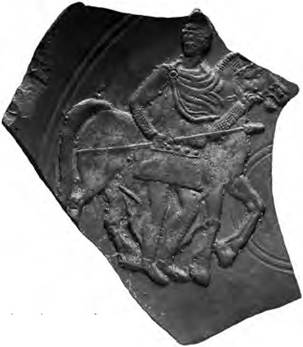
Figure 2. Fragmentary ARS bowl with one of the Dioscuri, 340-430 CE; private collection.
figures into the constellation of the Gemini, one of the signs in the Zodiac. From early onward these two divine figures were enormously popular throughout antiquity both in the Greek and Roman worlds. They were probably introduced in Archaic times to the West through the Greek colonies in southern Italy. The earliest mention of the Twins is an archaic Latin inscription dating to the fifth or sixth century BCE (fig. 1).1 They continued to be popular in the West during classical times, as attested by a terracotta relief with one of the Dioscuri in the Museum of Fine Arts, Boston, which reportedly came from a sanctuary near Taranto in southern Italy (Museum of Fine Arts, Boston, 01.798).[5] [6] The popularity of the two figures in the Latin-speaking world was not confined to the Italian peninsula but also migrated to the shores of North Africa. The twins continued to be venerated well into late antiquity, as reflected on ceramics of the early Christian era (fig. 2).
More on the topic The Myth:
- Foreword: Frances Moore Lappe
- Bibliographic Essay
- Conclusion
- Bostom Andrew G.. Sharia Versus Freedom: The Legacy of Islamic Totalitarianism. Prometheus Books,2012. — 1110 p., 2012
- Building a GoodJobs Economy
- Brodd Jeffrey, Little L., Nystrom B., Platzner R., Shek R., Stiles E.. Invitation to World Religions. 4th edition. — Oxford University Press,2022. — 1196 p., 2022
- Aruka Y.. Evolutionary Foundations of Economic Science: How Can Scientists Study Evolving Economic Doctrines from the Last Centuries? Springer Japan,2015. — 234 p., 2015
- CHAPTER 4 Illness as Divine Punishment: The Nature and Function of the Disease-Carrier Demons in the Ancient Egyptian Magical Texts
- Mesoamerica’s Priests, Farmers and Warriors
- CHAPTER FOUR Town and Country Urban devotions and rural rituals