Mesoamerica’s Priests, Farmers and Warriors
When rejecting Franciscan efforts to Christianise them in 1524, in the Aztec capital Tenochtitlan (today Mexico City), the priesthood of that place pointed out that they already had a religion of their own, one with roots deep through the vast extent of the Aztec tribute empire, and Mesoamerica itself.
Rather than insist on this point, the Aztecs preferred, as they put it, to open the treasure casket just a little, to allow a glimpse of their indigenous tradition. And they did so in a finely structured piece of rhetoric, which touches in turn on the three gifts of their gods, each being allotted a stanza that begins with the words ‘They gave’ or ‘give’ (yehuan-maca-) and ends with the question ‘where?’ (in canin). This part of their speech is worth quoting in full, because of its precise detail, and because it has not been widely published in direct English translation:They gave us
their law
and they believed,
they served, and they taught the honour among gods;
they taught the whole service.
That’s why we eat earth before them;
that’s why we draw our blood and do penance;
and that’s why we burn copal and kill the living.
They were the Lifelord
and they became our only subject.
When and where?—In the eldest Darkness.
They give us
our supper and our breakfast,
all things to drink and eat,
maize and beans, purslane and sage.
And we beg them
for thunder-Rain and Water
on which the earth thrives.
They are the rich ones
and they have more than simply what it takes;
they are the ones with the stuff,
all ways and all means, forever,
the greenness of growth.
Where and how?—In Tlalocan
hunger is not their experience
nor sickness, and not poverty.
They give also
the inner manliness, kingly valour
and the acquisitions of the hunt:
the insignia of the lip, the knotting of the mantle,
the loin-cloth, the mantle itself;
Flower and aromatic leaf, jade, quetzal plumes, and the godshit you call gold.
When and where?—It is a long tradition.
Do you know
when the emplacement of Tula was, of Uapalcalco,
of Xuchatlappan, of Tamoanchan,
of Yoalli ichan, of Teotihuacan?
They were the world-makers who founded
the mat of power, the seat of rule.
They gave
authority and entity
fame and honour.
And should we now destroy the old law,
the Toltec law,
the Chichimec law,
the Colhua law,
the Tepanec law,
on which the heart of being flows,
from which we animate ourselves
through which we pass to adulthood,
from which flows our cosmology
and the manner of our prayer?
In each of the three stanzas, the divine gift in question achieves meaning in human and sociological practice, which in turn is distinguished as that of the priest, the farmer and the warrior. The first of these groups or classes, the priests, draw their power from self-denial and penitence, a shamanist way which goes back to the palaeolithic and the eldest darkness (inoc yoayan). In the Mesoamerican cosmogony and system of world-ages recorded in thePopul vuh, this is the time when humans were first distinguished from animals by their capacity in principle to worship ‘Heart of the Sky’, with the copal incense that the Maya riddle in the Book of Chumayel and the Fire-god on the Fejervary title-page together identify as the ‘brains of the sky’. At the start of this world-age or 5,200-year Era, the high priest of its first city, the lowland Tula named below, is characteristically shown holding a copal incense-burner, as he is in the Rios Codex of Tenochtitlan (page 9). Evocative of the native American theory of evolution, with its lowly reptiles and iridescent birds, his name Quetzalcoatl (feathersnake or plumed-serpent) is the one by which the Aztec priests referred to themselves. This is the figure whose underworld trance journey, discussed above, made possible the creation of the human beings of this world-age.
After the priests come the farmers, the American agriculturalists who, after their economic success with gourds, manioc, chillis and other millennial crops, surpassed themselves with the invention of maize, probably not long after 3000 bce, the staple highly adaptable to altitude and soil type whose protein value is much increased when paired with beans.
The space-time of this invention is the rain-god’s lush abode at midday or zenith, Tlalocan: with his goggle-eyes and toothy mouth (like the rain-god of the Hopi further to the north), Tlaloc enjoys the power to bring down the waters above, as in the Flood which ended the first world-age. In his role as the ninth of the midwife’s night or lunar figures, which served as year-guardians, the rain-god Tlaloc was also the most propitious protector of the annual maize crop, as the Fejervary screenfold confirms (see Figure 52.3). Maize and beans with their respective flours, purslane and sage, are the primary agricultural produce shown to be due annually in the MendozaFigure 52.3: The Rain-god and the Maize Plant
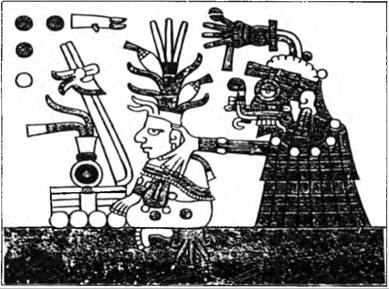
Codex and the tribute accounts of the Aztecs, while the staple maize becomes the very substance of mankind in the Popul vuh cosmogony. In the religion of the Toltecs, and even more in that of the Aztecs, Tlaloc’s rain was not freely given. It was bargained for, in exchange for the blood of sacrificed victims whose flowing tears would simulate and so stimulate the flow of rain: before dying, the victim would imagine his journey up to Tlalocan, the ‘house of quetzal plumes’, Tlaloc’s abode at the heart of the sky, passing on the way through the ‘place of the unfleshed’, the abode of‘the frightening prince’ or Lord of the Underworld—once again the trance journey.
Third come the hunter-warriors, the founders of empire, whose first impulse is to acquire and enhance the urban centre with luxury goods of clothing, incense and jewellery, likewise listed in the tribute books, in the same sequence. Indeed, with this third group political history begins, in a series of emplacements whose whereabouts the Franciscans could not have been expected to know any more than they are likely to have cared to. The roll-call of six particular cities begins with Tula or Tollan, the great lowland metropolis which stands as the first named city in a wide range of Mesoamerican texts, including thePopul vuh from highland Guatemala, and the Rios Codex of Tenochtitlan where its appearance (page 9) is synonymous with the start of the present 5,200-year Era.
And the list ends with Teotihuacan, which our archaeology is now confirming flourished up to no later than the end of the classic era, that is, about 800 ce. The hunter-warrior profession is shown also to have been at the origins of four laws or calendrical usages diagnostic of four of the principal imperial traditions of western Mesoamerica: the Toltec which goes back ultimately to the first city Tula, probably on the Gulf Coast; the Chichimec, which includes the Aztec themselves and other Valley of Mexico tribes; the Colhua which possibly linked Texcoco, to the east of theValley, with Tilantongo and the Mixteca; and the Tepanec, Oto mi-speaking and to the west, the demise of whose capital Azcapotzalco led to the rise of Tenochtitlan. Whatever may one day prove to be a full and correct reading of this concise historical scheme, there can be no doubt about the warrior’s role in it, or about his opposition in principle to the sedentary farmer, under the initial and primary aegis of the priesthood, representatives of which were after all delivering the speech in question.Of considerable interest in itself, and distinguished by initial verb tense in the speech, this last typal opposition between planter and hunter-warrior recurs elsewhere in Tenochtitlan literature. Written in Aztec or Nahuatl like the Priests’ Speech and the depository of an extensive collection of poetry from the tribute empire of that city, the Cantares Mex- icanos manuscript distinguishes the xopancuicatl or ‘burgeoning song’ of the planter from the yaocuicatl or war-song of the warrior; written in native or iconographic script, the Boturini screenfold when depicting the Aztec migration into the Valley of Mexico appeals to the same division, in order to characterise the separation of the eastern agriculturalists of Huexotzinco with their milpas and the western hunters of Malinalco with their arrows and nets. In architecture, it was emblemised in the twin temples atop Tenochtitlan’s main pyramid, the one dedicated to the rain-god Tlaloc, the other to the war-god Huitzilopochtli.
Modelled on Tezcatlipoca (‘smoking mirror’), who with the priestly Quetzalcoatl and the agricultural Tlaloc completes the ‘trinity’ of major Mesoamerican gods, this Huitzilopochtli of the Aztecs deserves a brief commentary in his own right. For in the Aztecs’ account of their migrations from Aztlan (somewhere in northern Mexico or the southern United States), when they were poor and despised, this figure is an unprepossessing character, carried with them along the road. This is how he appears in the Boturini screenfold, bundled up like a mascot and with a modest Humming-bird (huitzilin) disguise. When they attained power in Tenochtitlan, however, the Aztecs provided the world with a much grander image of the patron who had urged them on to glory. He was made into a solar god, his sanctuary next to Tlaloc’s then being given to him. He was also said to have been miraculously conceived by Coatlicue (Snake Skirt), the earth-mother, who was impregnated by a ball of fluff or down when she was sweeping. Her family felt dishonoured by her unexplained fat belly and swore to kill her. As they closed in, Huitzilopochtli leaped out of Coatlicue’s womb, fully armed like Tezcatlipoca, and slew them to a man. This feat has the solar analogy of sunrise ‘killing’ the stars and epitomises the power to strike instantly and definitely. In his annals of Tenochtitlan and the Valley of Mexico, the Nahua author Chimalpahin, writing about 1600, discussed this transformation of Huitzilopochtli from tribal mascot to sun-king. He showed how the Aztecs (like the imperialists of our own century) deliberately created and reshaped myths for political ends. In this respect, Huitzilopochtli is especially notable as one who was claimed to have been conceived miraculously. The moral and kinship problems caused by this special origin are resolved in his tremendous martial energy alone, this being provoked by doubts about legitimacy which are never explicitly denied.
Once acknowledged for what it is in the Priests’ Speech, the Tenochtitlan triple paradigm of Aztec religion proves on inspection to be endemic to Mesoamerica as a whole, over a wide geographical area, at horizons long prior to that of the Aztecs, and in media that include sculpture and architecture as well as literature.
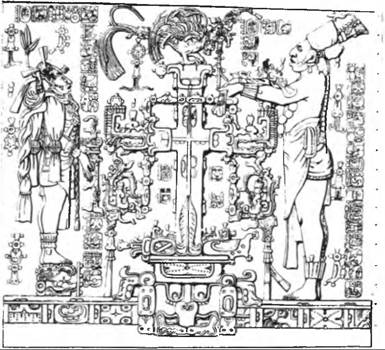
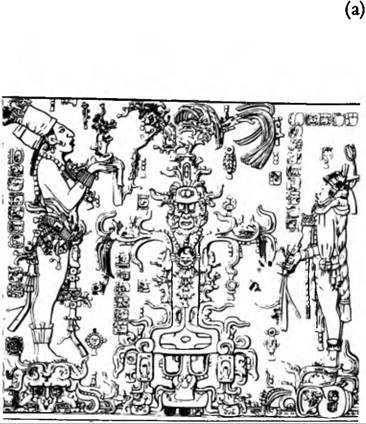
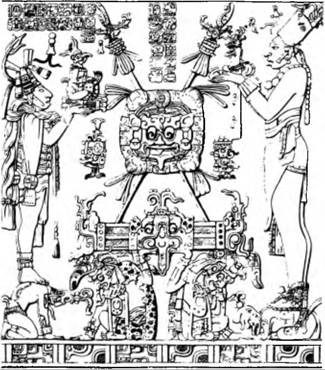
A striking example comes from the city of Palenque which flourished in the Maya lowlands five hundred or so miles to the east, nearly a millennium before the Aztecs delivered their speech (see Figure 52.4). The text in question consists of three panels set in three temples atop pyramids that rise to the north, east and west of a plaza in the city (temples said to be of the ‘Cross’, the ‘Foliated Cross’ and the ‘Sun’ respectively); while the latter two match each other in height, the northern one rises far higher. Each of the panels has the same format: a central design flanked by columns of Maya hieroglyphic writing, the greater stand-Figure 52.4: The Palenque Trilogy
(b)
(c)
ing of the northern panel here being reflected in the fact that it has an extra column to left and right. Calendrically, all three follow a pattern whereby the left-hand columns record events early in the Maya and Mesoamerican Era that began in the year —3113 while the right-hand ones deal with history nearer to the probable date of composition 692 ce.
Using the Aztec Priests’ speech as a guide to these three panels we are helped to interpret both their detail and their relationship to each other, and hence to appreciate the resilience of the priest-farmer- warrior paradigm in Mesoamerica and the holistic tendencies of its religion. About the priority of the first panel there can be little doubt, given its extra physical height, conventionally synonymous with a ‘northern’ placing in the Mesoamerican representation of space, and its extra columns of hieroglyphs. Moreover, it repeatedly invokes the name of the culture-hero Nine Wind who personifies par excellence the priestly Quetzalcoatl, the Feather-snake or Plumed-serpent after whom the Aztec priests named themselves, and whose Venusian aspect is pointed out in the accompanying glyph read as ‘God 1’ by Kelley and others. What is less sure is the identity of the central design customarily called the ‘Cross’ and of the small figure or manikin held in the arms of the officiating priest to the right. Comparisons with such texts as the Tepexic Annals (Vienna Codex obverse), which also repeatedly invokes Nine Wind over a span which likewise formally extends from the same era date as the Palenque text, would suggest a tree sooner than a cross and hence that the event is the ‘tree-birth’ of the priest-aristocracy of the city; such a birth theme is certainly present in other cradled figures at Palenque first reproduced by Stephens, could possibly be read from the ‘Euripos’ arrangement of signs for the inferior and superior planets to the left and right of the central tree stem, and appropriately echoes the fact that of all the male Mesoamerican gods Quetzalcoatl Nine Wind was the one most thoroughly identified with heritage and genealogy.
As for the other two panels facing each other east and west, they demand to be read as the stories of Palenque’s farmers and warriors, complementary to each other as are their respective horizons beneath the ‘northern’ zenith. The farmers’ ‘Foliated Cross’ is in fact not a cross at all but their consummate genetic achievement, the maize plant which began to transform Mesoamerica’s economy not long after the —3113 Era date and whose sustenance is identified in the Popul vuh creation story with the flesh of this Era’s people. The jade-skirt worn by the left-hand officiating figure, which has been cited as evidence of the local monarch Pacal’s desire to own all qualities, male and female, finds a deeper echo within Mesoamerican culture in the skirted Tlaloc that guards the maize in the Fejervary screenfold. Diametrically opposite, to the west, stands the Sun panel which is architecturally designed so as to relate to a solstice sun motif also elaborated in the Temple of the Inscriptions and the shaft of Pacal’s tomb below. At its most obvious, however, the actual centre-piece of the panel includes the shield and crossed spears of the warrior, below which crouch two captives, in the knightly uniforms of the jaguar and the eagle. The diagonal cross of the spears, moreover, schematically recalls the format of Mesoamerican tribute maps, like that of Tenochtitlan on the title-page of the Mendoza Codex. As for the recently detected Jupiter relevance of dates on this panel, it would also support rather than contradict this military reading.
Overall, the structural parallels between these two representations of religion, Aztec and Classic Maya, are the more striking given what otherwise amounts to major differences between those two cultures. The long-nosed Chac of the Maya farmer resembles Tlaloc only in part, while the chief weapon of his warrior gods, the blowpipe, is absent from the arsenals of Tezcatlipoca and Huitzilopochtli. Indeed, the roots of the triple paradigm must he as deep in Mesoamerican cultures as the notion of Tula itself, the first named city, and take us back to the first Olmec settlements on the Gulf Coast, midway between Aztec and Maya, where the oldest surviving representations of Quetzalcoatl have been found.