The Shaman’s Trance Journey
A striking introduction to all that concerns the trance journey is provided by the Ottawa-Algonkin shaman Chusco (Muskrat). Born a few years after Pontiac’s rising in the early 1760s, Chusco bargained with General Wayne at Greenville (1793); he was prominent in the Midewiwin but his wife’s involvement with the Christian mission at Mackinac led to his apostasy in the last ten years of his life (1828-38), during which time he divulged Mide secrets to Henry Rowe Schoolcraft.
In this way he came to contribute to the one-verse epic of Indian America in English, Longfellow’s Hiawatha (i.e. Manabozho), a work which draws heavily on Schoolcraft.In Schoolcraft’s Algic Researches (1839), Chusco’s narrative bears the title ‘Iosco or a visit to the sun and moon: a tale of Indian cosmogony, from the Ottawa’. The opening incorporates tales told by Indians who by one means or another had visited the Old World: travelling east, Iosco and five companions first cross the sea and end up in a gilded European capital. Still determined to encounter the sun and the true source of life, the six press on with their journey, and only from this point does the cosmogony proper begin. Changing entirely, the landscape becomes subterranean, and after three days which ‘were really three years’ the six meet the rattle-wielding Manabozho. In conversation he offers them guidance and notes that on arriving they had passed over three-fourths of their way and that they are to spend the remaining time with him, a day which also is really a year, making four in all. Before setting off again, in twos, each of the three pairs makes a wish about how long they should live, with the result that only the humblest pair, Iosco and his companion, succeed in crossing a chasm that then opens before them.
On the other side these two meet the moon, a woman in white ‘approaching as from behind a hili’.
She tells them that they are now half-way to her brother’s (the sun) and that from the earth to her abode was half the distance; and she promises in due time to lead them to her brother then absent on his ‘daily course’. In this half-way position they stay with her until the ‘proper time’ arrives to meet the sun. The story goes on:When the proper time arrived, she said to them, ‘My brother is now rising from below, and we shall see his light as he comes over the distant edge: ‘come,’ said she, ‘I will lead you up.’ They went forward, but in some mysterious way, they hardly knew how, they rose almost directly up, as if they had ascended steps.
At a point ‘half-way’ between the edge of the earth and ‘midday’, Iosco then converses directly with the sun, being in effect blessed by him. Then, having reached the point of plenitude, the ‘Heart of Heaven’ or midday, they set off down again, making the last half of the descent ‘as if they had been let down by ropes’.
With its references to Europe and the Old World, Iosco’s solar quest was no doubt Chusco’s own, and reflects the struggle he felt in himself between Mide and Christian teaching. In any case, the tale lives up to its cosmogonical epithet; it leads us up from the lower to the upper paths of the solar walk. For in time and space Iosco follows the apparent course of the sun and moon; and the 4+4 day-years he spends between west and east evoke the four-year leap day span of the sun, each year acquiring the quarter-day later defined between east and west; and they evoke as well the utas and the eight-year octaeteris over which the yearly sun and the moon again get back in step with one another (8 years equal 99 moons). As for Manabozho, the third figure in the story encountered prior to the moon in the underworld, he has been equated with the Nanabush of the Lenape Walam Olum and the great Hare or Rabbit Michabo. Just this identity is widely attributed to the Morning Star Venus in North America, among the Sioux, where as a hunter he steps over the eastern horizon before the sun (by rising heliacally), and in Mexico, where the sign for Venus is equivalent ritually to the sign Rabbit.
Along the solar walk of the northern Blackfeet Algonkin, the Morning Star, together with his parents sun and moon, makes up the ‘big three’, the trio of the brightest bodies in the sky; and it is the case astronomically that the octaeteris experienced by Iosco includes Venus (over 5 synodic periods) just as much as the moon and sun, a point developed below.The moral concerns implicit in Iosco’s quest were anticipated in a famous story recounted by Pontiac, likewise an Ottawa and a Mide shaman, as well of course as the great military opponent of the English. Faced with the task of closely uniting his diverse forces he described a pilgrimage similar to Iosco’s, undertaken by a member of the ‘grandfather’ tribe of the Algonkin nations and the Huron alike, a Lenape (Delaware) of the Wolf clan. The only record that survives of Pontiac’s words stems from the inimical pen of Robert Navarre who, witnessing the narrative, deplores it as ‘the principal of the blackest of crimes against the English nation, (i.e. Pontiac’s rising) and perhaps against the French, had not God in his grace ordered it otherwise’. Despite Navarre’s hostility as interpreter, the outline of the narrative comes through clearly and suggests the same paradigm of native religion and cosmogony. It is also perhaps significant that the day chosen by Pontiac to relate it, 27 April 1763, was reported as the fifteenth of the moon, i.e. full moon.
Anxious to know the ‘Master of life’, the Lenape sets out on his journey, making much the same preparations as Iosco does. Overall this again lasts eight ‘days’, and it leads to a choice between three paths that grow strangely luminous in the twilight of the eighth day. This motif conjoins the two lots of three paths evoked in Iosco: those of the bright trio on the solar walk (sun, moon, Venus), and those chosen respectively by the three pairs of travellers, only one of which led to midday in the sky (that of the sun). This reading is strengthened by the fact that again only one path, the third, takes the Lenape hero the whole way through the day; the other two go only ‘half-way’ and issue into a large fire ‘coming from underground’, which is where Iosco encounters Venus and the moon and where the unsuccessful pairs of his companions go no further.
Having travelled the right path, the Lenape is shown the way to his goal by the moon, who likewise appears on a mountain as a white woman.Several details in Pontiac’s narrative, notably the instructions given to the Lenape by the Master of life, are quite possibly Christian in origin and were perhaps inserted to win over the evangelised Huron and even the French to his cause. Yet there can be little doubt about its adherence to the solar-walk paradigm of Chusco’s story, and hence about its indigenous spirituality.
In literary-historical terms Chusco’s and Pontiac’s narratives are best understood as products of the Midewiwin, the predominantly Algonkin priesthood that had and has its heartland in Ojibway territory at the sources of the Mississippi, the Great Lakes and Hudson Bay. For they both invoke doctrines basic to that body, notably those relating to the hunt and to the initiation of novices by degrees, which feature Manabozho as guide, intermediary and instructor of the Mide, the moon and its phases, and the quest for life’s sources in the noon sun. Mide charts on birchbark graphically record the novice’s path through a series of degrees which like the ‘days’ of the solar walk conform to an ideal total of 4 (+4), while certain chronological symbols specify fast and feast periods each of four actual days. More graphically still, symbols recording antiphonal verses intoned during initiation, which also normally fall into stanzas of four, depict both the physical course of the solar walk which the candidate aspires to make and the celestial travellers along it, sun, moon and Venus.
Hence pictographic texts copied and interpreted by Sikassige, Little Frenchman, Kweweshiash and other Mide shamans begin with the entry into the Mide lodge, the collecting of fees, and preparatory activities like taking a sweat bath and digging down into the earth for ‘medicine’ with which to enhance perception for the journey itself. This may start ‘below’ and follow the course, for example, of the otter sacred to Manabozho, or the beaver renowned for his capacity to travel great distances before resurfacing.
Or it can be celestial: the candidate rises up on and into the arch of the sky by steps or like a bird and there encounters the Great Spirit (Gitche Manito) depicted as the sun. To a figure mounting the celestial arch from the east like ‘the sun pursuing his diurnal course till noon’, and like Iosco and the Lenape traveller, correspond the words: ‘I walk upon half the sky’; similarly the moment of plenitude at noon or midday is registered by a figure atop the arch, to which Sikassige puts the words: ‘The spirit has given me power to see’. (See Figure 52.1a, b.)Figure 52.1: Mide Symbols for the Solar Walk
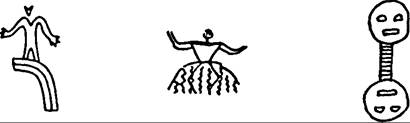
(a) half arch to noon (b) whole arch (c) above and below
The lower and upper courses of the solar walk are epitomised as such at their ‘half-way’ moments, in paired or double-headed symbols: arms ‘taking life’ from down in the earth or up in the sky; trees with foliage at crown and root and that walk; upright and inverted heads which rotate through the walk and to which attach the words: ‘I come up from below, I come down from above—I see the spirit, I see beavers’ (Figure 52. lc). In a single-stanza song ‘for beaver hunting and the Metai Mide’ collected by Tanner, the down-up opposition occurs in the first and last symbols, a subterranean lodge and a flying eagle. This text is also notable for the chronology encoded in its second symbol, which depicts the four ‘day-years’ familiar from Chusco and Pontiac. Referring to marks drawn on a fasting figure, on chest (2) and legs (4), come the words: ‘Two days must you sit fast, my friend; four days must you sit fast’. ‘Binding’ the legs the four lines mean actually sitting fast for four days but as far as the candidate’s inner devotion goes Tanner’s informant assured him that they are understood simultaneously to mean four years.
A definite link between these Mide texts and the extended alphabetic narratives of Chusco and Pontiac is provided by Catherine Wabose, an apostate like Chusco, who described her first solar walk both verbally and in a pictographic Mide chart.
Prepared by a ritual fast of four days, she sets off on a mysterious path stretching down between the setting sun and the new moon at the western horizon; having passed figures equivalent to the full moon and Venus (see Figure 52.2b, d), she rises to the heart of the sky, the climax of the vision, before again descending, on a snake. The importance of the moon’s phases is clear from Wabose’s and one of Little Frenchman’s symbols (see Figure 52.2c) while moon and Venus, in the posture of the guide Manabozho, are similarly conjoined in single stanza of hunter’s pictographs also recorded by Schoolcraft. The accompanying words read:
(a) sun
Figure 52.2: Mide Symbols for the Three Travellers

(b-c) moon

(d) Manabozho
I am rising (like the sun)
I take the sky, I take the earth (at the horizon)
I walk through the sky (like the moon) Venus guides me.
As Sioux living on the southern border of the Mide heartland, the Winnebago offer insights of their own into the meaning and function of the solar-walk paradigm. For though he scarcely comments on the fact, it has paramount importance in Winnebago funeral rituals meticulously recorded early in this century by Paul Radin, a friend and collaborator of C.G. Jung. Here, the solar walk is unequivocally revealed as the route to true life followed not just by the initiate shaman but by the soul after death.
Instructed by a great-grandmother figure, the Winnebago soul sets off on a path that takes him past the underworld fire of the Lucifer-like Herucgunina, leads him step by step over the eastern horizon, and brings him up to the circle of his relatives in the heart of the sky. He (or she) is told:
My grandchild, Earthmaker is waiting for you in great expectation. There is the door to the setting sun. On your way stands the lodge of Herecgunina, and his fire. Those who have come [the souls of brave men] from the land of the souls to take you back will touch you. There the road will branch off to war ds your right and you will see the footprints of the day on the blue sky before you. These footprints represent the footprints of those who have passed into life again. Step into the places where they have stepped and plant your feet into their footprints, but be careful you do not miss any. Before you have gone very far, you will come into a forest broken by open prairies here and there. Here, in this beautiful country, these souls whose duty it is to gather other souls will come to meet you. Walking on each side of you they will take you safely home. As you enter the lodge of the Earthmaker you must hand to him the sacrificial offerings. Here the inquiry that took place in the first lodge will be repeated and answered in the same manner. Then he will say to you, ‘All that your grandmother had told you is true. Your relatives are waiting for you in great expectation. Your home is waiting for you. Its door will be facing the mid-day sun. Here you will find your relatives gathered.
Texts such as this bring together the Mide tradition (compare the ‘footsteps’ with Iosco’s) with the Plains Ghost Dance of the 1890s, in which Sioux and Algonkin alike re-enacted the circular dance of their relatives in the heart of the sky.
Besides this, the Winnebago ritual observed by Radin touches on the matter of the 4+4 day-years experienced by Iosco and other travellers along the solar walk. For the Winnebago wake lasts four days, during which period the mourners concentrate on helping the soul on his way beyond death, until he has passed the critical half-way encounter with Herucgunina. Indeed, what the mourners say and do, whether or not they exaggerate or lie about their own capacity to help, directly affects the soul’s passage. For his or her part, the traveller enters another type of time, the ‘ancient’ time of the spirits, in which the true period of mourning is said to be not four days but four years. Similarly, sacrificial victims among the Aztecs contemplated a journey to the underworld with the words: ‘over four years we shall be carried on the wind’. In other words, as in Tanner’s fasting symbol, it is a question of two dimensions of time, earthly and spirit, days and years, which run concurrently, correlated by means of an astonomically significant cipher. (For the shamans not far north of the northern Algonkin a day is a year.)
Geographically, the solar-walk paradigm may be understood as part of a larger tradition of native American ritual and chronology whose coherence is especially marked in the northern half of the continent, extending from the Atlantic coast and the south-east, across the Plains to the south-west and Mexico. For in Mexico and Mesoamerica, the walk is clearly mapped out in native script, hieroglyphic and iconographic, in the screenfold books of ritual. On themappa mundi pages of the Fejervary and Laud screenfolds, for example, it may be traced through the cardinal stations of native astronomy in the tropics, the east and west horizons, with zenith and nadir each half-way between; such is the case too with the Venus tables in the hieroglyphic Dresden screenfold. For this is the route followed by the culture-heroes of Mesoamerican cosmogonies implicit on those pages and written out alphabetically in such works as the Nahua ‘Cuauhtitlan Annals’ and‘Legend of the Suns’, the Quiche- Maya Popul vuh, and the lowland Maya Books of Chilam Balam. True to the astronomical analogue, these travellers pass through the underworld (Mictlan, Xibalba), rise again at the eastern horizon, and reach the moment of plenitude in the heart of the sky.
In the ‘Legend of the Suns’ the ‘feathered serpent’ Quetzalcoatl descends to Mictlan to acquire the bones from which to make woman and man; on his way back up east, this Venus-figure faces a strange hazard, one astoundingly reminiscent of that faced at the same astronomical position by the Morning Star of the Blackfeet Algonkin: he is set upon and pecked at by birds. In the Popul vuh, whose underworld ‘test-theme’ has been fruitfully compared with that in the cosmogonies of the south-west, the hero Twins descend to Xibalba to avenge their father who had been murdered there and got no further than this half-way station; they themselves pass through and like their Mide counterparts step up into the eastern sky, where they actually become sun and moon:
And thus they took their leave,
Having completely conquered all of Hell (Xibalba)
And then they walked back up
Here amid the light,
And at once
They walked into the sky.
And one is the sun,
And the other of them is the moon.
Then it grew light in the sky,
And on the earth.
They are still in the sky.
(tr. M. Edmonson)
This same stepping up past the eastern horizon recurs in the far more esoteric lowland Maya version of what is basically the same cosmogony in the Chumayel Book of Chilam Balam. In a long and complex chapter of that book (pages 42-63), levels of reality are successively claimed through the establishment of the basic sets of Mesoamerican ritual themselves, the midwife’s 9, the augur’s 13, and finally the ‘alphabet’ of Twenty Signs, against each of which a tenet of Christian dogma is critically examined. Embodied as the uinal, this last set begins his cosmic journey under a great-grandmother’s tutelage, exactly as in Winnebago ritual which indeed is echoed with surprising closeness when it comes to ‘getting into step’ at the eastern horizon (here also a pun and an Eleatic paradox):
He started up from his inherent motion alone.
His mother’s mother and her mother, his mother’s sister and his sister-in-law, they all said:
How shall we say, how shall we see, that man is on the road?
These are the words they spoke as they moved along, where there was no man.
When they arrived in the east they began to say:
Who has been here? These are footprints. Get the rhythm of his step.
So said the Lady of the world,
And our Father, Dios, measured his step.
This is why the count by footstep of the whole world, xoc lah cab oc was called lahca oc 12 Oc.
This was the order born through 13 Oc,
When the one foot joined its counter print to make the moment of the eastern horizon,
Then he spoke its name when the day had no name.
as he moved along with his mother’s mother and her mother, his mother’s sister and his sister-in-law
The uinal born, the day so named, the sky and earth,
the stairway of water, earth, stone and wood, the things of sea and earth realized.
1 Chuen, the day he rose to be a day-ity and made the sky and earth.
2 Eb he made the first stairway. It ebbs from heaven’s heart the heart of water, before there was earth, stone and wood
It is on reaching the ‘heaven’s heart’ that thewiHa/ completed his journey and himself: the twenty constituent Signs join hands to form a circle of relatives reminiscent alike of the centre of the Aztec Sunstone and the Ghost Dance songs.
In all, the Mesoamerican texts lend a truly epic dimension to the solar-walk paradigm and relate it specifically to the emergence of man in the grand evolutionary scheme of multiple creation or suns. And in so doing they enrich our astronomical reading of the 4+4 cipher, further developing the day-year time-shift noted in texts from further north; compare, too, the lots of 4 day-years in the lives of the Navajo Sun’s children in the same world-age context. Duly observed in the Aztec Atamale ceremony the 4+4 years of the octaeteris are formally embedded in the very mechanism of the Mesoamerican calendar, which groups years into leap-day spans of four recurrent Signs and in which the second burial ceremony occurred after four years. For their part the Dresden Venus tables take the octaeteris (of 2920 days) as their base; and they clearly establish the much cited eight days of the solar walk as the official length of that planet’s inferior conjunction or underworld passage from west to east. This fact strongly corroborates our previous detections of Venus figures in Mide and related texts. The principle of the Dresden tables is Venus’s subsequent ascension in the east, its heliacal rising as Morning Star. Detailed in the iconographic screenfolds, this dramatic moment is ritually acknowledged in the Nine- night chants of the south-west and on the Plains, and appears for example in the Sioux story of the rabbit hunter who manages to outpace the sun. It also dominates the ‘Cuauhtitlan Annals’ version of One-Reed Quetzalcoatl’s self-incineration in 895 ce and his apotheosis as Venus, for prior to his heliacal rising, the passage through the underworld falls into two lots of 4 days, the official length of inferior conjunction either side of Mictlan. In a passage of great beauty, adapted by D.H. Lawrence in his novel The Plumed Serpent, we learn how Quetzalcoatl’s heart makes the same journey, having burned to incandescence:
So that where Quetzalcoatl burnt himself is called the place of Incineration.
And it is said that when he burned, his ashes rose up and every kind of precious bird appeared and could be seen rising up to the sky: roseate spoonbill, cotinga, trogon, blue heron, yellow-headed parrot, macaw, white-fronted parrot, and all other precious birds. And after he had become ash the quetzal bird’s heart rose up; it could be seen and was known to enter the sky. The old men would say he had become Venus; and it is told that when the star appeared Quetzalcoatl died. From now on he was called the Lord of the Dawn.
Only for four days he did not appear, so it is told, and dwelt in Mictlan. And for another four days he sharpened himself. After eight days the great star appeared called Quetzalcoatl on his ruler’s throne. And they knew, on his rising, which people, according to Sign, he penetrates, shoots into and loathes.
In conclusion here it may be fairly claimed that the solar walk was and is a paradigm in native North American religion. Integral to it are a pattern of days and years of astronomical significance and the principle of the time-shift itself. With Chusco this leads further into the inner dimensions of the day, forenoon and afternoon; in Mesoamerica it leads outwards towards a vast evolutionary story recorded at length in the Popul vuh and counted by aeons, hundreds of millions of years, in the hieroglyphic inscriptions.