The Good Shepherd of the Inca
To the south, in the course of their invasion of the New World, Europeans encountered in the Andean highlands a civilisation which for all its common native American traits, in curing, weaving and metallurgy for example, exhibited others quite distinctive to it.
Indeed, the Inca empire Tahuantin- suyu penetrated by Pizarro remains to this day a source of theoretical enquiry, as a result of its highly organised religion and state system, which served to hold together many thousands of kilometres of territory, radiating out from the capital Cuzco, its means of communication being the quipu. Nowhere else in the Americas was such thorough control of population and economy achieved over such a vast geography; nor was there a religion even nearly so institutionalised and monotheistic.At the same time, this region was the exclusive home of the four American camelids: the llama and the alpaca, the huanuco and the vicuna. Having in common with the Old World camels a remote and long vanished ancestor in the North American Ohio Valley, these animals differ somewhat in size and in quality and colour of wool, the first two having been domesticated and the other two not. While the larger llama, probably derived from the huanuco, has served largely as a pack-animal, the alpaca has been best known for its wool; the finest wool, however, belongs to the wild and rare vicuna. (The exact dates and places of domestication are still the subject of research, though bone evidence from Ayacucho points to as early as 4000 bce.)
Given these two characteristically Andean phenomena, sociological and zoological, the question naturally arises whether they were connected, and if so, how. A prime aid towards any answer is the
Latin American Traditional Religion corpus of texts native to the region, which in many cases have only recently been published and edited.
Written in Quechua and Spanish, and transcribed in part from quipu originals, these texts include the encyclopedic Nueva coronica y buen gobierno sent by Guaman Poma as a letter to Philip III of Spain and which structurally reflects, in its first part, Inca state organisation; the Huarochiri Narrative composed entirely in Quechua, which focuses chiefly on cosmogony and Christian attempts to incorporate native religion; other narratives like the Relacion de antiguedades of Santacruz Pachacuti, which includes a plan of the Inca temple Coricancha, as well as the Quechua originals of the Situa liturgy, in which the great god Viracocha is worshipped.In the first instance, these native texts confirm the categorical change signified by domestication as such, that is, loss of wildness. Nowhere is this more fundamentally stated than in the general American cosmogony of world-ages, where the eclipse that ends the second age prompts a domestic revolt against masters who have lost their capacity to worship and respect the life-spirit. In Mesoamerica, this upheaval is led by mortars and kitchen utensils tired of unfeeling use, and not least by the Dog and Turkey, the two creatures whose long-standing alliance with American man is elsewhere celebrated in rituals that survive even today, for example in the south-west of the United States. That in Tahuantinsuyu this same contract was perceived to have extended to llamas is clear from the Huarochiri Narrative, where during the eclipse the revolt of the utensils is accompanied by one on the part of these creatures, who turn on their masters in herds. Later in the same Narrative, this motif recurs in the binary opposition established between the few wild vicuna who help the poor Huatyacuri and the teams of llamas enlisted by his rich antagonist (Chapters 4 and 5). For their part, Quechua poetry and drama nostalgically invoke the aesthetic attraction of the‘wild’ llama, be it that of the beloved as a silky-haired, farouche vicuna, or that of the rebellious Ollantay who defies the Inca as a ‘straying lamb’.
Consistent with the terms of this domestic contract is the inclusion of the tamed creature as a ritual ally and even social companion. The actual process of inclusion is well-illustrated in Guaman Poma’s report of the religious ceremonies proper to the month Uma Raima (October; see Figure 52.5), in which supplicants for rain included not just human children and dogs, whose tears and howls were elicited as sympathetic magic, as in Mexico for example, but a black llama as well. In Inca cosmogony it was the plaintive quality of the llama’s faint cry or song that warned humans of the Flood that ended the first world-age (Huarochiri Narrative, Chapter 3), while socially this beast, this time coloured red, became the singing companion of the emperor himself in court performances of the Quechua yaravi. Indeed, for these capacities the llama, like our Ram, was elevated to the stars as a principal constellation and guide.Besides these functions, however, for which parallels can be sought elsewhere in native America, the tame camelids of the Inca
Figure 52.5
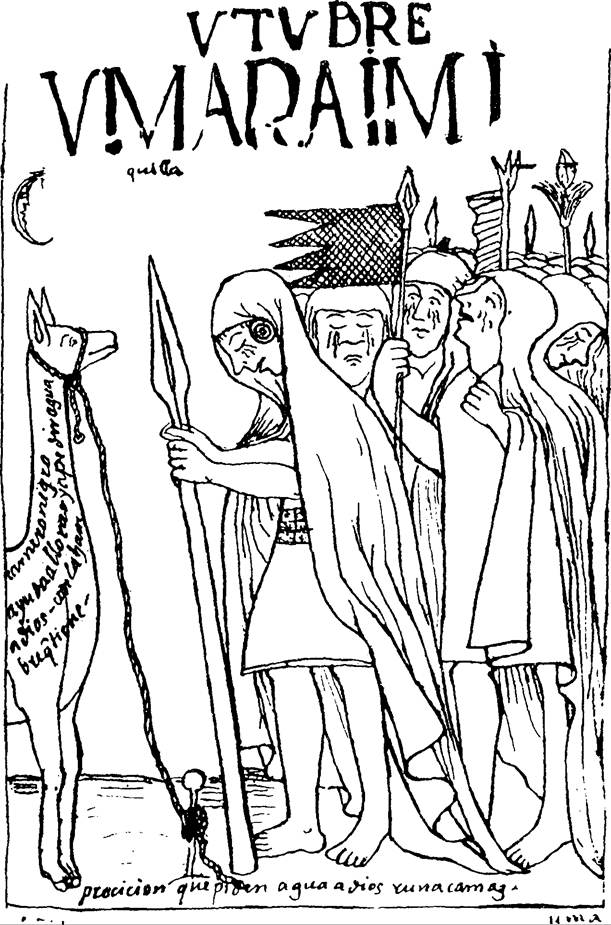
Latin American Traditional Religion had others, exclusive to them. For from all that has been recorded about the Inca state, it is clear that these creatures alternatively served just as units of value, mere items of exchange devoid of particular status or rights, and that as such they were transacted on the grand decimal scale of the quipu, whose first and most enduring use appears to have been to tally herds. In Umu Raimi, while one black llama sang for rain one hundred of his white brethren were simply slaughtered; and at the festival of Pariaca ‘several thousand’ were offered to his priests, such amounts being calculated and checked by means of the quipu, according to theHuarochiri Narrative (Chapter 9).
As a standardised arithmetical unit of value, especially for the purposes of Inca state religion, the llama in this respect can be well compared with other such units used both within Tahuantinsuyu and in urban economies beyond, like Mesoamerica.
Hence, on the one hand it resembles Mesoamerican tribute units of precious feather, stone and metal in its durability; and on the other, in its immediate usefulness, it resembles rations of woven cotton and food, like the mantles and the bushels of maize and beans separately rendered as tribute to the Aztec emperor, for its wool could be variously spun according to quality, its flesh eaten fresh or as charqui, its dung spread as manure and so on. Besides uniquely combining these qualities the llama had two others. In the complete absence of any analogue except humans themselves, the llama served as transport, carrying about 45 kilos for up to 20 kilometres a day, chiefly crops from the estates of Empire and Religion back to the capital Cuzco, and thus provided labour as well as commodity value. Secondly, it increased and multiplied itself as sheer capital (whence ‘cattle’). Inca attention to breeding, to the selection of prime males literally in ‘races’ and to penis size, is reported by the Huarochiri Narrative (Chapters 9 and 10).Combined, these qualities of the domesticated Andean camelid, llama and alpaca, endowed it with a value that could not easily have been restricted to the type of domestic contract honoured throughout native American culture. How and where its particular qualities were exploited over time need still to be researched, but the process must have begun with domestication itself. For his part, Guaman Poma (pages 57-78) speaks of a sharp increase of llama and people in the age of the warlike Auca who succeeded the Purun, the first to measure out owned land distinguishing pasture from fields (chacra). Without doubt the process led to a new definition of land use and ownership, the edge between tutelary and wild territory being a powerful feature of Andean ideology still today. This meant another social definition of the agriculturalist, whose particular rivalry with the shepherd, rather than with the hunter-warrior, as elsewhere, is likewise evident in the modern ritual of the Collas in Bolivia.
And it led to another formulation of religious control, of a flock obedient to its emperor-god, innocent of‘sin’, and hence sheltered from the ravenous dangers beyond the frontier fence.In the latter part of the story, a critical moment was certainly reached in the mid-fifteenth century, with the Inca Pachacuti’s conquest of the Lake Titicaca region, the ‘Collasuyu’ renowned for its huge pastoral wealth and its own imperial past. For it was under this emperor and his son and heir Tupac Yupanqui that the Inca state was given its definitive shape, in dispositions which all point to the importance of pastoralism as an ideological as well as an economic force. Whereas the guarding of llamas could be relegated to boys and girls of twelve acting out of‘love’ for the Inca, which is how Guaman Poma depicts it (pages 204 and 225), in incorporating the Collas the Inca emperors, in conjunction with the local chiefs, assigned the large herds they had appropriated to the care of professional shepherds. Though they worked full-time, these new appointees were privileged to retain their right to agricultural land, which was worked for them by their kin. Entrusted with the quipu accounts of Empire and Religion, these favoured few became pastoral retainers who among other rights could leave their post, patriarchally, to a son. At the same time the central administration set up by Pachacuti and Tupac Yupanqui made quite explicit the more general and significant equation between the llama flock and the human folk as complementary arithmetical components of the state, the latter being likewise counted on the quipu to the last unit and according to the ten categories and ages listed by Guaman Poma. This much is evident in the very term used for the police, michic or shepherd, responsible for surveillance of the population and for reporting absences from work and religious festivals once again by means of the quipu (Huarochiri Narrative, Chapter 31).
The same equation between flock and folk is made above all in the monotheistic worship of Viracocha exemplified in the following hymn from the Situa liturgy:
Oh dew of the world
Viracocha inner dew Viracocha you who dispose by saying ‘Let there be greater and lesser gods’ great Lord dispose that here men do multiply fortunately.
Father Viracocha you who say ‘Let there be the upper world and the lower world’ you who fortify the world below hear me
attend to me:
Let me live in peace and in safety, Father Viracocha,
with food and sustenance, with maize and llamas, with all manner of skills.
Abandon me not.
Remove me
from my enemies,
from danger, from all threat of being cursed, ungrateful, or repudiated.
In the Quechua cadences of this liturgy, the supreme god and paternalistic principle Viracocha is repeatedly asked to keep both men and llamas in peace and safety under the care of his representative on earth, the Inca emperor, and to favour their ‘increase’; he is also asked to keep his flock from straying into disobedience and sin, again concepts otherwise foreign to native American liturgy. Actual confession was helped by the payment of llamas, and there are even reports of a black llama serving literally as a scapegoat during the Situa ritual, collective sin being heaped upon it. Disobedience towards Pachacuti the ‘good shepherd’, and its retribution, certainly provides the whole message of the play Ollantay.
The catalogue of pastoralist traits peculiar to Andean religion could easily be lengthened. Yet those noted already are enough to justify the connection in principle between fauna and society in that area and in so doing to raise larger theoretical issues like the standardisation of value, land appropriation, the concentration of power within what thereby becomes the ‘state’, the deep complicity between the -isms of capital and social, and the pastoral roots of monotheism itself. Indeed, set in as it were the laboratory conditions of the New World the Inca Tahuantinsuyu offers useful pointers to features of our own religion long saturated with pastoralist ideology, from the fable of Cain the agriculturalist and Abel the keeper of flocks, to the doctrine of Christ both shepherd and sacrificial lamb.
Further Reading
Brotherston, Gordon Image of the New World. The American Continent Portrayed in Native Texts (Thames & Hudson, London and New York, 1979)
Dewdney, Selwyn Sacred Scrolls of the Southern Ojibway (University of Toronto Press, Toronto, 1975)
Eliade, Mircea Shamanism: Archaic Techniques of Ecstasy (Routledge & Kegan Paul. London, 1964)
Krickeberg, Walter Pre-Columbian Mexican Religions (Weidenfeld & Nicolson, London, 1968)