Egyptian connections
Of crucial importance for the exchange of conceptual beliefs are obviously the Egyptian connections. From the evidence as we have it, regardless of any borrowing, there is no reason to believe that the Aegeans adopted Egyptian conceptual systems when drawing on iconography or practice.
Yet significantly, recent evidence has confirmed the absolute priority of Egyptian materials in Crete and the Aegean, even before the earliest palaces (cf. Manning 2008). The links between the earliest Bronze Age Aegean civilizations and Egypt have been recognized since the beginning of the serious study of Aegean Bronze Age religions (e.g. Evans 1921-35; Nilsson 1927). Yet there are three significant changes since those early studies. First, the dates of the Egyptian civilization no longer assign Egypt a chronological priority over Mesopotamia (as had been assumed in the earlier part of the twentieth century CE): instead, the great urban literary civilizations of Egypt and Mesopotamia emerged in parallel in the third millennium BCE. However, the origins of urban Mesopotamia are slightly older; above all, the goddess whom we know as the Sumerian Inanna (the later Akkadian Ishtar) is certainly documented from before 3000 BCE (which is when Egyptian civilization effectively takes off). Yet, given the Minoan dominance of the sea, the presence of Egyptian materials in Crete at an early date is hardly surprising. Thus the diffusion of Mesopotamian motifs and iconography and direct trade contact with the Egyptians will have played a role before and during the highpoint of Aegean Bronze Age civilization. However, there is no reason to assume conceptual borrowings in that era.The second fundamental change is the gradual realization that (at least in the Middle East, which is the only region in the world where myths can be demonstrated to have existed more than four thousand years ago) myths are a relatively recent development.
Assmann has long argued that Egyptian myths did not really appear until the second millennium BCE. Recently, however, Alster (2011) has suggested that even the Sumerian versions of the Inanna myths did not appear until around the end of the third millennium BCE. This means that myth was only gradually appearing in the periphery of the eastern Mediterranean at the time that the Minoan palaces began to appear. But that at that time the borrowing was probably limited to Egypt and Mesopotamia and did not extend much further.The third change is the gradual recognition that the Minoan and Mycenaean traditions were distinctly different, in contrast to what Nilsson (1927, 1934) had argued. And yet here the evidence accumulating since then has contributed substantially to confirming that the Egyptians had direct contacts with both the Minoans and the Mycenaeans, which corresponded to Nilsson’s interpretation, stressing Egyptian influence. Thus, we can confidently assert that the Egyptians did in fact enjoy closer contacts with the Aegean than did the Mesopotamians, but also recognize that there is virtually no trace of conceptual influences from Egypt in the Aegean practices.
Interestingly, the Mycenaean funereal customs as described by Cavanagh (summarized above from Cavanagh 2008) bear a striking resemblance to Egyptian practices. Thus both the Minoans and the Mycenaeans enjoyed direct borrowing from the Egyptians which was far more important than the indirect borrowing from Mesopotamia. In the case of the Mycenaeans, it is clear that this was probably a direct contemporary borrowing and not part of some ancient inheritance from the Minoans (as the practices differ distinctly from the Minoans). However, although many details have direct parallels in Egypt, it is clear that there are also other older Indo-European influences involved - aside from what has become part of a set of universal funerary practices. These include the procession, banquet and preparation of the body, but also the symbolism of the tomb architecture itself which included the tripartite organization whereby a threshold separated the world of the living from the world of the dead.
But more significantly, Cavanagh (2008: 340) specifically stresses “ancestor worship”, which can clearly be connected to later traditions in classical Greece but also perhaps to much older traditions taking us back to the Neolithic and Palaeolithic (see Petrasch, Damm and Kaul, this volume, Chs 7-9).Significantly, the use of the Egyptian name Taweret in modern Aegean studies (from Evans 1921-35: IV. 433ff. through Younger & Rehak 2008: 168) is due to modern scholarship rather than the ambiguity of Minoan sources. The discussion arises because of the appearance of a rather bizarre “Minoan genius”: usually upright, with the head of an animal such as a lion or crocodile (Fig. 12.10). Evans referred to this Aegean creature as a “Minoan genius” and discussed at length an Egyptian goddess, “Ta-urt”, whom we know as Taweris or Taweret (Greek Thoeris), arguing a relation (and delving at length into details of the Egyptian and Aegean representations). The classic version of the Egyptian goddess is that of a standing expectant hippopotamus with the head gradually merging into jaws which can be associated with those of an hippopotamus (but also of a lion or crocodile depending upon the inspiration, intentions and skill of the artist and the imagination of the observer); the feet are those of a lion; the breasts and arms human; in astronomical versions it has a crocodile on the back (for the Egyptian goddess, cf. Gundlach 1986). Taweret should be distinguished from the “Devourer of the Dead” known from the Egyptian Book of the Dead (who likewise has features of a crocodile and a lion, but above all the jaws of a crocodile).
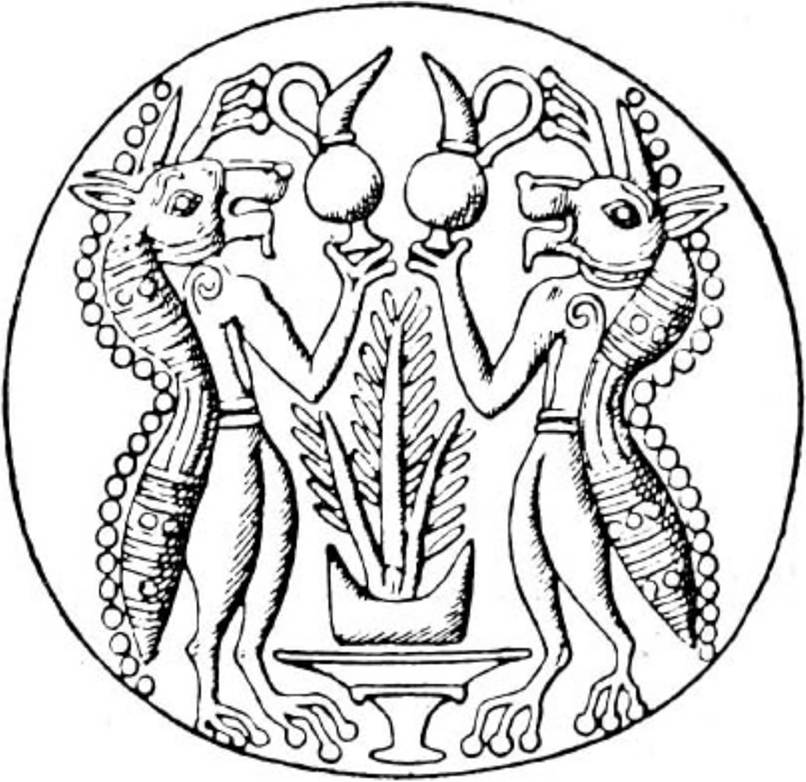
Figure 12.10 Evans’s drawing of a seal from Vaphio with two antithetical “Minoan genius” creatures (original less than 2 cm diameter) (Evans
1921-35: IV. 453).
In treating Taweret and her relations to the Minoan genius, Evans went on to discuss astronomical aspects of the Egyptian iconography, which are actually quite important, as well as the protective/apotropaic elements of the goddess in the Egyptian religion.
From my own standpoint, Evans was rather generous in including the crocodile jaws as part of Taweret, but in his own work Evans stressed the crocodile on the back of the figure when drawing parallels with the Aegean. Regardless, the Minoan representations are on occasion far more persuasively lion-like than the supposed Egyptian parallels. Evans’s advocacy of the equivalency has been adopted more forcefully by recent scholarship as a shorthand means of referring to this bizarre Minoan creature. In any case, the actual Egyptian name of the goddess is not found anywhere in the Aegean: the link is thus based on rather far-fetched interpretations of exceptional iconography rather than philology. That the Egyptian iconography may have inspired the Minoan artists is not impossible, but the designation and identification of the creature is an invention of modern research.By contrast, the Egyptian term “Taweret” basically means “the (female) great one”, and is thus not far from Potnia. Interestingly, an Egyptian version of Potnia would, however, also be Taweseret, “the (female) powerful one”, and both Taweseret and Taweret are probably to be identified as (independent) manifestations of the Egyptian goddess Hathor.