The goddess
This does not, however, resolve the nature of the Minoan evidence of religion as such. One of the major features of the Minoan religion is the woman depicted prominently in frescos and seals, and in the form of figurines found at Knossos.
The most important of these is the woman holding at least one snake in her hands (and is probably identical to the woman holding the staff symbolizing power in the Minoan and Mycenaean worlds). Many of these items belong to both Minoan and Mycenaean traditions (although clearly Minoan in inspiration and less important in the Mycenaean period). It is unclear whether this woman (or any of the others) should be interpreted as a priestess, a goddess or a ruler.It is also far from clear whether we can conclude from the prominence of women that the religion was based on fertility cults and/or a system of matriarchy whereby the women held power. Based on their interpretation of the evidence, Younger and Rehak (2008: 182) suggest that women may have “dominated Neopalatial society, perhaps even politics”. Evans had originally preferred a young priest-king. I tend to suspect that women do indeed dominate the iconography, but stress that women, while appearing widely, do so in benign contexts of symbolic importance whereas real power lay in the hands of the men. I thus interpret the seal shown above in Fig. 12.5 as meaning that the goddess is promising or offering the staff of power to the ruler in return for worship and obedience. In this fashion, the goddess is a source of legitimacy required by the and Pythia is also possible; the oracle at Delphi dates back to the Mycenaean period and the presence of snakes is striking. Thus, the goddess can also undergo a change as she moves from culture to culture, even perhaps being reduced to a priestess. Such an explanation might go some way to reducing confusion: but only in the sense of recognizing that the ambiguities may have existed in antiquity.
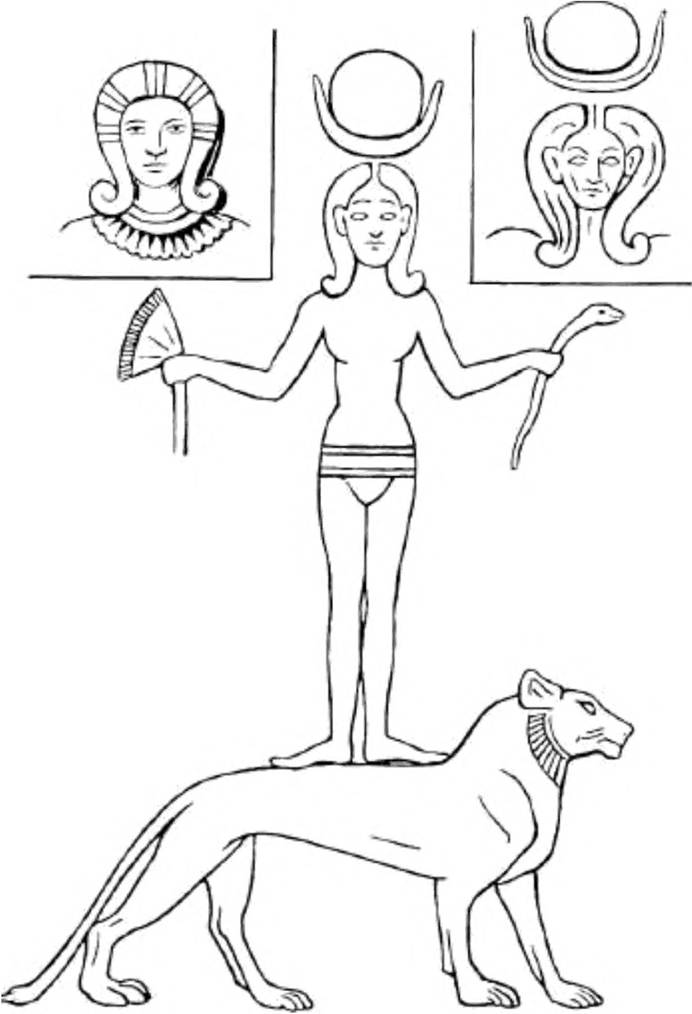
Figure 12.11 A schematic sketch by Evans (1921-35: III. 420) of the Egyptian version of the Syrian goddess Qadesh (with two dif-ferent headdresses: left, the Levantine schematic version of Hathor’s locks; right, the Levantine/Mesopotamian version of the Hathor locks with the
crescent moon). (The version is an idealized one, but the figures are rarely more than 30 cm high in the reliefs.)
In fact, however, the prominence of bulls and women in the Minoan and Mycenaean worlds has also been related to the women and bulls so prominent at Qatal Hdyiik in Anatolia millennia earlier, and these can be traced even further back, to the Neolithic as Cauvin (2000) argues (and indeed to the European Palaeolithic with the bulls of Lascaux and the Venus figurines: cf. Renfrew & Morley 2009). And this takes us into the debate about continuity, pursued by Burkert, Dietrich and others. Certainly, there is some possibility of a long-term inheritance in Bronze Age Greece combining elements from Neolithic Anatolia and the prehistoric steppe along with Bronze Age Egyptian and Levantine influences. However, I would argue that a good deal of what appears in the later Greek religions owes its origins to the stories accumulating from the end of the Bronze Age and the interactions with the Phoenicians in the Early Iron Age.