Eliade, 1920s-1980s: From Romanian post-truth to American New Age
It is not easy to summarize Eliade's ideas. A precocious writer who started publishing regularly when he was 12 years old, Eliade produced more than 2,500 works (counting literary, academic and journalistic contributions, translations included; Handoca 1997), and wrote an astonishing number of unpublished diaries, private notes and letters (Ambasciano 2014: 23).
However, thanks to recent, critical systematizations of Eliade's life and works, it is anyway possible to briefly outline the most important biobibliographical events in Eliade's career and reconstruct in broad strokes his intellectual and professional networks. This is all the more important because Eliade's works are so relevant for the contemporary HoR that a case could be easily made for the division of the disciplinary history into ‘before Eliade' and ‘after Eliade'. Considering that Eliade's own approach did not change much in more than five decades, that he accumulated over the years some minor and contradictory readjustments which we can skip here, that his pivotal ideas recur in all his works, and that he mostly accommodated data chosen expressly to fit into his own research programme, I will focus on a couple of major issues and themes (i.e. diffusionism, prehistory and shamanism), preferring to give a more comprehensive epistemological overview and referring interested readers to the much more detailed biobibliographical analyses included in Turcanu (2007), Ambasciano (2014), and Idel (2014).Greatly interested in biological sciences and evolution, fascinated by entomology, and fiercely anti-Darwinist since his youth, Eliade promoted a peculiar blend of social and biological evolution typical of the anti-modernist vogue of Romanian Interwar culture. For instance, in 1927 a 20-year-old Eliade eulogized Vasile Conta (1845-1882), ‘the greatest Romanian philosopher', and his political blend of racism, anti-Semitism and anti-Darwinism in which natural selection was discarded in favour of a focus on (and control over) ‘external influences' such as ‘emigration' and ‘cross-breeding' (Eliade 1996: 48, 50; Ambasciano 2014: 82).
The Romanian cultural setting was characterized by the typical features of aggressive European nationalism and involved the consistent exploitation of a top-down reinvention of racial, archaic and prestigious tradition(s) through media coverage, tabloid journalism and right-wing politics increasingly disengaged from truth values, in a way not dissimilar to the current post-truth era (cf. Idel 2014: 34). As described in painstaking detail elsewhere (Ambasciano 2014), Eliade's viewpoint was initially shaped by the following intellectual and cultural trends:1. Orthodox creationism and Biblical literalism as held by his mentor, extreme right-wing pundit and University of Bucharest professor of Logics and Metaphysics Nae lonescu (1890-1940). lonescu mixed these beliefs with his own philosophical system called trairism, a form of vitalism which rejected rational authorities and privileged mystical experiences. As University lecturer, Eliade also served briefly as lonescu's assistant.
2. Lucian Blaga's (1899-1962) metaphysical saltationism, namely, the metaphysical and discontinuist character of human culture in evolution as inherently theological and mystery-driven.
3. Constantin Radulescu-Motru's (1868-1954) energetic personalism, which was a cosmic, teleological evolution guided by a vitalistic force.
4. Bogdan Petriceicu Hasdeu's (1838-1907) providential evolution, i.e. evolution as guided by divine and transcendent Providence (Eliade 1967a; Eliade 1967b; Eliade 1967c; Eliade 1987; Eliade 1993; Eliade 1991: 255-60).3
A huge and precocious interest in occult, folkloric and fantastic literature,4 in the paranormal as a way to experience otherworldy realities, the orgiastic-erotic and narcotic experiences which were to define his approach to the study of religion (see Oisteanu 2010: 374-413), and the fascination for cultural trends that emphasized the primeval revelation of God's will and knowledge to make sense of the similarities between different cultures and religions (for instance, various forms of modern and contemporary esotericism, diffusionism and, later, Schmidt's Kulturkreislehre and Urmonotheismus), completed the list of Eliadean extra-epistemic fundamentals.
These motifs were all combined in a single, eclectic vision, one that remained incredibily stable for 50 years (Figure 12). Eliade seemed to believe in the possibility of retrieving the vestiges (or ‘living fossils') of antique religious truth, as well as techniques apt to experience again allegedly paranormal and prehistoric powers (especially for some gifted individuals), from the sui generis, historico-religious ‘metapsychoanalysis' of European and Asian myths and folklore (Eliade 1961: 35; cf. Ambasciano 2014, and Idel 2014). This mental framework was accompanied by Eliade's deep commitment to the revanchist and extremist programme of a far-right revolutionary social order insofar as the prestigious Eurasian past recovered by his HoR would have brought about the sheer uniqueness of the Romanian nation. In other words, since Romania lacked the ancient, classical or medieval documents or monuments found in other European nations, HoR was supposed to provide the academically recognized support for the creation of a powerful, xenophobic and
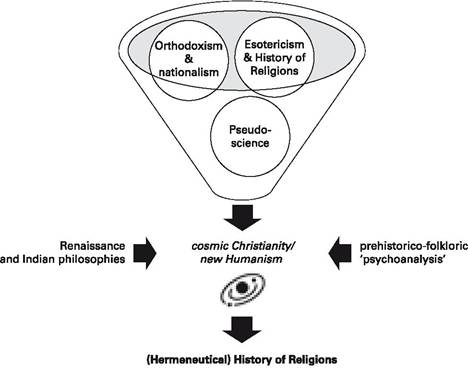
Figure 12 Eliade's (hermeneutical) history of religions: original features, influences, and main themes
totalitarian national state. As a result, Eliade developed a resentful approach to history per se, focusing instead on phenomenological escapism, wishful thinking and colonial fantasy, taking advantage of his role as a public intellectual, using his novels, his academic works, and his newspaper articles to justify extremist violence, and getting directly involved in the construction of both a nationalistic mythology and a ‘new man at the service of ultranationalist, fascist, anti-Semitic and fundamentalist political organizations born from the orthodoxist Legiune Arhanghelul Mihail (‘Legion of the Archangel Michael'; also Mifcarea Legionara, ‘Legionary Movement', and Garda de Fier, ‘Iron Guard') and the related party Totul Pentru Tara5 (‘Everything for the Fatherland'; see Laignel-Lavastine 2002; loanid 2005; Heinen 2006; Junginger 2008; Ambasciano 2014; Idel 2014; R. Clark 2015; Dumitru 2016; Ambasciano 2016a; Eliade's propaganda articles from this period have been collected in Handoca 2001; cf.
Oisteanu 2012 for a history of anti-Semitism in Romania, and Griffin 1993 for palingenetic ultranationalism).After his Romanian career as a political commentator in far- right tabloid journalism, and having been arrested in 1938 for his political involvement in the legionary party and its institutional organization,6 Eliade was granted a diplomatic appointment in London and Lisbon that allowed him to leave Romania and carry out institutional duties and propaganda activities for a new, monarchy-supported but still far-right, authoritarian, anti-Semitic, Romanian government during World War I I (Turcanu 2006: 387-436; Handoca 2008: 379-83; Junginger 2008; Ricketts 2008; Ambasciano 2014: 356-7).7 However, as we will see later, the knowledge of Eliade's political activity remained quite limited in academic circles before the mid-1970s.
With the war coming to an end, Eliade went to France, which provided him with a remarkable network of scholars. He lived for slightly more than a decade in Paris (1945-1956), where, invited by classicist and right-wing intellectual Georges Dumezil (1898-1986), he taught a 10-lesson course at La Sorbonne in 1946, completed some of his most important academic and literary works, and took part in the Eranos workshops held at Ascona, Switzerland, from 1949 to 1961, where he was introduced to mostly phenomenologically oriented colleagues interested in symbolism and depth psychology, among whom was Swiss psychoanalyst Carl Gustav Jung (Spineto 2006: 57-70; cf. Turcanu 2013). Between 1949 and 1954, Eliade completed his most important academic works, most notably the anti-historicist Le mythe de leternel retour. Archetypes et repetition (later translated into English as Cosmos and History: The Myth of the Eternal Return, 1954), the phenomenological handbook Traite d’histoire des religions (Patterns in Comparative Religion, 1958a), a re-elaboration of his old PhD thesis on the history and philosophy of yoga (Yoga: Immortality and Freedom, 1958b), and what is probably his most relevant academic contribution, Le chamanisme et les techniques archatques de lextase (Shamanism: Archaic Techniques of Ecstasy; Eliade 1964).
Meanwhile, Eliade kept on promoting the folkloric supernatural and the prehistoric paranormal with a slightly softened understanding (e.g. Eliade 1948a; Eliade 1960; Angelini 2005: 126-39), and acknowledged as foundational the speculative works of Pierre Lecomte du Nouy (1883-1947) and especially Pierre Teilhard de Chardin (1881-1955) who, respectively, justified the beginning of life as ignited by a divine will and saw the culmination of the orthogenetic process of evolution as reached on Earth by the ‘Omega point', that is the Christian Logos (Christ himself).8Invited to hold the Haskell Lectures at the University of Chicago in the mid-1950s by German phenomenologist Joachim Wach (1898-1955), and shortly after appointed as Wach's heir in the Divinity school of the same University, Eliade consolidated his fame in the field and rapidly became the most renowned morphologist- phenomenologist and influential historian of religions of the past century (Casadio 2005a: 4046-7). Historian of religions Jeffrey J. Kripal has recently suggested that the Eliadean use of the label ‘cultural fashions' during his Chicago years (e.g. Eliade 1967d) was an academic umbrella term which served to camouflage an emic, appreciative treatment of the paranormal (Kripal 2011a: 202). In the wake of such interpretation, Eliade's academic work during his Chicago years also could be considered as part of the pseudoscientific movement that in the 1960s and 1970s tried to ‘combine multiple unorthodoxies into a single volume' (Thurs and Numbers 2013: 139), from esotericism to archetypical psychoanalysis, from the paranormal to Intelligent Design (Ambasciano 2015a; cf. Pigliucci and Boudry 2013). As to the old, loose link between historicism and phenomenology, in the late 1970s Eliade concluded that Pettazzoni had taught him ‘ what to do, not how to do' (Eliade to I. P. Culianu, 3 May 1977; from Culianu 1978: 6). Additionally, since the 1960s Eliade had been advocating the active use of the HoR as a tool for Western or worldwide spiritual renewal, continuing his old advocacy of the orthodoxist ‘new man' in different terms (Ambasciano 2014: 301, 357, n.
617).During his entire post-war career, Eliade became the proponent of what David Hackett Fischer called ‘the fallacy of archetypes', that is a critical stance against history and change as degradation (whenever historical facts were not seen as the vehicle for spiritual renovation), coupled by Romantic anti-modernism. As Fischer argued, when this idea ‘is used by a historian to conceptualize his subject, then it becomes a fallacy, for the myth implies that what is real does not change. His time series is bent back upon itself in a sterile series of cyclical enfoldments’ (Fischer 1970: 151; cf. Spineto 2006). This interpretation extended from periodic mythical patterns to recurrent theories of myths themselves, to embrace not just Eliade’s ‘subject’ but the whole of history (Eliade 2000; Eliade 2010). As epitomized by Ivan Strenski, Eliade was simply ‘no historian’ (Strenski 2015: 143; cf. Dudley 1976). The Marburg manifesto remained a dead letter, and a new, post-truth natural theology conquered the HoR.