The sacred from the Stone Age to the present and back again
With such a cultural background, it is no wonder that Eliade was a staunch advocate of human discontinuity and human exceptionalism in evolution and, due to the influence of lonescu’s philosophical works, he apparently struggled to find a balance between his fascination with natural history and the outright rejection of evolution for all things concerning humankind, a conflict that ultimately led to his ambiguous and quasi- theological view of an orthogenetic, non-Darwinian evolutionary path.
As a result, he developed what is one of the most striking combinations of pithecophobia and Asiatism in the HoR (see Chapter 3, § Ladders, progress andpithecophobia). This stance is evident in the first pages of Eliade’s celebrated volume on the History of Religious Ideas: From the Stone Age to the Eleusinian Mysteries (Eliade 1978a, published 2 years earlier in French), a book that prompted English historian of religions Ninian Smart (1927-2001) to remark the ‘questionable, possibly confused, or even perchance false, premises’ of Eliade’s ‘greatly fruitful work’ (Smart 1980: 68). Let us delve deeper into these premises, starting from evolution.First of all, in such an academic work dating from the late 1970s and whose title indicates the Palaeolithic date of religious beginnings, Eliade’s treatment of evolution is nothing short of perplexing. Except for a couple of introductory pages where evolution’s role is downplayed, where monkeys are pithecophobically depicted as very cognitively limited animals, nonhuman apes are never cited, and human beings as ‘prehominians’ or ‘Paleanthropians’ appear on the scene fully formed and practically limited to H. sapiens itself, no updated scientific explanation is provided for the readers.9 After an anti-evolutionary rant about the attribution of ‘the theory of the nonreligiosity of the Paleanthropians’ to the ‘heyday of evolutionism, when similarities to the primates had just been discovered’ (Eliade 1978a: 5) - a theory which is thought by the author to be just a ‘misconception’ - Eliade admits that ‘it is difficult, if not impossible, to determine what [the primordial religious content] was’.
Quite puzzlingly, he explains that the palaeoanthropological documents available are insufficient, yet they do contain a language which can be identified through the unconscious via a hermeneutical effort aimed at discovering the underlying archetypes. Once that is done, those documents will reveal ‘a universe of mythico-religious value’ (Eliade 1978a: 6). In order to sustain his own version of human exceptionalism, Eliade argues thatif the Paleanthropians are regarded as complete men, it follows that they also possessed a certain number of beliefs and practiced certain rites. For, as we stated before, the experience of the sacred constitutes an element in the structure of consciousness. In other words, if the question of the religiosity or nonreligiosity of prehistoric men is raised, it falls to the defenders of nonreligiosity to adduce proofs in support of their hypothesis.
Eliade 1978a: 5; my emphasis
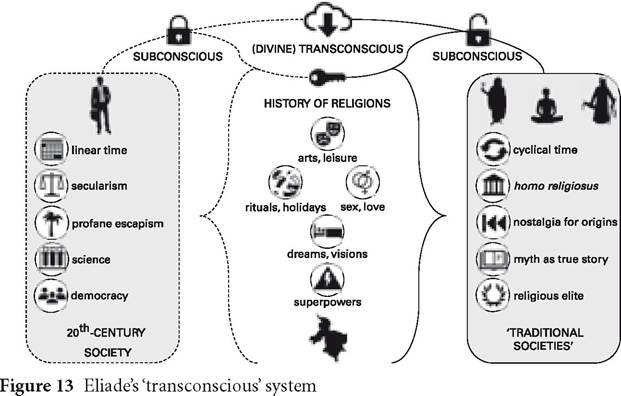
While Eliade’s justification here amounts to a reversal of the burden of proof, and a rejection of the null hypothesis, and thus falls within the range of immunizing logical fallacies (cf. Shermer 2013: 218; Pigliucci and Boudry 2014), his peculiar idea of the sacred deserves a brief explanation. Since the 1930s, Eliade envisaged the sacred as the result of deep, symbolic contents settled and deposited in the human subconscious. This content is encased within archetypes, in turn transmitted through a ‘transconscious’, which is a transcendent vertical link that connects the human conscience with an unspecified otherworldy and divine reality through the virtual mediation of the subconscious as receptacle and ‘apish’ imitator.10 Therefore, every activity is ipso facto religious and derived from a divine source nested in human conscience, and archetypes contain the instructions, so to say, for every folkloric, fantastic, religious and nonreligious action, belief or symbol. All hark back to prehistory, and archetypes are thought to be (also) the remnants of long-lost truths now encoded in myths, dreams, visions, imagination and desires.11 Finally, such archetypical contents are expressed differently in ‘traditional’ and modern Western societies, for the latter merely experience a degraded, degenerated, secularized and profane version of such themes. The fideistic hermeneutics promoted by Eliade’s comparative study of ‘living fossils’ and contemporary Western vestiges is thought to help in recovering and re-establishing a new transconsciously reinvigorated religiosity (e.g.
Eliade 1958a: 450, 454; Eliade 1958b: 226-7; Eliade 1961: 17, 37, 120; for the differences between ‘traditional’ and modern societies see Eliade 1959; cf. Spineto 2006; Ambasciano 2014: 66, 105, 124-5, 133, 281, 451-61). Eliade envisioned a metatheological agenda for his HoR in that he created a theology of primeval nostalgia centred on the human longing for the now lost, divine contact (or coexistence) with(in) an otherworldly reality (Olson 1989). Religion is the result of such nostalgia; but since the sacred is a ‘an element in the structure of consciousness’, and thus cannot be obliterated in any way whatsoever, it lives on (as a more or less degraded expression) in arts, leisure activities, rituals, holidays, dreams, visions, love, sexual activity and the occasional superpowers showed by some particularly gifted individuals who attained freedom from physical constraints and ‘victory over death’, such as the ‘levitating’ Italian Franciscan St Joseph of Cupertino (Giuseppe da Copertino, 1603-1663) - as testified by ‘a witness’ (Eliade 1964: 481-2; see Figure 13).12Now, according to Eliade, the scientific underpinnings of these subconscious structures are to be found in the works of Romanian, anti-Darwinist biospeleologist Emil Racovita (1868-1947), and they represent the link between psychoanalytical and palaeoanthropological explanations.13 Eliade had been trying to translate Racovita’s ideas from cave biology to racial ethnohistory since the 1930s, justifying each nation’s own eschatology and mythical arc, the historical resilience of certain archaic practices (such as yoga), and the persistence of some populations apparently stuck in time,
within an evolutionary, but not Darwinian, process (Eliade 1991: 113-16; cf. Ellwood 2001: 682). All of these were reputed ‘living fossils', and Eliade applied this definition indiscriminately to both cultural and social items.
As cave biology discovered organisms which were supposed to be living fossils of long-extinct faunas, Jungian archetypal psychoanalysis allegedly uncovered the depth of otherwise inaccessible human knowledge buried within both the individual and collective subconscious (see Ambasciano 2014: 89-97, 124-5; Strenski 2015: 144). Thus, in From the Stone Age to the Eleusinian Mysteries, Eliade cites Racovita as an authority and recalls the equivalence between troglobites, i.e. animals that, quoting Eliade, ‘inhabit caves [and] belong to a fauna that has long since been transcended', and current ‘archaic civilizations' that have ‘survived until recent times on the margin of the ecumene (in Tierra del Fuego, in Africa among the Hottentots and the Bushmen, in the Arctic, in Australia, etc.) or in the great tropical forests (the Bambuti Pygmies, etc.)'. All of these ‘civilizations, arrested at a stage similar to the Upper Paleolithic, thus constitute] a sort of living fossils' (Eliade 1978a: 24 and n. 36).And yet, Racovita's ideas have long been shown to be false. Troglobites are not living fossils, the fauna they were a part of has not been ‘transcended' and, moreover, the concept itself of ‘living fossils' has been disproved (Ambasciano 2014: 89-98; cf. Gould 2002: 937; Switek 2012; on cave biology and troglobites, see Romero 2009 and Culver and Pipan 2009). The level of technological knowledge exhibited by the cited populations is different and does not reflect a single historical cause.14 And this is without even mentioning the fact that no human population has ever remained stuck in an ahistorical void capable of preserving it as a social, cultural, religious and technological ‘living fossil' - whatever that may mean.15 More worryingly still, Eliade kept on using such dated terms in an academic publication in the late 1970s to combine the ideas of a scala naturae with a scala religionum, to showcase ‘primitive' human populations as an open-air museum for Westerners' past,16 in a way not dissimilar to Schmidt's own approach (Schmidt's works are actually referenced in From the Stone Age to the Eleusinian Mysteries).