Identity of Visitors to the Hot Springs
These two categories of votive offerings offer a starting point for identifying visitors to the thermae. Some of the votive lamps contain crosses and were likely dedicated by Christian visitors.
The rest lack distinguishing iconographic motifs or inscriptions that would indicate the religious identity of their dedicators. In general, they conform to lamp typologies known from Palestine and Transjordan, mostly their northern regions (Uzzielli 1997). The votive inscriptions also offer conclusive proof for the presence of Christians among the dedicators, through the inclusion of crosses or distinctly Christian language.[341] However, the Christian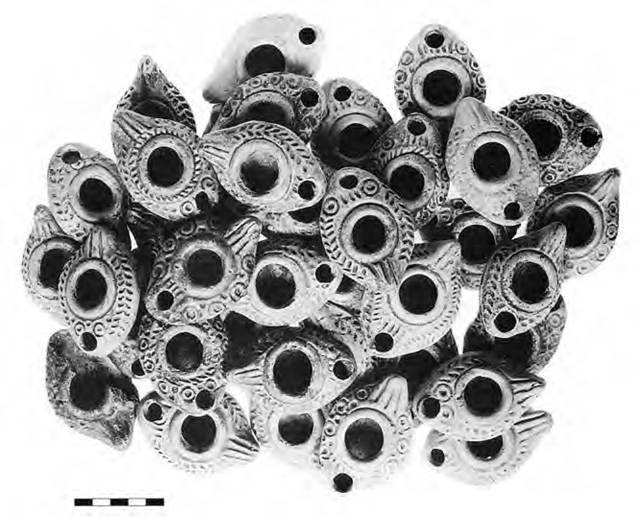
Figure 4. Group of lamps found in Area B at Hammat Gader; Uzzielli 1997, 321, fig. 1; used with the permission of the Israel Exploration Society.
identity of these inscriptions is unsurprising, given their postrenovation date, and other visitors may have chosen not to draw attention to their non-Christian status. Jewish names do appear on a couple of inscriptions, but in two of these cases, other names suggest that the family had recently become Christian, perhaps to maintain their administrative positions (Di Segni 1997, nos. 2 and 21).[342] Leah Di Segni argued that a third inscription does present a covert message of Jewishness, on the basis of the individual’s name and the multiplicity of available meanings for the XML acronym (no. 32). A final inscription that could be Jewish is Di Segni’s no. 38, on the basis of Semitic names and the use of a slightly different formula to introduce the inscription.
To gain a more complete picture of the bath’s patrons, we must look beyond these votive offerings. There is no doubt that the initial construction of Hammat Gader, completed in the second century CE, was a pagan endeavor and that it was frequented by pagans from the beginning.[343] Two possibilities have been raised as to the identity of those responsible for the monumentalization of the site.
While the original excavators did not uncover any clear indication of the exact circumstances surrounding its construction, they concluded that it was built by the local, Semitic population of Gadara (Hirschfeld and Solar 1984, 39). Estee Dvorjetski offers the alternative proposal that Roman soldiers, rather than local inhabitants, were responsible for the construction. The Roman army patronized local healing cults throughout the Mediterranean in large numbers, due in part to the harsh realities of life on a military campaign, and Dvorjetski (2007, 106) argues that the army allocated “considerable military resources” to the development of therapeutic facilities. The probability of the army's involvement at Hammat Gader, she contends, is augmented by numismatic and epigraphic evidence that places Legio X Fretensis in the area.[344] Furthermore, a story in the medieval rabbinic compilation Midrash ha-Gadol (Deut 26:19), which describes Emperor Hadrian meeting a girl covered in sores as he made his way from Hammat Gader to Gadara, is offered by Dvorjetski as additional evidence for an official Roman presence at the site. In response to Dvorjetski, the excavators of Hammat Gader concurred that army was stationed in the region of Gadara and that there could have been Roman influence on the bath alongside the efforts of the local population, but they questioned her conclusion that the army's presence alone proves that it was responsible for the bath's construction, since no evidence of this was discovered in the course of the excavations (Hirschfeld 1997, 478). Despite this disagreement regarding the role of the Roman army, the plan of the bath complex followed standard Greco-Roman models, and its pagan character should not be doubted.While Hammat Gader's use by pagan and Christian populations is widely acknowledged, Jewish patronage of the hot springs must still be addressed. Material evidence for a Jewish presence at the hot springs can be found in the impressive synagogues built in the immediate vicinity of Hammat Gader and Hammat Tiberias, the latter of which was located on the west side of the Sea of Galilee, roughly eighteen kilometers northwest of Hammat Gader.
Unlike Hammat Gader, where substantial architectural elements of the bath complex have been uncovered, little remains of the Hammat Tiberias baths. However, at both sites, evidence for Jewish patronage of the hot springs should be seen in the construction of nearby synagogues. The key point is that these synagogues were found in the immediate vicinity of the hot springs, rather than in the larger towns of Gadara or Tiberias, which had their own synagogues; in fact, Tiberias was said to have thirteen synagogues (b. Ber. 8a).[345] [346] Gadara and Tiberias were located at some distance from their respective baths, two and a half kilometers away in the case of Tiberias, and four and a half kilometers away in the case of Gadara, making it impractical for their Jewish inhabitants to attend the synagogues near the hot springs on a routine basis. While small settlements did spring up around both bath complexes, it seems unlikely that the impressive synagogues at Hammat Gader and Hammat Tiberias were built for their use alone. Instead, it is probable that these synagogues were built to accommodate Jewish visitors to the thermae.Inscriptions from these synagogues substantiate the presence of Jews among the visitors to the hot springs. The synagogue at Hammat Gader underwent major renovations in the fifth century to repair damage caused by the same earthquake that affected the bath complex, and its inscriptions consequently postdate this restoration. Four Aramaic inscriptions are extant in the synagogue’s mosaic pavement, each of which begins with the phrase, “And be remembered for good.../’ (nub "I’mi) (Sukenik 1935, 39-55). The names found in these inscriptions indicate that the synagogue attracted patrons not merely from Hammat Gader or Gadara, but from around the Galilee and the Golan.11 In addition, the inclusion of Roman and Greek names, female donors, and civic titles highlight the distinctiveness of this synagogue when compared to others in the region (Dvorjetski 2007, 310-11).[347] The diverse nature of these dedications can best be understood as the product of nonlocal visitors to the bath complex, who commemorated their quest for healing by making a dedication at the nearby synagogue.
The relationship between synagogue and bath complex is more visible at Hammat Tiberias. Some of the inscriptions from this synagogue are similar to those found in the bath complex at Hammat Gader. For example, the inscription from the west aisle reads, “May he be remembered for good and for blessing (μνησθή εις αγαθόν καί εις ευλογίαν). Profotouros the elder built this stoa of the holy place (του αγίου τόπου). A blessing on him. Amen. Shalom (Dlb^)” (Dothan 1983, 60-62).[348] As in the inscriptions from the bath at Hammat Gader, this example includes both the formulaic use of μνησθή and the reference to the site as a holy place (άγιος τόπος). The idea that benefactions to the synagogue were related to ritual healing at the hot spring seems more explicit in other examples from Hammat Tiberias. Eight inscriptions were found at the north end of the synagogue’s center aisle; in six of them, the patron's gift was connected to the fulfillment of a vow or prayer. For example, Maximos commemorated his visit with these words, “Maximos made [this dedication] because he vowed [it] (Μάξιμος ευχόμενος έποίησεν). May he live [long]” (Dothan 1983, 55-56). Of the eight inscriptions from the north end of the center aisle, only the two longer ones do not contain this reference to a vow, ευχόμενος, likely due to the space constraints. Given the location of this synagogue, it is likely that the vows in question were associated with the experience of miraculous cures at the thermae. Votive dedications were common at healing shrines and seem to be the best explanation for the inscriptions from both the synagogues and the bath complex. They testify to the sanctity of the site, and, I would argue, to the ritual nature of the cures that were sought in the hot spring.