Sites of ritual healing are known throughout the ancient Mediterranean world, particularly those related to the cult of Asklepios.
Famous Asklepieia at places such as Epidauros, Pergamon, and Kos existed alongside smaller sanctuaries and a network of local heroes who were also known for their ability to work miracles.
Amid the considerable scholarly attention devoted to these therapeutic sanctuaries, an interesting lacuna has emerged: the apparent dearth of such sites in Greco-Roman Palestine. This paper attempts to bridge that gap by examining the form that local healing cults took at the region's thermal-mineral springs. More importantly, I will argue that these sites were not strictly pagan, but that they were also frequented by Jews and Christians.[336] While it was not uncommon for sacred sites to be appropriated as power dynamics in an area shifted, and while this would eventually happen at the thermal-mineral springs, this paper suggests that multiple religious traditions coexisted at the baths before their ultimate Christianization. Despite this peculiarity, the form of ritual practiced at the baths was similar to that experienced in sanctuaries of Asklepios and other local healers across the Mediterranean. In other words, visitors took part in a type of ritual incubation wherein they would await the divine healer's appearance in a dream or vision. The idea of Jewish incubation for the purpose of healing deserves special consideration, as examples are not as widely known as they are in both pagan and Christian healing rites. In the end, I will suggest that what differentiated supplicants seeking miraculous cures was not the form of their ritual, but rather the identity of their divine healer.Palestine lies along a geological rift that stretches from eastern Africa to southern Asia Minor. The movement of the tectonic plates produced numerous hot springs in the region, of which eight are known from ancient literary testimonies: Emmaus-Nicopolis, Hammei Ba'arah, Hammat Gader, Hammei Livias, Hammat Pella, Hammat Tiberias, Kallirhoe, and the Waters of Asia.
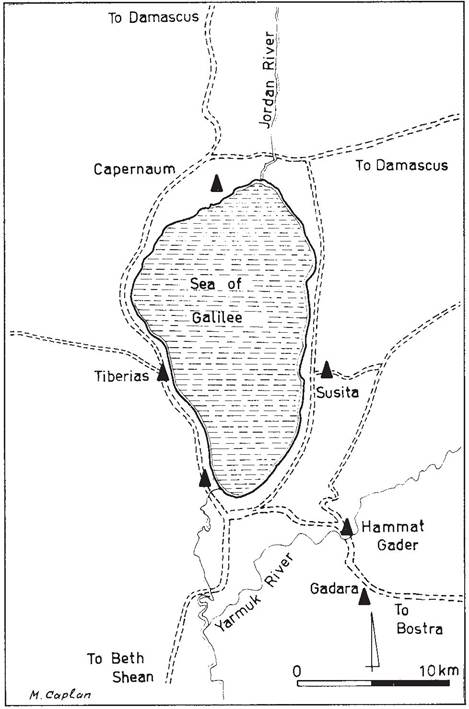
AllFigure 1. Map of area around Hammat Ga- der; Hirschfeld 1997, 1, fig. 1; used with the permission of the Israel Exploration Society.
but the last of these sites have been identified with a fair degree of confidence, and several have been at least partially excavated.[337] Beyond these physical remains, most of what we know about the thermal-mineral baths comes from a variety of Greek, Roman, Jewish, and Christian authors.[338] These literary sources indicate that visitors to the hot springs suffered from a wide variety of maladies, and that some of the thermae were particularly known to cure specific diseases. As we will see, ancient visitors understood the hot springs to be sacred, which suggests that they viewed any healing that they experienced at these sites to be the result of divine intervention rather than due to the mineral properties of the water. Scholars have long recognized the sanctity that was ascribed to these sites, but the way that visitors encountered the baths as sacred spaces is poorly understood.
Hammat Gader was arguably the most popular of the hot springs in the land of Israel, as well as the only one to be excavated and published systematically. The thermae were located within the territory of the Decapolis city Gadara, which was situated roughly four and a half kilometers away on a steep ridge (see figure 1). Excavations in the vicinity of the bath complex have revealed a synagogue and a church, a theater, and a residential area (Hirschfeld 1987, 107— 16). A colonnaded street ran from the Yarmuk River to the theater, where it intersected with a wider colonnaded street that went toward the bath complex. The bath was quite large, covering more than 4600 m2 (Hirschfeld 1997, 10). Along the southern side of the complex was a series of hot pools that culminated in the spring itself in the southeast corner.
On the northern side of the complex was a cold-water pool with a number of fountains and niches along its perimeter (see figures 2 and 3).The final site report for Hammat Gader identifies fragments of between sixty and seventy Greek inscriptions, most of which were professionally carved into the pavement of the bath complex (Di Segni 1997). These inscriptions unequivocally assert the sacred nature of the hot spring. Their language is quite repetitive, frequently including some variation of “In this holy place be remembered...” (έν τώ άγίω τόπω μνησθή), a phrase otherwise typically associated with temples, synagogues, or churches.[339] All of the inscriptions appear to postdate the fifth century reconstruction of the site following an earthquake. In 363 CE, a major earthquake struck Palestine, causing extensive damage that stretched from the Galilee to Petra. A letter attributed to Cyril of Jerusalem names Hammat Gader among the sites damaged by the earthquake (Brock 1977, 276). An inscription from the thermae’s Hall of Piers (Area C) commemorates the 455 CE completion of repairs and renovations, which included the new floors into which the Greek inscriptions were set. While there are no surviving inscriptions that date before this renovation, votive inscriptions were certainly not a new phenomenon in the fifth century, and there is nothing to preclude earlier dedications that were damaged or removed during the repairs. Stories about cures experienced at the hot springs should be read in light of these inscriptions from Hammat Gader, particularly their repeated references to the baths as a “holy place” (άγιος τόπος).[340]
A second category of finds from Hammat Gader also attests to the bath's sacred character. One hundred forty-eight complete oil lamps were found at the
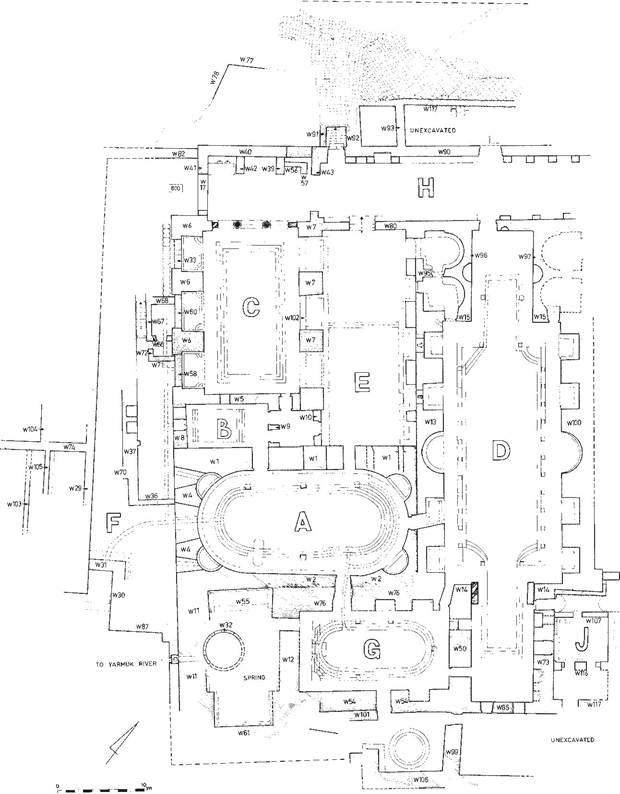
Figure 2.
General plan of Hammat Gader bath complex; Hirschfeld 1997, 12, fig. 11; used with the permission of the Israel Exploration Society.site, along with fragments from roughly two hundred additional lamps. Most of the intact lamps were located in one of two concentrations: sixty were found in locus 211 under a renovated floor in Area B, and another deposit was found in locus 441, an isolated alcove in Area D (Uzzielli 1997, 319). The deposition of these lamps all took place prior to the fifth century reconstruction of the site. While these lamps offer a somewhat less explicit testimony than that preserved
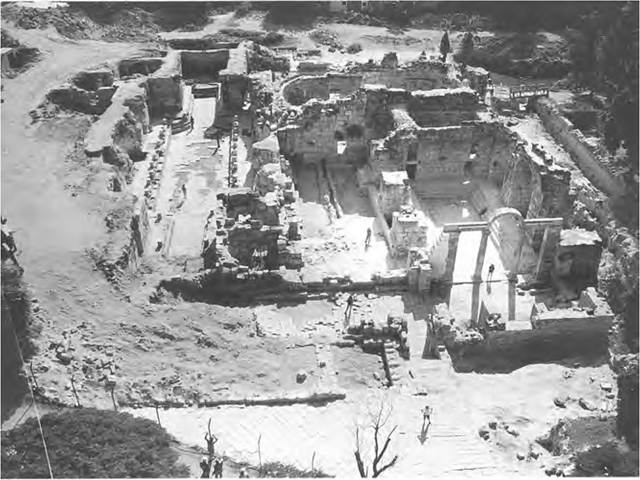
Figure 3. Remains of Hammat Gader at the conclusion of the 1982 excavations, looking south;
Hirschfeld 1997, 11, fig. 10; used with the permission of the Israel Exploration Society.
by the later inscriptions, their deliberate placement reflects a traditional desire to keep votive offerings in the sacred space. Many of these lamps do not contain the soot marks that would have been present if they had been lit even once (figure 4). This suggested to the excavators that the lamps were deposited as votive offerings, likely related to healing, rather than casually left behind after their use as functional lights (Uzzielli 1997, 319).