2 Indigenous Religions of North America
Jeffrey Brodd
California State University, Sacramento
Layne Little
University of California, Davis
Bradley Nystrom
California State University, Sacramento
Robert Platzner
California State University, Sacramento
Richard Shek
California State University, Sacramento
Erin Stiles
University of Nevada, Reno
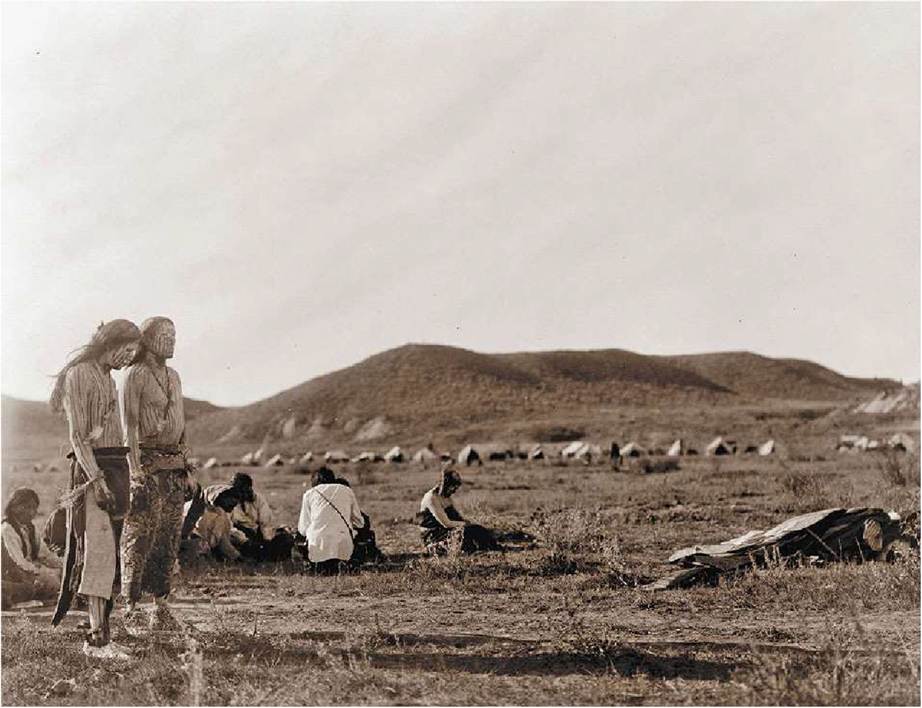
This photo from 1910 shows several Cheyenne people gathered in preparation for a Sun Dance ceremony.
THE HOT AFTERNOON SUN beats down on the eighteen men and women who dance in patterned formation in the midst of a circular enclosure. Caleb, a twenty-six-year-old medical technician from Rapid City, South Dakota, is one of the Eagle Dancers. Caleb and the others dance to the rhythmic beating of a large drum, their faces turned upward to the eastern sky. This is the sixth time this day that the group has danced, each time for forty minutes, each time gradually shifting formation in order to face all four directions, honoring the spirit beings of the East, the South, the West, and the North. One more session of dancing, later this afternoon, will bring to an end this year’s annual Sun Dance. The Sun Dance is a midsummer Native American ritual that spans nearly two weeks, culminating in four days of dancing. This Sun Dance, in the wilderness of the Pacific Northwest, is open to all participants —from all Native American nations and even non-Native Americans.
In the center of the circular enclosure stands a remarkable tree. Perhaps a hundred bundles of colorful cloth hang from its boughs. Its central limbs hold a branch of chokecherry, from which hang effigies of a buffalo and of a man. The cottonwood tree was carefully selected months in advance for this purpose, and then ceremoniously felled the day before the dancing began and carried many miles to be positioned at the enclosure’s center.
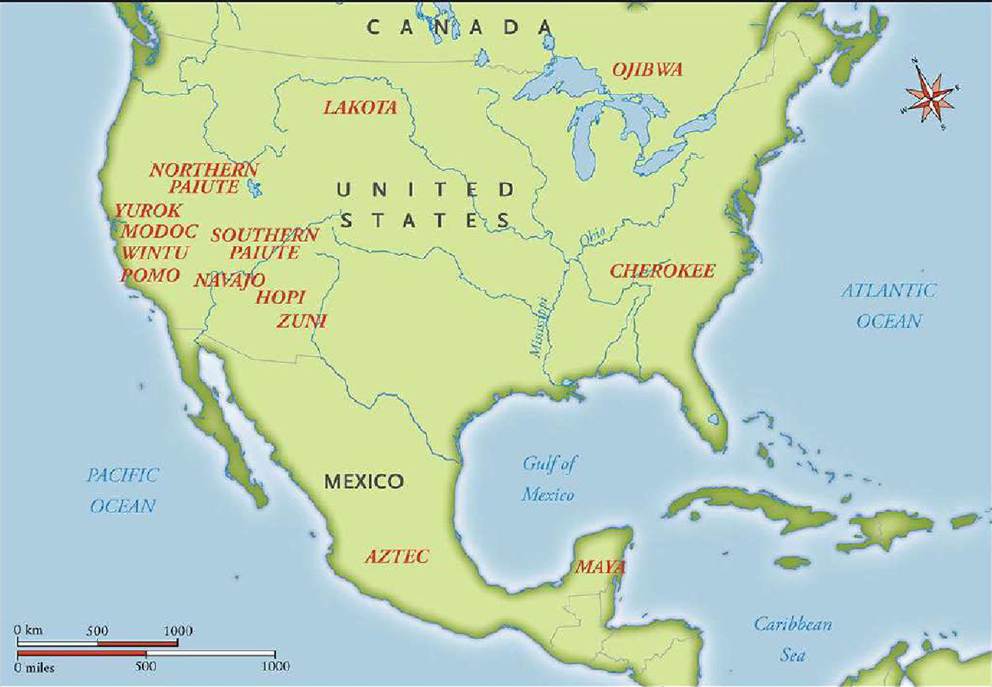
Indigenous peoples of North America that are discussed in this chapter.
Click here to learn more in an interactive map.
The tree’s significance for all those gathered at the Sun Dance can hardly be overstated. Due to the ritual of the dancing, the circle for these four days is sacred space. The tree stands at the center and marks the most sacred space of all. In fact, it is the tree that establishes the circle and defines the sacred space. Added to this is the significance of its verticaliiy. By reaching upward, the tree is thought to be the point of contact with the spirit world that connects the sacred expanse of the sky to the sacred space of the circle and to Caleb and the dancers. In every respect, the cottonwood tree is a kind of axis mundi (Latin, “the center of the world”), a symbol that scholars of religious studies and mythology have recognized in cultures and traditions globally. Planted in the earth, reaching skyward, and establishing the sacred enclosure of the Sun Dance, the tree is perceived by the participants as being the center of the world—and of reality itself.
Caleb is a member of the Lakota Nation, a people of the Northern Plains. Caleb is a special type of dancer known as an Eagle Dancer. He and the two other Eagle Dancers dance attached to ropes that are strung from the tree’s trunk and looped around skewers that were pierced through the skin of their chests on the first day of dancing. At the end of the fourth day, they will fall back on their ropes, pulling the skewers free from their flesh. This act is considered a sacrifice to the Great Spirit, or God, a gift of the one thing that is truly one’s own to give—one’s being. The Eagle Dancers spend almost the entire four days in the midst of the sacred circle, enduring the days’ heat and the nights’ chill, and taking neither food nor drink. Though he is a young man, Caleb has spent several years preparing for this Sun Dance, the first summer of three in which he will be an Eagle Dancer.
Training under the guidance of a Lakota healer, Caleb has practiced the difficult arts of fasting and enduring the heat.As the temperature hovers near 100 degrees, the dancers gradually complete this round. The challenges of the fast and the hot sun are especially daunting for the three Eagle Dancers. As the youngest and least experienced of the Eagle dancers, Caleb has difficulty enduring the harsh conditions and the rigors of the dance. He nearly faints on several occasions.
The Sun Dance incorporates many ritual features: the sounds of the beating drum, often accompanied by chanting of sacred words; the sights of the tree and the dancers; the smell of cedar smoke used to ritually purify the grounds and participants; and, for the Eagle Dancers, the experiences of fasting and the acts of sacrifice. The cumulative effects of these features are self-evident to Caleb and the others involved. The perception of sacred space, with the tree as the axis mundi, is complemented and enhanced by the perception of sacred time. The usual partitioning of everyday life is superseded by the ritualized stages of the dancing and of the ceremony at large. For Native Americans like Caleb, these effects tend to induce a state of heightened awareness of the spirit world—and of the Great Spirit, or god.
The Sun Dance has been practiced for centuries by many Native American tribes of the Northern Plains. Details have varied, depending on particular tribal traditions. The Sun Dance retains its importance today and is becoming more popular as Native peoples strive to rediscover and to nurture traditions rooted in the past. No one ritual, however important or popular, can exemplify the religious practices of all Native Americans. Still, the Sun Dance features certain elements—such as the axis mundi, the perception of sacred space and sacred time, and the communing with the spirit world—that are quite common to the religions of North America.
TIMELINE
North American Religions
| 1500 bce-200 BCE | Olmec period in Mesoamerica. |
| 600 BCE-300 CE | Zapotec period in Mesoamerica. |
| 300-900 CE | The Mayan culture is flourishing; elements of Popol Vuh seen in hieroglyphic script. |
| 300-400 CE | City of Teotihuacan reaches peak population of 200,000 people. |
| 700-1400 | Mississippian culture flourishes; the city of Cahokia is inhabited. |
| 900-1519 | The Mayan cities decline; major urban centers are deserted. |
| 800S-1100s | The first pueblos are built in the American Southwest. Pueblo cultures thrive. |
| 1100-1519 | The Aztec civilization thrives. |
| 1513 | The Spanish arrive in Florida. |
| 1519-1521 | The Spanish arrive in Mexico; Hernan Cortes. Collapse of Aztec Empire. |
| 1540s | The Spanish arrive in American Southwest. |
| 1607 | The English establish Jamestown. |
| 1700s | The Popol Vuh written in Quiche Mayan language in Roman script. |
| 1819 | The Civilization Fund Act is passed. |
| 1870 | The First Ghost Dance. |
| 1889 | Wovoka’s vision. |
| 1890 | The Second Ghost Dance. |
| December 29, 1890 | Tragic battle at Wounded Knee ends the Ghost Dance. |
| 1904 | The Sun Dance banned in the United States. |
| 1918 | The Native American Church is founded. |
| 1978 | The American Indian Religious Freedom Act is passed. |
| 1995 | The use of peyote is made legal for religious purposes. |
| 2016-2017 | Standing Rock resistance to Dakota Access Pipeline/NoDAPL resistance. |
Click here to learn more in an interactive timeline. In this chapter, we will explore the indigenous religions of North America. The chapter focuses primarily on the practices and beliefs of peoples in what is today the contiguous United States, and also draws examples from indigenous Canadian, Mexican, and Central American traditions.
Because these spiritual traditions are so numerous, we will not attempt to discuss them all but rather will select examples from a few. It is important to observe that these religions are not relics of the past. Although they are practiced on a smaller scale, they are not simpler or more basic than large-scale religions like Christianity, Buddhism, or Islam. Therefore, they should not be considered evidence of a “primitive” or less developed religious mentality. Rather, indigenous North American religions are highly complex systems of belief and practice, with sophisticated cosmologies and firm ethical principles. Although followers, like Caleb, certainly inherit ideas and practices from their ancestors, the religions are not simply copies of ancient religions. They have changed—and continue to change—in response to interaction with other belief systems, other cultures, and technological advances.Although we explore these religions together in a single chapter, it is important to note that there are many indigenous religions in North America. Today, more than 700 tribal nations are recognized in the United States alone. In the past, there were many more. The human landscape of North America changed dramatically with the arrival of Europeans. Prior to European contact, the population of the Americas as a whole was estimated to be as high as 100 million. However, due to disease and conquest, the Native population throughout the Americas was decimated, and it is likely that some religious traditions were lost forever.
There is much diversity in indigenous North American religious traditions, but there are also some common patterns in religious practice, teachings, and historical development. Ritual practices like the Sun Dance are found in many traditions. Also, many religions share the belief that the sacred coexists with and infuses everyday life. Similarly, many share a recognition of the interconnectedness of all things and thus emphasize the importance of reciprocal relationships between humans and other elements of the natural world. Also, although these religions each have individual histories, they have faced similar issues and events in early modern and modem times, particularly with the European conquest of the Americas.