IsIam as a Way of Life
What does it mean to be a practicing Muslim? What does one do on a daily basis? In this section, we discuss worship practice, the Islamic year and important holidays, and Islamic law.
We also explore gender roles and family life and the complex concept of jihad.VOICES:
An Interview with Dola K. and Tasiima S.
Dola was bom in Bangladesh and has lived in the United States since she was two years old. She is now twenty-seven and holds BAs in Anthropology and English and is studying for her MA in English with an emphasis in rhetoric. Taslima is twenty-four and recently graduated with a BA in Finance and Economics, and she plans to pursue another degree in International Business. Taslima moved to the United States from Bangladesh when she was sixteen years old and hopes to become an investment banker.
In your view, what is the essence of Islam? What should students understand about Islam?
Dola: For me, the first thing is the belief in a supreme being that is all powerful, allknowing, and has a hand in what happens in the universe. Islam is also about how you live your daily life according to guidelines and principles. To me, the essence of Islam is being a loving and kind person, and seeing the good in everything and everyone. Living your life with love is how I understand Islam. Islam is not homogeneous—it contains many beliefs, and many interpretations can be derived from those beliefs; how you practice it is personal, and I don’t believe it’s necessary for everyone to follow Islam in the same manner.
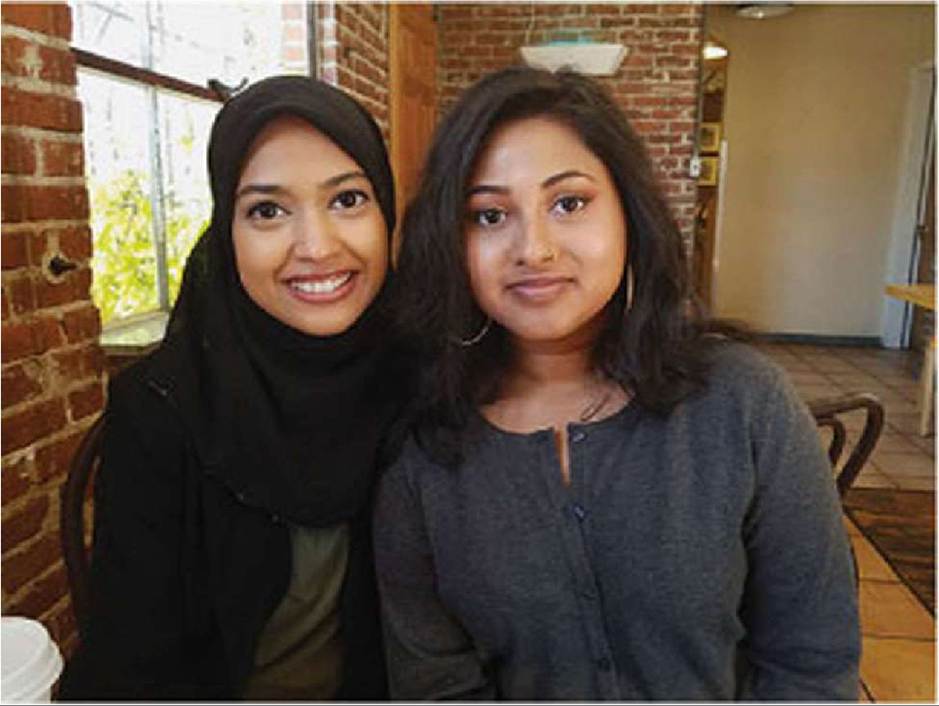
Tasiima S. (left) and Dola K.
Taslima: To me, Islam is a set of guidelines that helps you achieve your daily goals. Islam is kind of a reality check for me: I think that God will not give you what you do not work for. You have to work for your goals, and you earn your own dimes.
God never oppresses—rather, you oppress yourself if you do not take initiative. God told me I can be a businesswoman someday. Muhammad’s first wife was a businesswoman! She went to war, she was a merchant, she had her own values and her opinions. God did not oppress her, so who are we to oppress ourselves?What is humanity’s place in the world? How does being a Muslim shape your worldview?
Dola: Humanity’s place in the world is to help each other. Even though we live in this big wide world of billions of people, we should be one community. We should treat each other kindly and lovingly, and I think that is what Islam teaches.
Taslima: Islam stresses equality for all. To me, the main purpose of being a Muslim is that I have the opportunity to share with others. If I am eating one day and I see my neighbors are not eating, then I will be there forthem. Islam has taught me regardless of what other people’s point of view is, to be respectful and to harm no one because of their views. I have learned to see the best in people.
From your perspective, what is it like to be a Muslim in North America today?
Dola: In the current political atmosphere, I find that I am cautious of how I approach people. I have no problem admitting that I am Muslim, but it has made me more cautious about how I talk about culture, politics, and society. I haven’t experienced much direct discrimination, but members of my family have. But I also find that I am more accepting of others. Being Muslim in the US has helped me become more accepting of people who are different in other ways.
Taslima: I agree with you. You can’t always practice your religion by the book. A French imam recently argued that we need to reevaluate our religion in terms of Western culture. The adaptability is something I like about Islam.
When I started high school in the US in 2011, people would ask me if my father was Osama bin Laden. I would respond by joking about it. When I used to work at a fast food restaurant, someone once chanted “terrorist” at me in the drive-through.
I wear hijab in everyday life, but since I work at a very conservative place, I have chosen to not wear it at work. My family is not religious, but when I was a child I had a religious friend, and once I started learning more about Islam I decided to try wearing hijab. My parents were so upset!Dola: Oh, my parents would be so happy if I did! I don’t wear hijab, and nobody in my family wears hijab. I do speak Bengali out in public with my family, but I don’t have an accent; I have perfect American English. People don’t tell me to “Go back to where you came from!” But people have told my mom that because she has an accent.
What opportunities and challenges do you face as a young Muslim woman in the United States?
Dola: I often struggle with being who I want to be as a Muslim and who my family and culture want me to be as a Muslim, especially because my upbringing had such strong Western influences. I don’t really fit into the “ideal Bangladeshi Muslim” mold, and some of my values and morals clash with those of my family. For example, the subject of dating. It’s taboo in my family and culture, but as a young adult, I dated because everyone around me was dating, and I never thought there was anything wrong with it. And many Bangladeshi Muslims and Muslims, in general, date. However, I did ask my parents to arrange my marriage. My parents never pressured me about this, but they were so happy when I asked them to arrange the marriage. They never thought I would. And while my marriage wasn’t totally arranged (there was a little bit of dating involved), I’m now married to a Muslim Bangladeshi man who is more wonderful than I could have ever imagined.
Taslima: My family is more liberal, and are okay with us dating. They don’t think dating is bad, but they are focused on the future, and they want dating to lead to a long- lasting marriage. But they want me to finish my education first. My parents don’t want me to have to rely on a man.
Dola: My family holds Islam above our Bangladeshi culture.
But I think they are so intertwined that you can’t really tell the difference. I think religion should adapt to culture, not the other way around.Taslima: As American Muslims, we can adapt our religion. As an American woman, I have freedom to do what I want. Yes, I have my own religious and cultural views, but I am also an American. I want other Muslims to know that it is okay to be a Muslim and an American—it is never a bad thing to be an American. It is never a bad thing to be a woman of color, or a Muslim woman who is dating someone different. Your sexual orientation is not a bad thing. If you are a Muslim, you pray and you believe in the five pillars, and that’s it. I came to America to be an American, and I’m going to be the best possible American.
Dola: That’s how I feel. I can be Bangladeshi, I can be Muslim, and I can be American. I try to be an example for the younger girls in my community, and I tell them they can be themselves and stand up for themselves.
_________________________________________________________________________________________________________________________________________________________________________________________________________________________________