Islam and Social Justice
In the modern era, Muslims around the world have been active in social justice movements. In the nineteenth and first part of the twentieth century, many of these movements focused on anticolonialism and resistance to European imperialism.
Reformers of the time advocated a consideration of Islamic sources in light of contemporary problems and issues. They argued that traditional scholars had not focused as much on social welfare as Islam requires. A number of the reformers discussed earlier in this chapter, such as Jamal al-Din al-Afghani, Muhammad Abduh, Hassan al-Banna, and Sayyid Qutb, had a strong social justice component to their teachings and activism. In his writings, al-Afghani advocated that devout Muslims should be focusing on improving life in this world, rather than simply focusing on the next:Islam... is concerned with its believers’ interests in the world here below and with allowing them to realize success in this life as well as peace in the next life. It seeks “good fortune in two worlds.” In its teachings it decrees equality among different peoples and nations. (al-Afghani, 2007:19)14
Hassan al-Banna argued that it was necessary for Islamic societies to work for and maintain justice. A key part of this was the necessity of a moral approach to economics, and the Muslim Brotherhood emphasized Islamic economics as a means to ensure social justice. Sayyid Qutb, also a member of the Muslim Brotherhood, wrote a book called Social Justice in Islam (1948), in which he argues that Islam is inherently concerned with earthly matters and “prescribes the basic principles of social justice” (1948), which are built on freedom of conscience, equality, and mutual responsibility in society.
Since the early twentieth centuiy, gender justice has been a focus of many Muslims around the world. Many Muslim feminists have sought paths to gender equality that diverge from Western models.
In their view, Islam itself provides the necessary means for women to achieve equality, and thus there is no need to follow a Western model. Many argue that the Qur’an must be reinterpreted in an attempt to eradicate cultural practices that are detrimental to women but have been justified as appropriate Islamic practice. Some have argued that women’s status would be much improved only if Islamic laws were properly followed. Some Muslim women in recent decades have reembraced modest dress as a feminist statement. In Egypt, this idea became prominent in the 1980s, and many mothers and grandmothers who had consciously decided against wearing veils or headscarves were dismayed that their daughters were wearing them, ironically with the same rationale their grandmothers used to discard it.Muslim feminists differ in their approaches to Islam. The Egyptian feminist Zaynab al-Ghazali (1917-2005) advocated increasing women’s rights and improving women’s status through Islam. Nawal al-Saadawi (1931-2021), also Egyptian, maintained that women can achieve equality only by rejecting what she views as the patriarchal tendencies of religion. Al-Saadawi was both a medical doctor and a writer, and her novels and stories have been both influential and controversial in the Arab world because of her focus on feminist issues and problems facing Arab women. Dr. al-Saadawi was active in the 2011 Egyptian revolution that overthrew the thirty-year presidency of Hosni Mubarak.
In the twenty-first century, gender justice efforts have often focused on reforming Islamic family law as it is applied in practice. In the early 2000s, Egypt, Jordan, and other Muslim- majority Arab countries made state-level changes to divorce law to permit no-fault divorces initiated by women through a divorce procedure known as khul‘; Pakistan had done something similar in the late twentieth century. Other states have limited or prohibited men’s rights to unilateral divorce, known as talaq. In 2017, the Indian Supreme Court banned what is known as “triple talaq,” or an instant divorce by repudiation.
Although women’s rights organizations lauded this, when the Supreme Court also criminalized triple talaq in 2019, many interpreted this decision as discriminatory against the Muslim community.As noted earlier, most African American Muslims are not members of the Nation but are rather Sunni Muslims whose beliefs and practices are like those of other Sunni Muslims around the world. Many American Muslims today are either immigrants or the descendants of immigrants. Like all immigrants to the United States, Muslims have come in waves from many parts of the world; most are from the Middle East, South Asia, Southeast Asia, and Iran, though others came from eastern Europe, Africa, and elsewhere. In the late nineteenth century, people migrated from the Middle East, namely, Syria, Jordan, and Lebanon, to the Americas for economic reasons. Most of them were uneducated, and most were single men. This resulted in much intermarriage between these Muslim newcomers and people of varied cultural and religious backgrounds.
In the middle of the twentieth century, Muslim immigrants began to come from other areas of the Middle East, the Soviet Union, and eastern Europe. Many in this wave of immigrants were educated and from wealthy families, and many had a great interest in assimilating to the wider American population. In later years, Muslim peoples came to the United States from South Asia, Iran, and other parts of the world. Many in this most recent wave have had less interest in assimilating to mainstream American culture, instead hoping to preserve their cultural and religious heritage.
GLOBAL SNAPSHOT
Muslims in the West
Islam is truly a global religion. Through population growth, Muslims are becoming a significant religious minority in the United States, Canada, and Europe, and are playing an increasingly important public role. In 2006, the United States saw the election of the first Muslim member of Congress, Representative Keith Ellison of Minnesota.
Mr. Ellison remained in Congress until January 2019, when he became the Attorney General of Minnesota. In 2018, the United States elected two Muslim women to Congress, Representative Rashida Tlaib of Michigan and Representative 11 han Omar of Minnesota. It is notable that Ms. Omar follows Mr. Ellis as the second Muslim elected to Congress representing Minnesota’s 5th district, which is predominantly Christian. In 2015, eleven Muslims were elected to the Canadian Parliament—the highest number ever. Muslim politicians are also increasingly prominent in the United Kingdom and Europe. In 2020, the mayors of both London and Birmingham in the United Kingdom are Muslim, as is the mayor of the large Dutch city of Rotterdam. However, as with many immigrant groups before them, immigrants from the Muslim world face challenges in Europe and North America.In the United States, Muslims are not only a religious minority but also must contend with the added difficulty of an American population that does not know much about Islam except for unflattering stereotypes. In the aftermath of 9/11, North American Muslims faced suspicion and hostility from their non-Muslim neighbors. Some nonMuslim Americans mistakenly viewed the terrorist attacks as representative of Islam and Muslims and, in turn, targeted Muslim communities, breaking windows in mosques and threatening teachers at Islamic elementary schools. In 2010, a controversy about the building of an Islamic center in lower Manhattan turned especially heated. Many nonMuslim Americans were vehemently opposed to the center because it was a few blocks away from the site of the September 11 attacks on New York.
Despite these difficulties, many Americans have expressed increased interest in understanding other faiths and cultures—particularly Islam. Also, many American Muslim individuals and communities have made concerted efforts to educate other Americans about their faith, beliefs, and religious practices and to explain that the vast majority of the world’s Muslims regard terrorist acts as distinctly un-lslamic with no basis in the faith. Through these outreach efforts and the efforts of non-Muslim Americans to understand Islam and Muslim peoples and cultures, meaningful religious diversity in the United States may become possible.
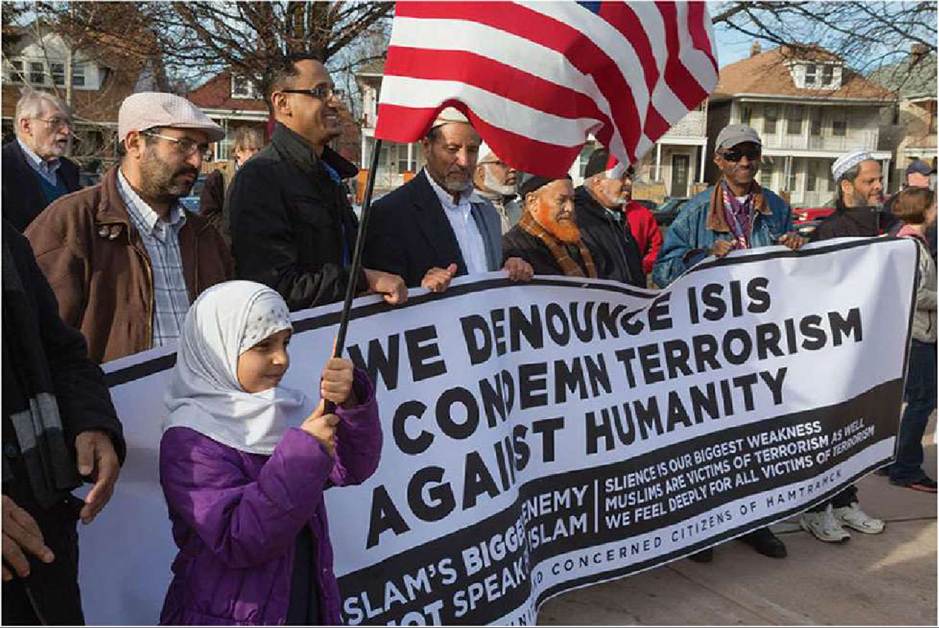
In 2015, several hundred members of the Muslim community of Hamtramck, Michigan, rallied at City Hall to condemn terrorism and ISIS.
Self-Assessment 13.2
[Please note: You must be using an online, browser-based eReader in order to view this content.]