Islam in India
Islam came to the Indian subcontinent within decades of its birth. Arab merchants had been trading along the west coast of India even before the advent of Islam. Now, the Arab traders were Muslims.
Increasingly, some of them settled along the southern and western coast, married locally, and formed pockets of Islamic culture interacting peacefully with their neighbors. These settlements were entirely pacific and interactions with neighbors remained virtually without conflict even into the recent past. There were also constant interactions with Muslim traders and craftsmen from Turkey and Central Asia in such areas as Northeast Panjab, Kashmir, and Eastern Bengal from the eighth century on. Many of these “foreign” artisans had settled permanently by the thirteenth century. There was also at least one military incursion, however - that in the area of Sind: Muhammed Ibn Qasim, pursuing pirates who had plundered an Arab ship, led an army of 6,000 against Qahar, king of Sind in 711. Within three years he had established hegemony in the Indus Valley region (much of the area that is now Pakistan).It was the military incursions of Afghans that in hindsight have haunted Hindu-Muslim relations in recent years. The first of these invasions was that of the armies of Mahmud of Ghazni in the eleventh century. There are many varied interpretations of Mahmud’s activities in India. It appears he first entered to rescue some Turkish soldiers and craftsmen who had been “enslaved” and to retrieve payments for elephants and equipment, which had been promised by Raja Jaipal. It is also apparent that, in India, his armies plundered and razed temples and decimated Buddhist institutions. His motives appear to have been for profit, personal glory, and filling the coffers of his capital.3 Yet sources in Persia and Central Asia, by the thirteenth century, were rhetorically praising him as a “great sultan” whose conquests were consistent with the earlier caliphs and were done in the name ofjihad.
Originally, jihad had connoted the act of carrying out the will of Allah and preparing oneself and the world for submission to Allah. However, under the caliphs jihad became an excuse for “just war” against those who resisted conquest and it was eventually included in the legal codes as such.4 Hence, for some Persian rhetoricians, Ghazni was engaged in jihad for the conquest of infidels in the name of Allah. On the other hand, even al-Biruni, the Muslim astronomer who had been brought into India by Ghazni and wrote descriptions of the Indian religious and scientific landscape, spoke of the sultan as having engaged in insensitive excess, of having “utterly ruined the prosperity of the country,” and breeding an “inveterate aversion towards all Muslims.”5 At the least, Ghazni’s (or subsequent rhetoricians’) use of Islam to justify his raids was a classic case of “civil religion,” the use of religious rhetoric in support of political action.While Mahmud of Ghazni had no long-term plans to establish hegemony in India, another Afghan raider did. A century later Muhammed of Ghor, perhaps less controversial than Mahmud, nonetheless began to combine military engagements with alliances to extend his political control southward. Because a political and religious vacuum existed, especially in the border regions of the north, a result, in part, of centuries of infighting and regional skirmishes, Ghor was able to establish hegemony in Northwest India. His successor appointed as regents in Delhi members of his court who had been taken as “slaves” and trained for administration. These “slave kings” were to establish the first of four Delhi sultanates.6 While this sultanate lasted only from 1206-90, it was powerful enough to fend off the brunt of Mongol expansion in the thirteenth century. Though the Mongols came to the fringes of Northern India, they marched rather into the Middle East burning cities and turning mosques into horse stables. Baghdad was sacked as blood literally flowed in the streets.
One of the results of the Mongol thrust westward was the migration of Muslims from the Middle East to a “safe haven,” namely, to a place with a sultanate where they could feel safe. The Islamic era had become a fixture in much of North India.The political context
Three separate sultanates followed the slave kings: the Khaljls (1290-1316) only ruled for twenty-six years, but in that period fended off the Mongols twice.7 Their hegemony was largely on the boundaries - for example, Bengal, Kashmir, and Panjab. The Tughluqs followed (1320-88). It was they who established the tax (jizyah) on those who were not Muslims (dhimmis). This had been a policy in the early Islamic caliphates - the hierarchy usually had put Arabs at the top (and usually members of the Quraysh tribe at that); non-Arab Muslims next, and dhimmis last (a term then applied to nonMuslims who were “followers of the book” - that is, Jews and Christians). This group was generally permitted autonomy in Islamic polities, so long as jizyah was paid as an indication of one’s recognition of the hegemony of the political ruler. The Tughluqs proved to be weakened rulers. Muhammed bin Tughluq, for example, was a relatively free thinker, influenced by the logician Ubaid, who was for that reason opposed by ideologues of the ‘ulama ‘ who feared loss of power. A severe famine from 1355-42 also weakened Muhammed’s hand.8 Among the results of these measures was that the sultanate came to be divided. Mongol armies were able to enter the domain during the Tughluq period and plundered Sind and Gujarat. Later yet (1398) Tamerlane of Central Asia invaded Delhi and pillaged and plundered in his wake.9 The Tughluqs were eventually followed by the Lodis (14511526). By this time more Hindus were learning Persian, the language of the courts, and were moving up in the power hierarchy. Some of the Lodis continued to make alliances with Hindu princes in the outlying regions, following a strategy of governance the Tughluqs had initiated - that of establishing regencies to govern on their behalf on the fringes of the sultanate.
The Lodis also patronized Hindu arts and culture and combined Islamic and Hindu notions of kingship to bolster their legitimation. The Persian word huzUr - “sacred presence” - that is, Allah’s sanction in the court, was used to give divine sanction to the sultan.10 The political leader thus also was a sacred leader. In the meanwhile, on the outskirts of the sultanate, outlying ministers were paid to maintain order and allegiance, while officials were appointed by the sultans to administer the land and see that taxes were paid by landowners. (These officials came to be known as zamindnrs after the Mughal period and represented a practice continued by the British.) In fact, at least one new caste group was established at this time: the kayasthas, a non-Muslim caste which was skilled at writing, knew Persian, and did the bookkeeping in the courts.The Mughal dynasty which followed brought Indo-Islamic culture to its apex.11 Established by Babur in 1526, the Mughals increased the exchanges between Persia and India and made Delhi one of the most important centers of culture in Asia. By the mid-sixteenth century at least, Delhi was a major center for libraries and learning. Medicine flourished thanks to the combining of Arabic and Indian forms of medicine. Delhi housed at least five observatories.12 Indo-Islamic forms of architecture, music, and dance flourished, practiced by Muslim and Hindu alike. Akbar (1556-1605), Babur’s grandson, was, by most measures, a ruler of great skill and sensitivity. As a boy, he was open to Shiite teachings and the mysticism of Persian poets. Early in his reign, however, his advisers were Sunnis, some of whom persecuted Shiites, thereby incurring the emperor’s wrath. This led to his sacking the Sunni advisers and replacing them with Sufis.
In 1562 Akbar married a Rajput princess and the tenor of his reign was set. He was a charismatic leader concerned more with efficient organization than with Islamic orthodoxy.
The result was an efficient central authority; the appointment of various local leaders, including many Hindus to be “governors” in outlying areas; and a minimum of corruption. Akbar’s authority was enhanced by several other developments, including the increased manufacture of paper, which increased administrative efficiency; enhanced travel and income from European merchants; and the death of Iran’s Shah in 1522, encouraging Akbar to declare his sovereignty over a wider area. His religious perspective was eclectic, trying the patience of the Sunni ‘ulama He permitted Hindu practices within his court, including certain festivals, patronized Hindu arts and culture, and encouraged translations of such texts as the Artharva Veda, Ramayana, and Mahabharata. With mixed success, he sought to abolish certain “excesses”: child-marriage; large dowries; and the immolation of widows (sati). He was known to have presided over inter-religious discussions in his court, in which Hindu pandits, Jains, Zoroastrians, even Catholic priests from Goa participated. He finally created his own sect in 1585: Din-ilahi (“Divine Faith”), known for its eclectic character and for making him the center of the sect and thereby further legitimating his status as emperor.His son Jahangir (1605-27) decentralized the administration he inherited and increased the influx of Persians and Persian art and culture during his reign. His bureaucracy grew rapidly, expenditures increased, as did corruption. He was far less tolerant than his father of other religions as he patronized Islamic institutions more and restored the conservative ‘ulama ‘ to the role of court advisers. He was known to have persecuted Jains and to have had the Sikh guru Arjun executed in 1606. Jahangir, who had bestowed honors on certain Muslim dignitaries, nonetheless distrusted Sikhs (who had supported an uprising against him), and Sikhs indeed became increasingly alienated from the Mughal court. (A more systematic discussion of the Sikh movement will follow in the next chapter.)
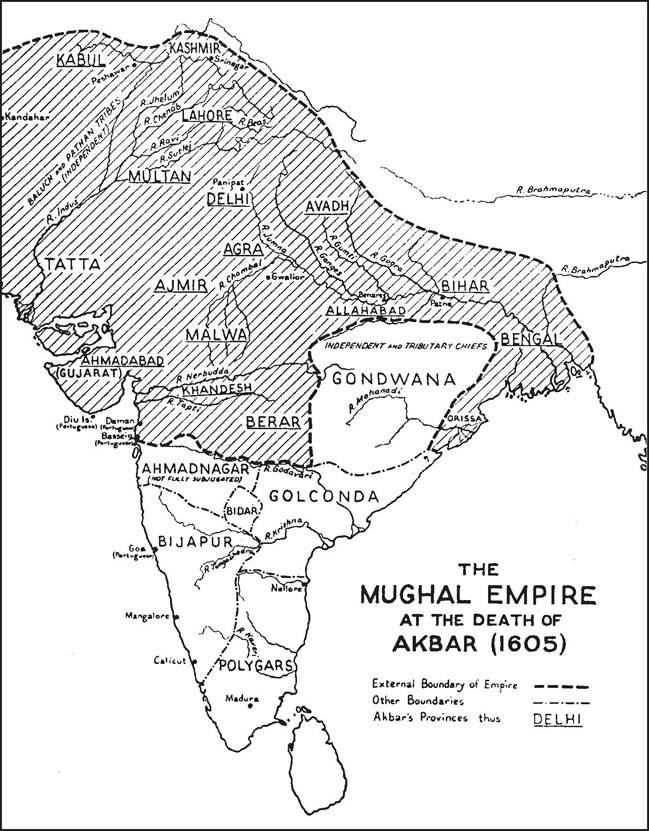
Map 4 The Mughal Empire
Reprinted from A Cultural History of India, ed.
by A. L. Basham (Clarendon Press, 1975), p. 591, by permission of Oxford University Press.Shah Jahan (1628-58), a good administrator, became the patron of Indo- Islamic art and architecture at its peak. He built the Taj Mahal as a memorial to his wife and the adjacent gardens as a replica of paradise. He was responsible for other tombs and forts. The architects for these projects were generally Muslim and the craftsmen Hindu. Some of the alliances with Hindu princes were restored and the empire extending into Kashmir and into the Deccan was maintained; yet his military power began to wane and the treasures of the court were increasingly depleted.
His son Aurangzeb (1658-1707) marks the last of the significant Mughal rulers. Putting his own father under house arrest and usurping the throne, Aurangzeb proved to be less flexible as a ruler. Most historians are not kind to Aurangzeb as it seems he was more interested in Sunni orthodoxy than in administrative flexibility. He turned to the ‘ulama ‘ for legitimation and sought to make the state more nearly “Islamic.” He was known to have assassinated yet another Sikh guru, to have broken alliances with Hindu leaders, and to have banned Hindu customs and music in the courts. He also found himself trying to retain Mughal power against several forces at once: Marathas, Sikhs, and Afghans, for example. This continuous fighting in the Deccan managed to drain the treasury; he even moved his capital to the Deccan - to the town now known as Aurangabad in an attempt to control the Marathas. He abolished any taxes which were not explicitly required by Islamic law (sharl‘a) and reimposed the jizyah tax in 1679. The result of his policies was fragmentation in the empire, disenchantment by formally aligned sub-rulers, and the permanent weakening of the Mughal line. After Aurangzeb’s death in 1707, the Mughals were effectively powerless even though they retained modest hegemony in Delhi itself into the nineteenth
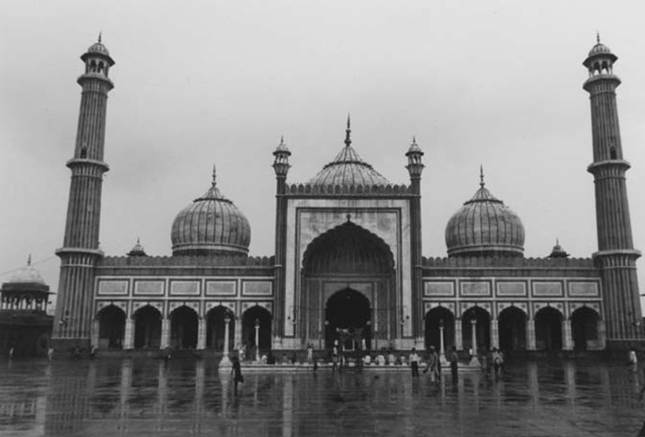
Figure 5 Jama Masjid, Delhi, the oldest and largest mosque in India. Photograph by Rob F. Phillips.
century. In fact, in 1739, the Persian Shah sacked Delhi and the era of Islamic power in India was at an end.
This brief sketch of the political landscape under Islamic rulers suggests several realities of the period. Islamic polity took many forms - there was no single policy toward subjects. Further, almost invariably, the hegemony was really only strong at the center; the further one went from the center, the less the control. Considerable autonomy and flexibility existed within certain of the sultanates and during much of the Mughal period. Certainly, there were military skirmishes, but these were almost invariably political in nature - Muslim princes against Muslim princes; Hindu princes against Hindu princes; Hindu mercenaries fighting in an army on behalf of a Muslim prince and vice versa. While the chief advisers in the courts were often Muslim, Hindus were increasingly employed and even the Muslim advisers varied from different schools of Sunni to Sufi character, from orthodox to eclectic.
Diversity of Islam in India
It is clear that Islam in the subcontinent was not monolithic. We turn now to something of the diversity and character of Muslim communities in India. To begin, there were clearly several cultures and languages that migrated into India. Arab merchants brought Arabic language, but Arabic patterns of governance were also applied, particularly in the early sultanates. More importantly, Arabic was the language of the Qur‘an, hence the language of orthodoxy, and the language taught in the madeasas (schools) when individuals and communities sought a sense of rootedness and identity, particularly in the period of the first several generations of migrants. Turkish and Afghan “culture” tended to the language of warfare. Turkish warriors were less cultured, yet Turkish soldiers were being employed even by Hindu princes as early as the ninth century. These soldiers of Turkish background continued to live on the subcontinent and tended to mingle with the “common” folk and effect exchanges of vocabulary and customs. The Persian cultural stream was the most significant influence in the courts especially by the fifteenth century when language, music, architecture, and other arts experienced the influence of Persian motifs. There was also some “exporting” of cultural forms into Persia.
Sunnis
But Indian Muslim communities have showed great diversity in their religious orientations as well. The Sunnis, for whom interpretation of Islamic law (shari‘d) depends on the councils (‘ulama‘), are one of the forms of Islam in India. But there were at least four different schools of Sunni interpretation of which the two most liberal are to be found in India: the Hanafis and the Shafi‘is.
The Hanafis were traditionally the most “rationalistic” of the interpretive schools. Influenced by Aristotelian philosophy, they argued that revelation was to be tested and verified by reason. Somewhat pragmatic, their ‘alama's tended to be less strict in interpreting the hadith. The Hanafis were the school of choice in the heyday of the ‘Abbasid caliphate in Baghdad in the mid-ninth century. It was the Sunni school most commonly associated with the Mughal court. Further, many South Indian Muslims today identify themselves as Hanafi Sunnis without knowing the nuances of what that entails. In fact, each ‘ulami‘offered its own particular consensus (ijma‘) in interpreting the tradition, building on rulings from the past. Each region in India could have several ‘alamo's and hence several possible interpretations of the tradition. It should be noted that, at least by the seventeenth century, lay Indian Sunni Muslims were less likely to look to Mecca or Persia or the Middle East for their interpretations of Islamic practice - they looked rather to their regional ‘ulama‘s, that is, to councils in Tamil or Bengali areas, for example.
The other major Sunni school on the subcontinent was the Shafi‘is. The Shafi‘is were more conservative than the Hanafis. Originating in Egypt, the Shafi‘is tended to mediate between the Hanafis and the more conservative Sunni schools known as the Malikas and the Hanbalis. The Shafi‘is emphasized the hadith (the works and actions of the Prophet) as the basis for Islamic practice, yet argued that critical reasoning was appropriate in specific circumstances when “reasonable” rulings were needed. Relatively pacific in their understandings of the shan‘a, they tended to be more scholastic or neo-classical in their interpretations. More specifically, the Shafi‘is had contributed several principles to Islamic jurisprudence, most importantlyfiqh (“intelligence”), which indicates the importance of linking reason to the intimations of the Qur‘an and hadith, and ijma‘(“consensus”), which indicates the importance of making decisions through the consensus of the ‘ulama ‘ - the specialists in legal interpretation.13
Shl'ls
Shiism is a second major form of Islam on the subcontinent. Shiites, of course, were those who considered the imaim the appropriate interpreter of the Qur‘an and hadith in both religious and political matters. Two schools of Shiites, in particular, influenced the subcontinent. The Ithna ‘Asharis, also known as the “twelvers,” started in Persia but were found in Mughal India and in such centers as Lucknow. The Ithna ‘Asharis believed that in 878 ce the twelfth imam withdrew from the world, but would return in order to purify the world at the end of history.14 The Shiites in India were not averse to following forms of Islam not considered appropriate in classical Islam. These Shiites, for example, believed in the efficacy of pirs who could have been folk heroes or spiritual masters, even after death. The tombs of pirs, known as dargahs, became centers of worship, and pilgrimage focused on such sites on festive occasions. The most significant commemorative event for Indian Shiites has been Muharram, the anniversary of Husain’s assassination, when mourning and family gatherings mark the occasion. Shiites also tended to observe more sacred days than the Sunnis, including special events in the life of Muhammad. But both Sunnis and Shiites in India have made a feast (id) of Muhammad’s birthday and have incorporated a number of Indian customs into their rites of passage and ritual life. It is also not uncommon to find Muslims, and especially Shiites, sharing a pilgrim site with Hindus on the grounds that some Muslim saint had performed a significant act at that place. New sects of Shiism, indigenous to the subcontinent also appeared. One such movement was that known as the Ahmadiyah movement.15 Its founder declared himself to be the Mahdi who had returned and the prophet (rasal) for a new time. The Ahmadiyahs claimed thatJesus had survived persecution, and had fled to Northwest India where he eventually died. In short, the Shiites and their imams in India tended to incorporate folk and indigenous elements into their religious orientation.
The other major branch of Shiism has been the Isma‘ilis, also known as the “seveners.” They claimed that the eldest son of the sixth imam was the appropriate successor of the interpretive tradition (the ‘Asharis had claimed that the younger son of that imam was the correct one).16 Once strong in Egypt and anti-‘Abbasid, even militantly “nationalistic” in their approach, they spread into Gujarat in Northwestern India, where they indigenized and took on various forms of the Indian cultural landscape. The Isma‘ilis split into several groups, each group following a different imam. In recent decades, many Isma‘ilis have come to be very progressive and highly educated, taking leadership roles in a number of Indian cities.17
Sufism
The third major form of Islam impacting the subcontinent was Sufism, perhaps the most generally liberal and most influential of all these movements. Sufism had its start in the deserts of Arabia where it grew as a parallel movement to the rise of Islam. In the early stages of the movement, Sufis often thought the Caliphs to be corrupt and/or unresponsive to the best intentions of Islam and often differed with the ‘ulamd‘s as to the appropriate interpretations of Islam. Given to a mystical lifestyle, Sufis insisted that Allah could be found within one - that he was accessible and to be enjoyed. SUfi mystics practiced a quiescent asceticism characterized by experiential wisdom and ecstasy. The mystical experience was often expressed in terms of the metaphor of love and the dawning of an inner illumination, both deemed to be gifts of the divine. Both women and men had been attracted to the movement. Among the most notable were Rabi‘ah, a woman born of poor parents in Basra, Iraq; the Persian al-Hallaj, who was executed in Baghdad in 922 for declaring himself to be one with Allah; al-Gazzali (1058-1111), scholar and theologian who made the mystical experience an acceptable part of Islamic practice; and al-Rumi (1207-73), the great Persian poet and mystic.18
By the tenth century, some Sufi orders were emerging in Iran that were influenced by Buddhism,19 just as prior to that Sufis had incorporated Christian and Jewish practices. A Sufi order would develop as seekers gathered around saintly leaders known as sheikhs and spent some three years receiving instruction. Several such orders entered India, the most widely spread of which was the Chisti order. Some came to flee the Mongols; others came at the invitation of Islamic sultans on the subcontinent and came to serve a role similar to that played by brahmans under “Hindu” kings. That is, Islamic rulers sometimes “imported” Sufi leadership to help integrate the prince’s central administration. They were, for the most part, eclectic and non-confrontational. The construction of tombs to pirs served a purpose similar to the construction of earlier temples by Hindu rulers. It localized religious fervor and gave a sanction to the ruler involved. As a result, in many settings, Sufi leaders enjoyed patronage of Islamic rulers: they were the educators, often teaching Persian as the lingua franca in the Islamic courts of Islamic rulers, but they also learned the local languages; they made connections with the common people and served to legitimate the state.20
Not all Sufi sheikhs were politically engaged. Those who “dabbled” in politics were known as ‘ulama‘-al-dunya. When Akbar, for example, got rid of his Sunni ‘ulama, he installed ‘ulama-al-dunya, as his ministers. Such Sufis also served in the courts of Deccan rulers. Those who sought purely spiritual roles were ‘ulama‘-al-akhara. Such were the Chistis at first, who eschewed political roles. A third group was the ‘ulama‘-al-sin, who were informally consulted by rulers on occasion.21
Quite apart from their political role, Sufi sheikhs had a significant religious role in the shaping of Islam on the subcontinent. Religiously, Sufis followed some ten principles. 1) Repentance was to be done in several stages and included an emptying of self-orientation. 2) Abstinence from materialism implied refraining from unnecessary accumulations of possessions, as well as living simple lives. 3) Piety entailed focusing on the sovereignty and accessibility of God. 4) Once one is ready, one takes a vow of poverty - to possess nothing other than what is needed as daily necessities. 5) Patience was a requisite part of self-discipline. 6) Gratitude for the mercies of God was accompanied by: 7) The fear of God. 8) Hope is the expectation of filling by the Divine nature. 9) Contentment with one’s spiritual stature is followed by 10) submission to the Divine will. At this stage it was believed God had now filled one’s person with the Divine presence. In a sense, one had become Allah and Allah had become one.22
Such an affirmation was not always popular with the orthodox Sunni ‘ulama‘ and, on occasion, Sufi interactions with the ‘ulama‘ were prickly. While some Sufis remained on good terms with orthodox Islamic ‘ulama‘s, others were more eclectic. Indeed, many Sufis borrowed freely from certain forms of Hindu devotionalism (especially from the Natha sect of Saivism and from Vaisnavism).23 They appropriated indigenous musical forms, even came to create their own indigenous forms of music, known as the ghazal. In fact, insofar as Sufi sheikhs lived in areas where Buddhism had been decimated and Hinduism underdeveloped, the sheikhs were found to be attractive spiritual leaders and teachers by common folk, who scarcely cared as to the religious label they or their guru had. Needless to say, this eclectic form of Sufism attracted followers in such areas as Kashmir, Bengal, and Panjab and was also instrumental in carrying the message of Islam into Southeast Asia.
It is clear from this sketch that Islam took many forms on the Indian subcontinent and a Muslim in India could assume many identities at once. A Muslim could be a Hanafi Sunni Muslim, but she may celebrate festivals of the Shiites and rites of passage that reverberate with the customs of her Hindu counterparts. She may have visited the local dargah and Hindu women may have done so too; she may have visited a pilgrimage site where Hindus also went. Not only that, Muslim families usually continued to speak the vernacular language - for example, Tamil or Bengali; and may have identified themselves by occupations that virtually assumed the character of a caste - for example, rowthers (growers) or panjankutis (cotton-spinners). In fact, many converts to Islam retained their caste identities. These Muslims may even have come to affiliate themselves with a Sufi order or pir or Sunni council (‘ulama‘) that represented the place of their birth and upbringing. Those local and regional identities often took precedence in Muslim families over any “global” or transnational religion called Islam. It is impossible, as a result, to speak of any single form or strategy that characterizes Islam in India. But by at least the sixteenth century and, in many cases, much earlier, Islam was a fully “Indian” phenomenon.
Recommended reading
Islam in India
Agrawal, C. M. Akbar and His Hindu Officers. Jalandar: ABS Publishers, 1986.
Alam, Muzaffar. The Crisis of Empire in Mughal North India, 1707—1748. Oxford and Delhi: Oxford University Press, 1986.
Asher, Catherine. Architecture of Mughal India. Cambridge: Cambridge University Press, 1992.
Eaton, Richard. Sufis of Bijapur, 1300—1700: Social Holes of Sufis in Medieval India. Princeton: Princeton University Press, 1977.
Eaton, Richard. The Rise of Islam and the Bengal Frontier, 1204—1760. Berkeley: University of California Press, 1993.
Esposito, John. Isl./irn: The Straight Path. New York: Oxford University Press, 1991.
Israeli, R. and Johns, A. H. eds. Islam in Asia. Volume one. South Asia. Boulder, CO: Westview, 1984.
Nanji, Azim. TheNizariIsma'ili Tradition in theIndo-Pakistan Subcontinent. Delmar, NY: Caravan Books, 1978.
Qureshi, I. H. The Muslim Community of the Indo-Pakistan Subcontinent, 610—1947: A Brief Historical Analysis. The Hague: Mouton, 1962.
Rahman, Fazlur. Islam. Second edition. Chicago: University of Chicago Press, 1979. Richards, John F. The Mughal Empire. Cambridge: Cambridge University Press, 1993. Rizvi, S. A. A. A History of Sufism in India. Two volumes, reprinted. New Delhi: Munshiram Manoharlal, 1986.
Russell, Ralph and Islam, Khurshidul. Three Mughal Poets: Mir, Sanda, Mir Hasan. Cambridge: Cambridge University Press, 1968.
Schimmel, Annemarie. Mystical Dimensions of Islam. Chapel Hill: University of North Carolina Press, 1975.
Schimmel, A. Islam in the Indian Subcontinent. Leiden: Brill, 1980.
Sharma, S. R. The Religious Policy of the Mughal Emperors. Bombay: Asian Publishing House, 1972.
Subham, John A. Sufism, Its Saints and Shrines: An Introduction to the Study ofSufism with Special Reference to India. New York: Weiser, 1970.
Titus, M. T. The R.el.igious Quest of India; Indian Islam. Oxford: Oxford University Press, 1930.
Yasin, M. A Social History of Islam in India 1605—1748. Lucknow: The Upper India Publishing House, 1958.
More on the topic Islam in India:
- Islam in India
- Some historians begin their discussion of “modern India” with the Islamic period because in many ways the presence of Islam on the subcontinent was a watershed in the self-perception and practice of Indian religion and culture, especially in Northern India.
- The centuries following the first appearance of Islam in the subcontinent were among the most creative in the history of religion in India.
- Clothey Fred W.. Religion in India: a Historical Introduction. Routledge,2007. — 300 p., 2007
- Introduction: Changing Demographic and Religious Landscapes in India and the Involvement of Islam and Muslims
- Buddhism in India
- Conclusion
- Introduction
- History and Sociology of MPL