Modernization and Related Phenomena
Modernization is the general process through which societies transform economically, socially, and culturally to keep pace with an increasingly competitive global marketplace. Its net effects include increased literacy, improved education, enhanced technologies, self- sustaining economies, the increased roles of women in various aspects of society, and the greater involvement of the general populace in government (as in democracies).
All these effects involve corresponding changes within religious traditions. Higher literacy rates and improved education, for example, facilitate increased access to religious texts that previously were controlled by and confined to the religious elite. Technological advances, strengthened economies, and increased participation in government all nurture greater equality for and empowerment of the common people. Moreover, a general feature of modernity is its tendency to deny the authority of tradition and the past. Traditional patriarchal modes, for example, have tended over time to be diminished. Around the globe, we are witnessing a general erosion of long-standing power structures within religions. Obviously, this is not the case in all circumstances; changes have tended to occur in different societies at different times, and some religious institutions are better equipped to resist change.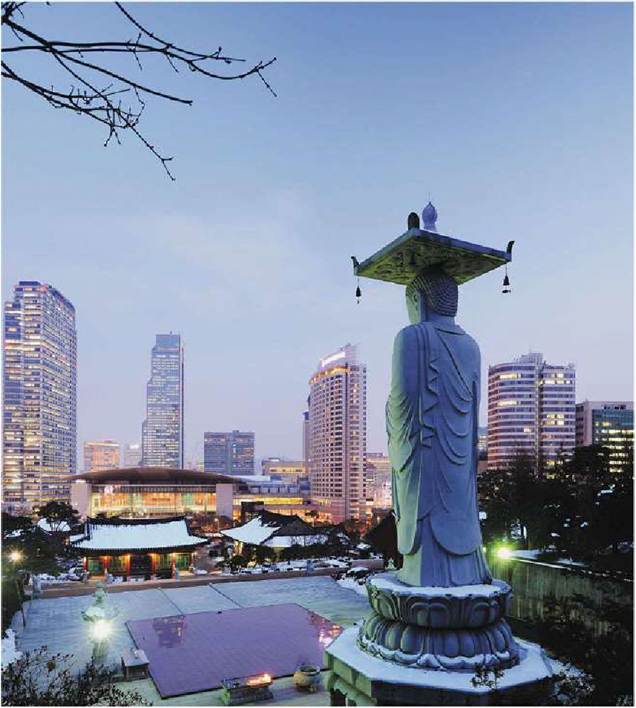
Bongeunsa Temple, founded in 794 ce, is surrounded by the ultramodern cityscape of Seoul, South Korea.
Urbanization
Urbanization, the shift of population centers from rural, agricultural settings to cities, is a significant demographic effect of modernization. A century ago, only about 10 percent of the global population lived in cities; today, this figure has risen to more than 50 percent. Many religious traditions developed within primarily rural settings, with calendars of holy days and rituals patterned around agricultural cycles. For most religious people, such patterns have far less relevance today.
Globalization
Globalization is the linking and intermixing of cultures. It accelerated quickly during the centuries of exploration and colonization and has been nurtured considerably by the advanced technologies brought about by modernization. The extent of this linking and intermixing is evinced in the very term World Wide Web, and the pronounced and rapidly evolving effects of the Internet and other technologies have been extraordinary. The almost instantaneous exchange of information that this technology allows is more or less paralleled by better means of transportation. In sum, we now live in a global community that could hardly have been imagined a few decades ago.
Multiculturalism
The most pronounced religious effects of globalization pertain to the closely related phenomenon of multiculturalism, the coexistence of different peoples and their cultural ways in one time and place. Many people today live in religiously pluralistic societies, no longer sheltered from the presence of religions other than their own. This plurality increases the degree of influence exerted by one religion on another, making it difficult for many individuals to regard any one religious tradition as the only viable one. This circumstance, in turn, fosters general questioning and critical assessment of religion. To some extent, such questioning and critical assessment erodes the authority traditionally attributed to religion. Globalization, then, like modernization, has nurtured the notably modern process of secularization, the general turning away from traditional religious authority and institutions.
More on the topic Modernization and Related Phenomena:
- Modernization and Related Phenomena
- Brodd Jeffrey, Little L., Nystrom B., Platzner R., Shek R., Stiles E.. Invitation to World Religions. 4th edition. — Oxford University Press,2022. — 1196 p., 2022
- CASE 94: An Offense Related to Public Pietas
- Profanations: religious vs secular in the Temple of Western modernity
- Political Geographies of Palestinian Families
- Courts are cornerstone institutions of liberal-democratic constitutionalism.
- The word ‘civilisation' is special in the West: ‘By this term Western society seeks to describe what constitutes its special character and what it is proud of: the level of its technology, the nature of its manners, the development of its scientific knowledge or view of the world, and much more.'1
- Ukraine is God-given and God-chosen.
- LEGAL PLURALISM
- Violence and the different phases of constitutional formation