14 New Religious Movements
Jeffrey Brodd
California State University, Sacramento
Layne Little
University of California, Davis
Bradley Nystrom
California State University, Sacramento
Robert Platzner
California State University, Sacramento
Richard Shek
California State University, Sacramento
Erin Stiles
University of Nevada, Reno
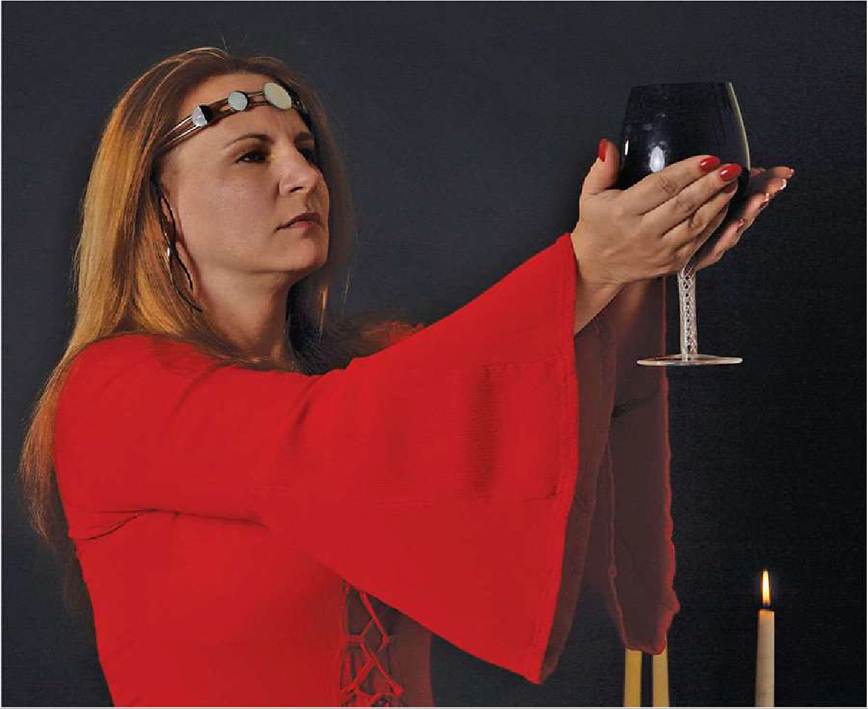
An offering of wine to the earth spirits is a common feature of Wiccan ceremonies.
IT IS THE EVENING of August 1, and Barbara Z. is preparing an altar for the celebration of Lughnassadh, a fall harvest festival celebrated by practitioners of Wicca. For centuries, European men and women who worshiped the forces of nature, or who believed that they could perform acts of magical power by communing with these forces, were often referred to as “witches,” a term contemporary Wiccans often use to describe themselves. Unlike the witches of fairy tales and films, however, Barbara Z. is a successful business professional who was raised as an Episcopalian and who had never heard of Wicca until a close friend suggested she read The Spiral Dance by Miriam Simos (better known by her Wiccan name of “Starhawk”).
Reading that book, and many others that described the beliefs and of Wicca, changed Barbara’s life. She soon established a personal connection with a local coven, or witches’ circle. In their company, she discovered a community of like-minded men and women whose worldviews were remarkably similar to her own. For Wiccans, the natural universe is alive with sacred energy, a power that is often represented in Wiccan ritual as the worship of a specific “god,” and by paying homage to that deity, Wiccans believe they are celebrating the beauty and wonder of nature itself. Lughnassadh (also known as Lammas), named for the Celtic god Lugh, is one such festival.
Wiccans take a particular interest in pre-ChristianEuropean deities, and many of their sacred festivals are dedicated to one or another of these “pagan” gods. Like many of those who have joined a new religious movement, Barbara thinks of Wicca as a break with her Christian upbringing and as an essential part of a journey of spiritual self-discovery.
The celebration of Lughnassadh entails several ritual acts, all of them related symbolically to the fall harvest. Part of the day is spent baking a loaf of bread, which is to be used later that evening during the Lughnassadh ceremony. Wiccans customarily share this bread in celebration of the grain harvest, and it is from this practice that the name Lammas—meaning “loaf-mass”—is derived. At dusk, Barbara will create a magic circle of lights, placing her altar at the center of this circle. On that altar Barbara will place a sheaf of wheat and several cornbread figures, representing the god Lugh and his worshipers, and a basket of star-shaped cookies. Each member of the coven will be asked, in turn, what they fear and what they desire most from the coming year, and they will then perform a dance in honor of the dying year that will soon be reborn. Having tossed the cornbread figures into a fire, the participants in this ceremony will then eat the star-shaped cookies in anticipation of a bountiful year to come. Following the conclusion of this ritual, the members of the coven will sit down to a celebratory meal, at which time the witches will address each other by their “craft” names. As a third- degree Wiccan priestess, Barbara will be addressed as Lady Sparrow, combining a title of honor with the name she chose on entering the Wiccan community.
Ritual practices will differ from one Wiccan community to another, the great constant being the underlying conviction that each act performed by the coven brings their community—and every member of that circle—closer to the indestructible source of life that is nature itself.
More on the topic 14 New Religious Movements:
- What is “New” About New Religious Movements?
- What are the Causes of these Movements?
- Control Movements and Decisions
- The Concept of Causality in Revitalisation Movements
- 14 Christianity in North America from the Sixteenth Century
- The Esoteric Traditions and Antinomian Movements
- Notes
- 55 Western Europe: Self-Religions
- The New Atheism
- Clarke Peter et al. (eds.). The World's Religions. Routledge,1988. — 995 p., 1988