Rastafarianism
The Rastafarian movement, which can be traced back to Kingston, Jamaica, during the 1920s and 1930s, exhibits only the most tenuous relationship to either Christianity or the advent movements that grew out of Christian thought in the nineteenth and twentieth centuries.
However, like the Unification Church, it shows unmistakable signs of millenarian thought. Combining elements of black nationalist ideology and liberation theology (Chapter 12), the Rastafari religious culture attempted to lift up the African diaspora of the Caribbean out of poverty and despair and to inspire both a pride in African ancestry and a desire for repatriation to an Africa freed from white colonial oppression.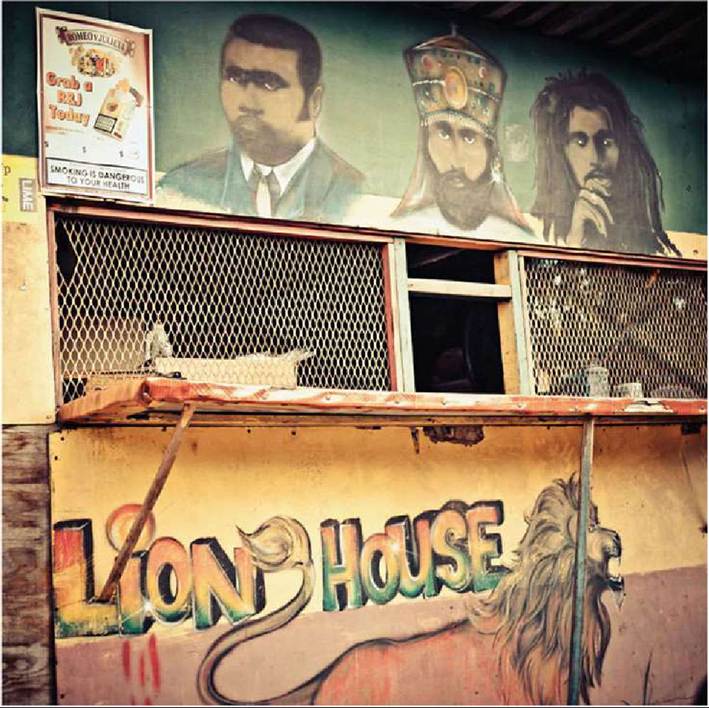
A simple Rastafarian food shop named Lion House in Stony Hill, Jamaica, features paintings of Rasta heroes Marcus Garvey, Haile Selassie, and Bob Marley.
An important influence on Rastafarian thought is Marcus Garvey (1887-1940), a militant Jamaican socialist leader. In his writings, Garvey expressed indignation over the plight of the island’s poor and disdain for the shallow materialism of the West and its racist hatred of Africans. Regarding the enslavement of blacks as a form of divine punishment, Garvey concluded that the African diaspora’s period of tribulation was drawing to an end and that a king would emerge in Africa who would lead the disenfranchised black masses back to their homelands and to a life of dignity and prosperity.
The ascension of the Ethiopian prince Ras Tafari Makonnen—better known by his throne name as Haile Selassie (1891-1975)—to the position of emperor of Ethiopia in 1930 seemed to give concrete shape to Garvey’s prophecy. Jamaicans who were influenced by the teachings of the Jamaican priest and mystic Leonard Howell (1898-1981) became convinced that the moment of collective liberation from white rule had finally come.
For Howell, and others who now began to speak of themselves as followers of Ras Tafari—hence “Rastafarians”—Haile Selassie was more than a mortal ruler: he was either Christ returned to earth or God incarnate.When Selassie first visited Jamaica in the 1950s and met with Rastafarian leaders, many in the movement concluded that Howell’s “Adventist” view of Selassie had been validated and that this visit signaled the final move back to “Ethiopia” (understood as a metaphor for the whole of Africa). However, the few thousand Jamaicans who did emigrate to Ethiopia in the 1960s soon found that their dreams of apocalyptic fulfillment were not to be realized and that the moment of divine deliverance had to be deferred.
The overthrow of Selassie in 1974 and his death a year later shook the Rastafarian movement to its core. Some followers denied that Selassie had really died, and others were convinced that his spirit would return to his earthly body at some point in the future. Today, most Rastafarians speak of “liberation before repatriation”—signifying a demand for social justice within the countries they reside in—and although many still revere Haile Selassie and believe that his spirit lives on in Rastafarian artists and teachers, they are prepared to wait some time for the Day of Final Judgment against “Babylon” (i.e., Anglo-European society) to arrive.
Rastafarians have adopted distinctive religious practices that—to those outside the movement —typify the behavior of all Rastafarians. This is particularly true of the practice of smoking marijuana (or “ganja”). Though not universal, this practice is encouraged within the Rastafarian community in the belief that it both enhances one’s health and opens the mind to greater sources of spiritual influence. Similarly, the practice of wearing one’s hair in dreadlocks (particularly among men) reflects the Rastafarian belief that they have adopted the behavior of the biblical Nazirites (Samson, for example), whose uncut hair was a sign of strength and devotion to God.
In addition, and out of the desire to live a “natural” life, many Rastafarians have adopted a vegetarian diet consisting only of organically grown foods.Avoidance of pork and alcohol are also common, once again reflecting the influence of Old Testament mores on Rastafarian thought.
Most Rastafarian festivals revolve around important dates in the life of Haile Selassie, particularly the date of his accession to the throne of Ethiopia (November 2,1930). In addition, Rastafarians will gather together for informal discussions called “reasonings” or for celebratory dances connected to formal holidays (known as “nyabinghis”). The smoking of ganja is common to both occasions.
The most popular cultural icon of the Rastafarian movement, even today, remains the 1970s reggae singer and Jamaican political activist Bob Marley (1945-1981). As the front man of a band called “The Wailers,” Marley became a charismatic advocate for Rasta values throughout the Caribbean during his short lifetime, and since his death his songs have become an anthem for young Jamaicans—and young people everywhere—who long for a world without racism and injustice.